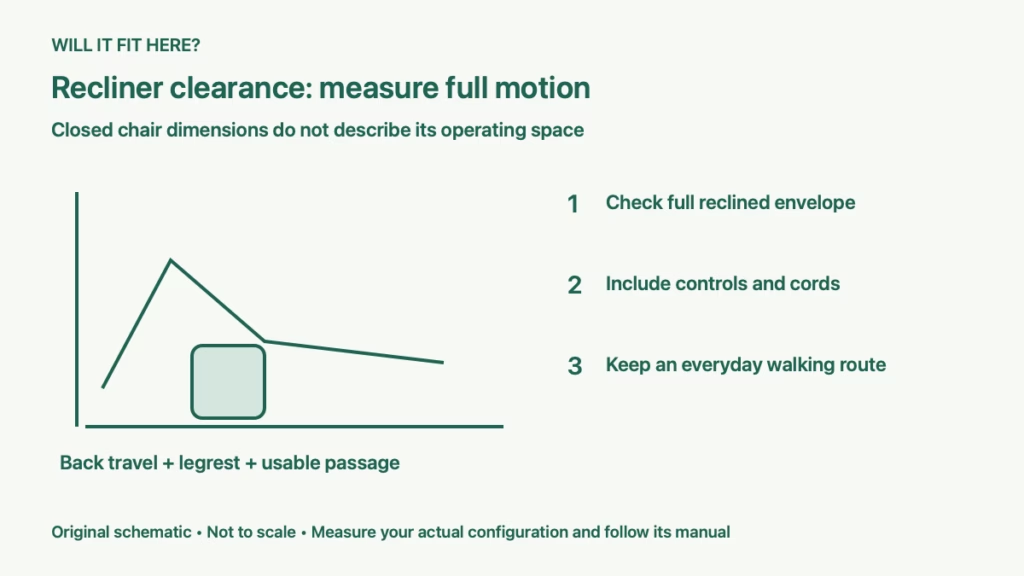
Quick answer: Recliner clearance must cover the chair’s full operating envelope, including the reclining back, extended legrest, controls and the space you need to stand up. Closed width and depth only describe the chair at rest. Check the exact model’s extended dimensions and wall-clearance instructions, then test the layout with everyday furniture in place.
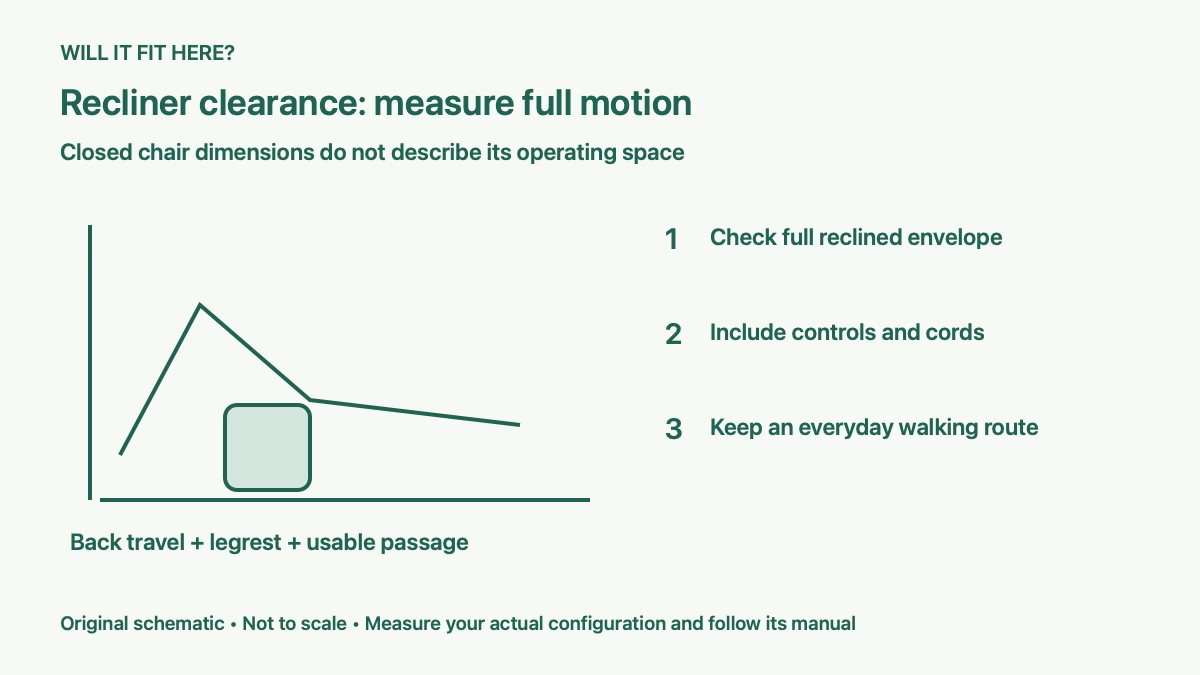
This guide is for someone considering a recliner in a small living room, where the closed chair fits but the open position may block a table or walking route. A wall-recliner design can help with rear space, but it still needs room in front.
1. Find the correct recliner clearance dimensions
Record the complete model and mechanism: manual, power, rocking, swivel or lift. Look for overall closed dimensions, fully extended length and the manufacturer’s required wall clearance. Do not compare a manual version’s diagram with a power or lift variant unless the maker confirms they match.
For an example of the difference, La-Z-Boy’s Morrison Wall Recliner, style 016766, lists 38-inch body depth and 67.5 inches fully extended. The page describes approximately 7 inches of wall spacing for that model and notes that upholstery and construction can vary the dimensions. These numbers describe that chair, not all recliners.
If the seller gives only closed dimensions, request the full motion drawing or measure the exact display chair in every intended position before ordering.
2. Map the back and legrest movement
Use removable floor tape to mark the closed chair and the farthest open position. On a side-view sketch, add the back’s travel at its widest point. Include a radiator, windowsill, wall trim or curtain that stands in front of the plain wall.
Recliner clearance must remain free during the movement, not just at the final stop. A footrest can catch the edge of a coffee table while opening even when it clears the table once extended. Measure the path rather than pushing furniture aside after every use.
If the chair swivels or rocks, include that permitted motion as well. Do not assume a wall-saving recliner has the same motion or rear requirements as a rocker. Follow the product manual for the mechanism you actually select.
3. Allow access to controls and power
A side-mounted handle needs a hand to reach and move it. Leave usable access between the arm and adjacent furniture. For a power chair, identify the outlet position and follow its instructions for cord routing and power supply placement.
Keep the cord clear of the moving mechanism and walking route. A connector behind the chair can consume space that a flat wall drawing misses. Recliner clearance should include the actual cable arrangement, without stretching a lead or placing it where it can be trapped.
Check whether a side table hides the control or becomes unstable when you operate it. Test from the seated position, because reaching over an arm while standing is not the same action.
4. Test standing up and the daily walking route
Mark where your feet land when you enter and leave the chair. Check the fully closed and permitted open positions, then walk the route to the door with the chair in its normal use position. Leave practical space for the people who live there, rather than relying on an exact fit between hard edges.
Include an ottoman, pet bed and side table in the mock-up if they normally stay in the room. A chair that blocks the only route whenever someone reclines may be the wrong layout even if it technically opens. Our living-room rug layout checks can help map the surrounding furniture.
5. Confirm delivery and verify the actual chair
Room recliner clearance and delivery access are separate checks. Ask for packed dimensions and the manufacturer’s permitted handling arrangement. Do not assume the back can be removed from every chair. Use our large-furniture delivery measurements for doors and turning spaces.
After placement, check the actual chair’s movement without forcing it against an obstruction. Follow its manual, keep the moving area clear and confirm the controls remain accessible. Keep a written list of the model, closed footprint, full extension and wall requirement for future rearrangements.
Decision: Recliner clearance passes when the full movement, control access, entry space and daily route all work. If only the closed footprint fits, choose a different position, smaller model or mechanism that has verified suitable operating dimensions.