Quick answer
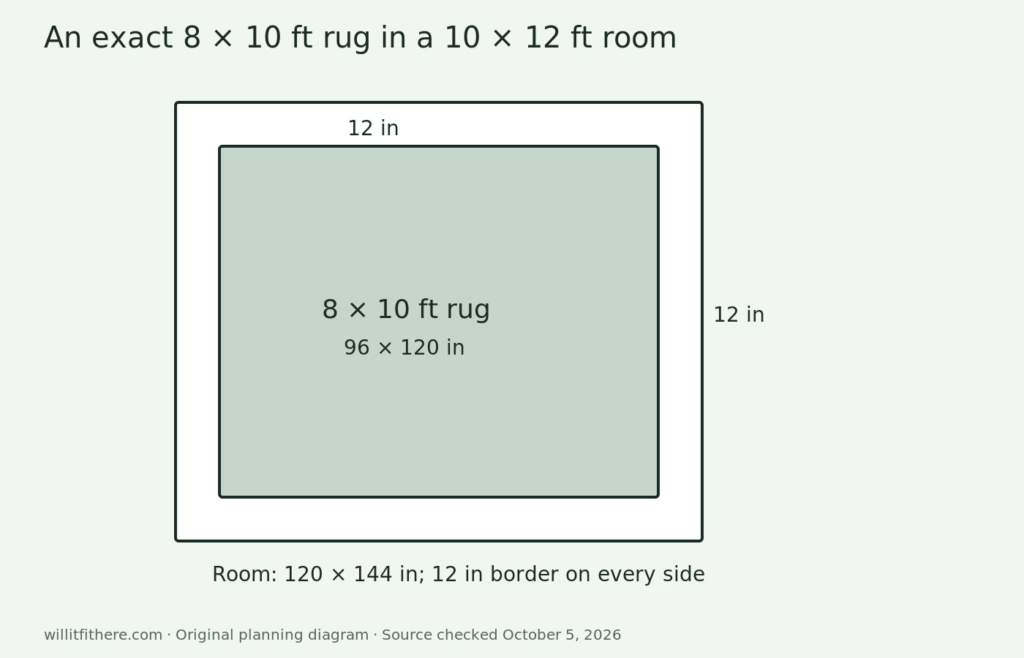
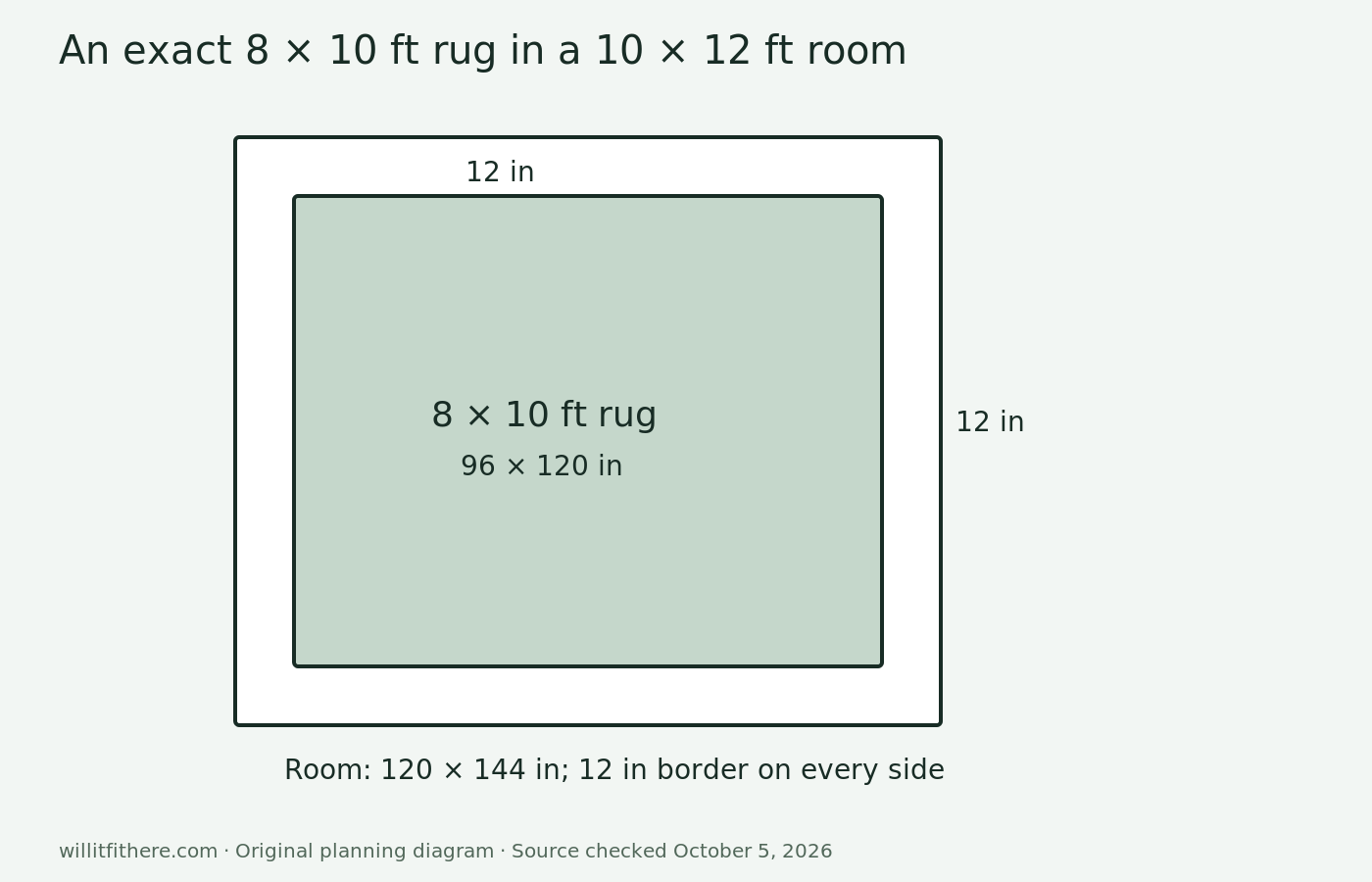
Yes, an exact 8 × 10 ft rug fits inside a clear 10 × 12 ft room, with the eight-foot side across the ten-foot room width. Centered that way, it leaves a one-foot border on all four sides. That proves the rectangle fits; your sofa, door sweep and walking route determine whether the arrangement works.
Calculate the border before choosing a layout
An 8×10 rug in a 10×12 room is a straightforward starting point: convert both sizes to the same units. The room is 120 × 144 inches and the rug is 96 × 120 inches. Across the width, 120 − 96 = 24 inches; divide by two for a 12-inch border. Along the length, 144 − 120 = 24 inches, also giving 12 inches at each end when centered.
The metric equivalents are 304.8 × 365.76 cm for the room and 243.84 × 304.8 cm for an exact eight-by-ten-foot rug. These are mathematical conversions, not a claim that a particular rug is manufactured to those dimensions. Keep your measuring tape and calculations in one unit system.
This comparison assumes clear rectangular space and the intended orientation. A bay, hearth or angled wall changes the usable shape. Measure the actual floor area rather than relying on a listing that rounds the room to whole feet.
An “8×10” shopping category is not an exact size
Read the specific product’s measurement panel before ordering. For example, IKEA’s beige STOENSE rug, article 906.232.83, is currently listed at 7 ft 10 in × 10 ft. That is 94 × 120 inches, two inches narrower than an exact eight-by-ten rug. It is a useful example of why a category filter is insufficient.
| Rug used in calculation | Centered side borders | Centered end borders |
|---|---|---|
| Exact 96 × 120 in | 12 in | 12 in |
| Listed 94 × 120 in STOENSE example | 13 in | 12 in |
For the STOENSE example, (120 − 94) ÷ 2 = 13 inches. This table uses the published inch dimensions for planning and does not promise production tolerance or the measured size of a delivered rug. Check any size-tolerance note and measure the rug after it has settled according to its care instructions.
Center the rug on the seating group if that works better
Room symmetry is optional. If the sofa faces a television on one wall and the room’s entry sits on another, centering the rug in the room can leave the seating group off-balance. Start by placing the furniture for use, then slide the rug outline until the sofa and chairs relate to it sensibly.
You can put the front legs of the seating on the rug or choose a larger arrangement that holds more of each piece. Treat those as layout options, not compulsory rules. Check the actual leg positions underneath your sofa: wide arms can make the sofa’s outer width quite different from the spacing between its feet.
For a hypothetical sofa whose outside front feet span 84 inches, a 96-inch rug leaves 12 inches total across that span, or six on each side if centered. That does not mean the whole sofa is 84 inches wide. Use the dimension relevant to the placement you want.
Keep door sweep and daily routes in the plan
Open every nearby door fully and note where the bottom edge passes over the proposed rug. The rug and its underlay add thickness. A door that clears the bare floor may drag on the finished combination, and pile compression is not a dependable cure for interference.
Draw the path from the entrance to the sofa and onward to other rooms. Decide whether that path should cross the rug or stay on bare floor, then check the transition at the rug edge. A narrow leftover strip is not automatically a useful walkway, particularly when a chair leg or side table interrupts it.
Avoid positioning the rug corner exactly where people turn through a doorway if another layout provides a cleaner route. Keep edges flat and follow the rug and underlay makers’ instructions. No single border dimension proves the whole room is comfortable for every person.
Compare the two orientations and an offset
In the usual orientation, the 96-inch rug side runs across the 120-inch room side. Turn the same rug 90 degrees and its 120-inch side spans the entire nominal room width, leaving zero border on those sides. Along the 144-inch room length, the 96-inch side leaves 48 inches total, or 24 inches at each end when centered.
That turned layout may interfere with trim or other projections even before furniture is considered. A room measured slightly under ten feet will not accommodate the full ten-foot rug side flat between the same boundaries. Do not fold the edge to make an overlarge rug appear to fit.
An offset layout can be more practical. Move an exact 96-inch-wide rug four inches from center and the original 12-inch side borders become eight and 16 inches. Their sum stays 24 inches. Use this simple check to keep an offset drawing honest.
Test the rug outline with the furniture in place
Mark the intended edges with floor-safe removable tape, or use small paper markers that will not damage the finish. Measure diagonals if you need to confirm the rectangle is square. Put the furniture into its normal positions and walk the room, including the route taken while carrying a tray or laundry basket.
Look at the layout from seated height as well as from the doorway. Check that a coffee table, ottoman and sofa feet have the relationship you intended. A flat tape outline cannot simulate thickness, so use the product’s listed thickness plus the intended underlay when checking doors.
- Measure clear room dimensions, not nominal dimensions.
- Copy the exact rug SKU and listed length and width.
- Choose a seating relationship before centering.
- Check door sweep with rug and underlay thickness.
- Confirm edges and corners do not fight daily routes.
Frequently asked rug-fit questions
Is an 8×10 rug too big for a 10×12 living room? Not from dimensions alone. An exact rug leaves one-foot centered borders in the normal orientation. Furniture arrangement and openings can make the same rug work well in one room and poorly in another.
Must all sofa legs sit on the rug? No single arrangement suits every seating group. Compare actual foot locations and the appearance you want. Make sure the furniture remains stable in the chosen arrangement.
Will a 7 ft 10 in × 10 ft rug look very different? The numerical difference is one extra inch of border on each side when centered across a ten-foot room. Pattern, color and furniture placement can matter more visually.
Can the rug sit off-center? Yes. It can follow the seating area. Record both unequal borders and test the route rather than assuming centered is always better.
Source notes and what the diagram proves
Source checked October 5, 2026: IKEA STOENSE 906.232.83, listed at 7 ft 10 in × 10 ft. The nominal-rug, sofa-foot and offset examples are original calculations. The diagram illustrates exact dimensions and is not a photograph or a physical product test.
Measure the actual room and delivered rug before deciding on final placement. For furniture delivery rather than floor placement, see our sofa delivery measurement guide.