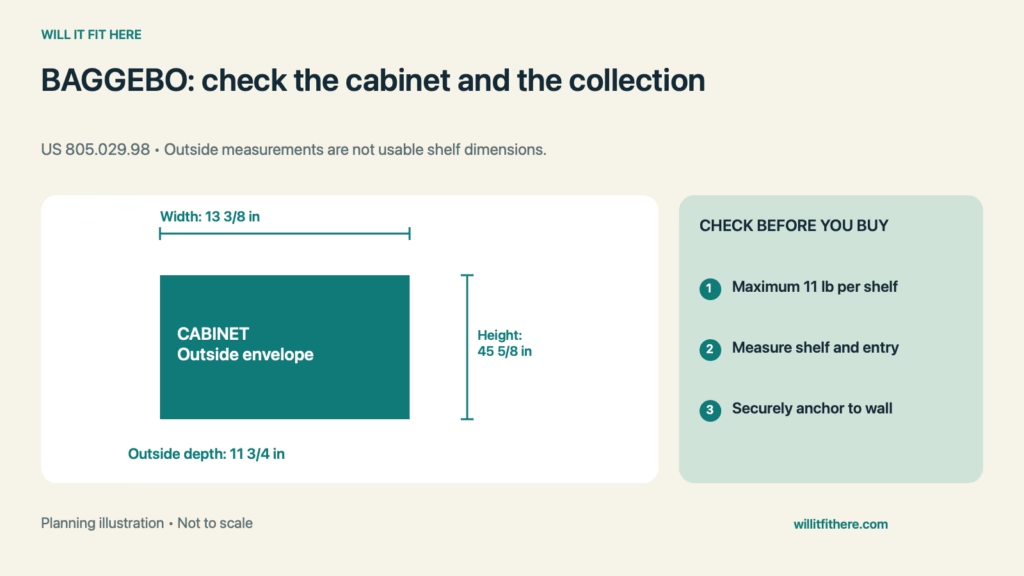
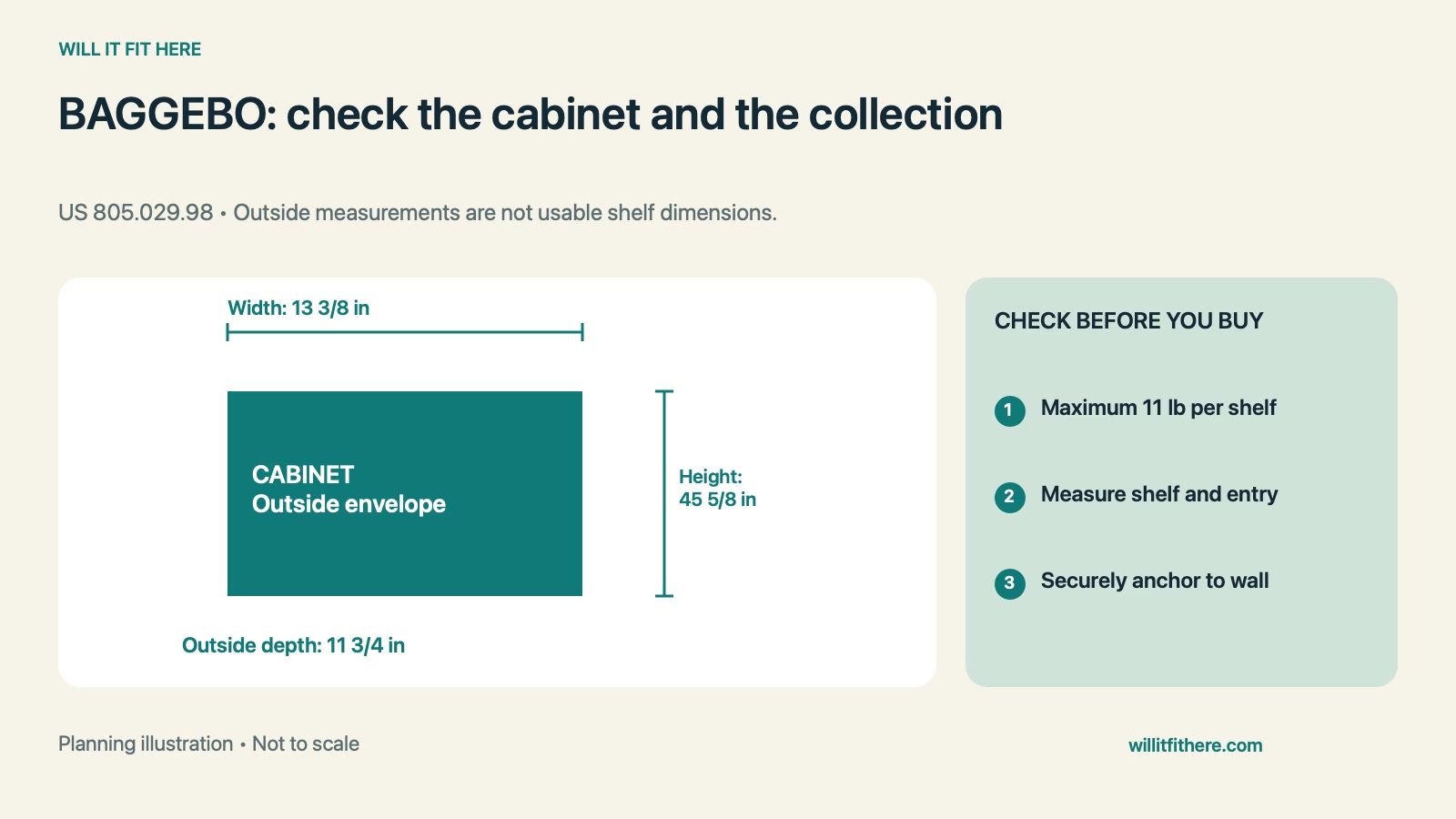
Fit verdict: BAGGEBO Display Fit requires two separate checks: room for the cabinet and room for the collection inside it. IKEA US article 805.029.98 measures 13 3/8 inches wide, 11 3/4 inches deep, and 45 5/8 inches high. These outside dimensions do not describe the glass shelves or the clear door opening. Measure those separately before promising a home to a tall vase or a wide model.
This guide interprets official specifications and uses hypothetical planning examples. It is not a firsthand product test, and no unpublished shelf clearance is presented as a measured fact.
BAGGEBO Display Fit: published dimensions
| Measurement | Official specification |
|---|---|
| Model covered | Glass-door cabinet, metal/white, 805.029.98 |
| Outside width | 13 3/8 in |
| Outside depth | 11 3/4 in |
| Outside height | 45 5/8 in |
| Included shelves | Two glass shelves |
| Maximum load per shelf | 11 lb |
1. Check the cabinet position, not just the floor area
Mark the cabinet footprint where it will actually stand. Measure against baseboards and any wall trim, then look up for window ledges or wall-mounted furniture. A floor-level gap may be clear while a shelf above intrudes into the cabinet’s height. Include the space occupied by an adjacent curtain when it hangs normally. Avoid a position where opening a room door would strike the glass.
BAGGEBO Display Fit also depends on the floor. Account for rugs or uneven surfaces when measuring height, and follow the instructions for the adjustable feet. Do not estimate extra capacity by assuming the cabinet can be tilted into position and left uneven.
2. Measure the actual shelf boundaries
Inside dimensions must come from a physical measurement or an applicable manufacturer drawing. The outside width and depth include the frame, back, and front assembly. Make a list of your largest objects with their maximum width, depth, height, and weight. Include protruding wings, handles, stands, or protective bases. A round plate displayed upright can need more height and depth than its diameter initially suggests because of its separate stand.
For a collection you already own, trace the widest pieces on paper. Place those templates on a measured shelf outline to test the arrangement before handling delicate objects.
3. Test the journey through the door
A sculpture might fit on a shelf but fail to enter through the door at the angle available. BAGGEBO Display Fit should therefore include the narrowest clear entry width, opening height, and the room needed for your hands. Consider whether the item must be rotated while entering. Do not rely on flexing the frame or pushing against the glass to create clearance.
Plan the loading sequence as well. The tallest object might need to enter before another piece occupies the adjoining space. If the arrangement requires removing shelves, check the official assembly instructions first rather than assuming any configuration is permitted.
4. Keep weight and glass protection in the plan
IKEA lists an 11-pound maximum per shelf. Add the weight of display stands and bases, not just the collectible itself. Avoid interpreting empty space as unused weight capacity elsewhere: a limit for one shelf cannot automatically be transferred to another. If an object’s support is unusually concentrated, obtain suitable guidance rather than assuming the published shelf load answers every loading question.
IKEA also warns against damaged glass edges and side impacts. Keep hard objects from knocking the shelf while you insert them. Allow enough hand space to lift an item cleanly without dragging it across the glass or squeezing it against a door edge.
5. Make room for anchoring and future cleaning
BAGGEBO Display Fit is not complete without the required secure anchoring. Check the wall material and the fixing position before choosing a narrow location. Use appropriate fasteners and professional advice when the installation is uncertain. Being short enough to fit under another shelf does not eliminate the restraint requirement.
Think beyond the first arrangement. You should be able to open the cabinet, remove a piece, and clean without moving other heavy furniture every time. An installation that leaves only fingertip access is inconvenient and increases the chance of bumping delicate objects.
A worked fit calculation
Imagine a 15-inch-wide gap, a 13-inch-deep usable floor area, and an overhead shelf 47 inches above the floor. The outside-width allowance is 15 − 13.375 = 1.625 inches total. The depth allowance is 13 − 11.75 = 1.25 inches. Nominal headroom is 47 − 45.625 = 1.375 inches. This is a plausible space for the cabinet body, subject to floor level and installation access.
Now suppose two objects weigh 6 pounds and 4 pounds, with a 2-pound display base. Their combined 12 pounds exceeds the listed 11-pound shelf limit even if all three footprints fit. This BAGGEBO Display Fit example shows why a successful exterior measurement cannot approve the collection inside.
Before you decide
- Check the glass-door model’s exact article number.
- Measure the installation space at floor and cabinet-top level.
- Obtain usable shelf and door-opening measurements.
- Weigh the objects together with their display bases.
- Verify secure anchoring and comfortable cleaning access.
FAQ
Are the shelves 13 3/8 inches wide?
That is the cabinet’s outside width. BAGGEBO Display Fit for a collectible needs the actual shelf and entry dimensions.
Can I use the full cabinet height for one object?
Do not assume that. Check the construction and permitted shelf arrangement, then measure the resulting clear height and insertion path.
Will a narrow gap make the cabinet stable enough?
No. Follow IKEA’s secure-anchoring requirement and the assembly instructions regardless of nearby furniture.
Related fit guides
For other display measurements, see MOSSLANDA ledge and frame-height checks. For storage inside a different IKEA system, see measuring bins for KALLAX compartments.
Official sources
Specifications checked November 6, 2026. Confirm the exact article number and current installation instructions before purchase.