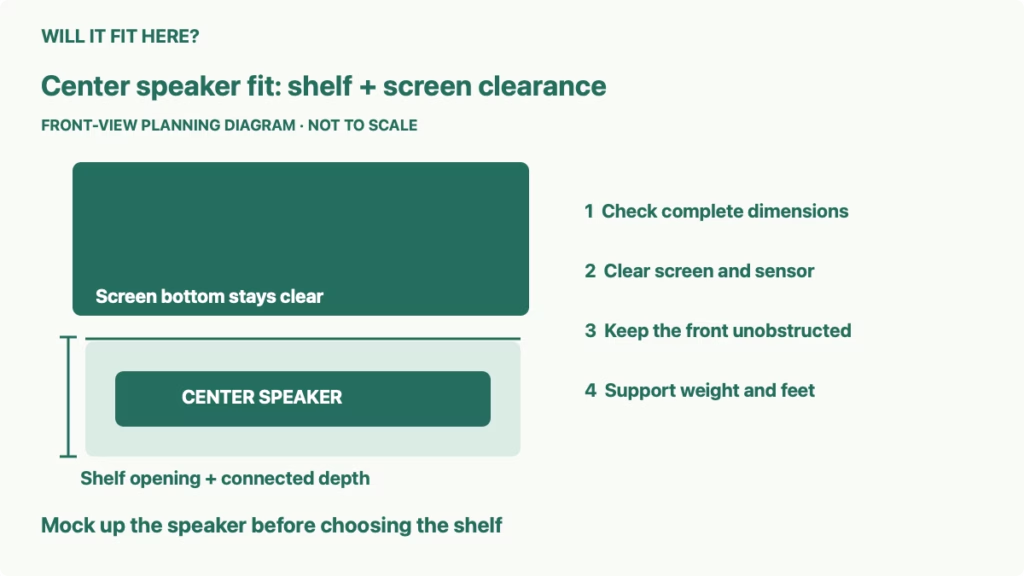
Quick answer: Center speaker fit under a TV requires a usable shelf opening wider and taller than the complete speaker, enough depth for connected cable ends, full support for its feet, and a front face that does not obstruct the screen or sit behind a solid cabinet door. Check the exact model’s placement instructions before accepting an enclosed position.
You have a TV stand with an empty middle compartment and want dialogue to come from a separate center-channel speaker. The decision is whether that compartment provides a workable location, or whether the speaker needs the top surface or different furniture. This guide focuses on a passive center speaker’s physical placement; amplifier compatibility and room calibration need their own checks.
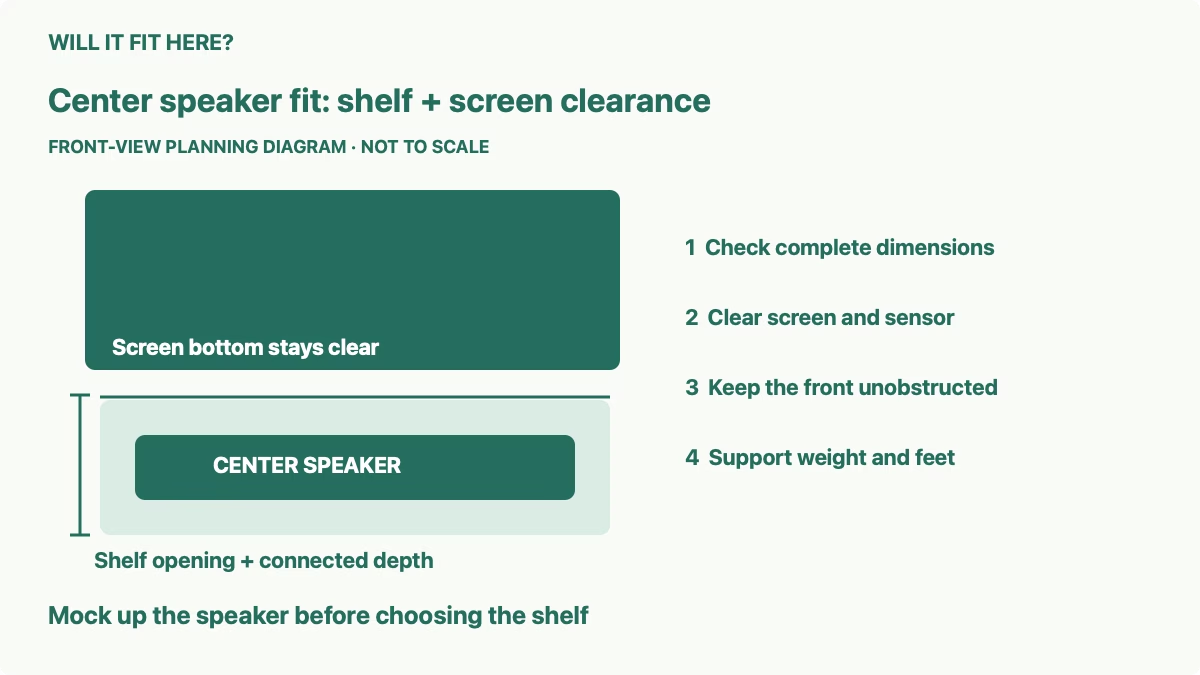
1. Measure the opening for center speaker fit
Measure the narrowest internal width, clear height above the proposed support surface, and useful depth. Furniture listings usually describe the outside of the unit. Internal dividers, door frames, shelf pins, hinges, and rear panels can make the compartment substantially smaller than those outside dimensions suggest.
Check the entrance as well as the final position. A wide speaker may fit behind the cabinet frame yet not pass through its opening in the orientation its instructions require. Measure the path from the room into the shelf without assuming you can tilt the speaker through a gap while its drivers or terminals brush the furniture.
Write the three speaker dimensions in the same order as your three shelf measurements. Height, width, and depth labels matter particularly for speakers that manufacturers also allow in another orientation. An approved upright use does not mean the horizontal center configuration has the same height.
2. Compare complete dimensions, feet, and weight
KEF’s Q6 Meta gives a concrete example: its published horizontal dimensions are 210 mm high, 629 mm wide, and 303 mm deep, with the terminal included. The listed weight is 14.1 kg. KEF identifies it as a three-way closed-box speaker. These figures apply to this model and are not a minimum shelf size for every center speaker.
The depth note is useful because it tells you the measurement includes the terminal, but it does not prove that your connected plugs and bent cables fit inside the same 303 mm. Keep the bare product measurement and the finished connected arrangement separate. Check whether the feet, grille, or other accessories change the relevant measurement in your chosen setup.
As an illustrative calculation, a 650 mm clear opening minus the example’s 629 mm width leaves 21 mm total across both sides. Centering it would leave 10.5 mm per side before any other required space. That arithmetic shows the remaining room; it does not establish an approved clearance or an easy insertion path.
Find the shelf’s rated load and confirm whether it applies to one shelf or the whole unit. Add the speaker and any other items sharing the support. Place all feet on a stable surface. A cabinet top that looks broad enough may have a recessed edge, a cable opening, or an unsupported overhang where a foot would land.
| Fit check | What to measure or confirm |
|---|---|
| Opening | Narrowest width, usable height, entry frame, and shelf depth |
| Complete speaker | Correct orientation, feet, grille, terminals, and connected cables |
| Support | All feet supported and the relevant furniture load rating satisfied |
| TV clearance | Screen bottom, stand feet, controls, and remote receiver remain clear |
| Front access | No solid door or furniture frame crosses the driver area |
3. Check the screen and the speaker’s front
If the speaker will sit on top of the media unit, measure from that surface to the bottom of the visible TV picture. Include the complete speaker height in its supported configuration. A speaker can fit between the TV’s feet yet cover subtitles or the lower image because the visible screen sits lower than expected.
Locate the TV’s remote-control receiver and front controls as well. Their position may differ from the center of the screen. Test the intended arrangement with a cardboard outline before placing the heavy speaker, so you can see whether the outline blocks the control path from your normal seat.
Inside a shelf, check the cabinet’s front frame against the speaker’s driver area. A solid closed door in front of the speaker is a different arrangement from an open compartment. Do not assume perforated furniture, a fabric panel, or an acoustic-looking door performs like the manufacturer’s supplied grille; verify the proposed use with the relevant product guidance.
Consider the front edge of the shelf and the normal listening position. Recessing the speaker far inside the compartment changes the surroundings of its front face. Use the exact model’s placement guidance, and keep any manufacturer-approved tilt or support accessory within its stated use. A measured fit cannot guarantee dialogue clarity in the room.
4. Leave space for the real cable arrangement
Identify where the speaker terminals sit and how your chosen cable ends attach. A bare-wire connection and a projecting plug can need different depth. Measure the connected arrangement without sharply bending the cable or trapping it against a rear panel. Follow the speaker and amplifier instructions when handling connections.
Check the cable outlet’s position. A hole below the terminals may require the cable to turn downward before it can exit, while an opening directly behind them may provide a simpler route. The hole’s presence alone does not tell you that a stiff plug can make that turn.
Keep the cable route away from a moving cabinet door and from walking space. Plan how you will remove the speaker or reconnect a lead later. If reaching the terminals requires lifting a heavy unit over the TV stand every time, the compartment may be inconvenient even when all dimensions pass.
For a ported speaker, identify where the port is and follow its own positioning requirements. The Q6 Meta example is described as closed-box; that description should not be transferred to a different center speaker with a rear port. Avoid inventing a universal rear gap from the cabinet depth alone.
5. Make the final decision with a mockup
Use a cardboard box or taped outline matching the complete speaker’s width, height, and depth. Mark the feet, terminal position, cable route, and any required placement space. This helps separate the actual constraints from the visual impression of an empty shelf.
View the mockup from the normal seat. Check the entire picture, TV controls, and speaker front. Open nearby doors and drawers, confirm there is a practical insertion route, and verify that the final support meets the relevant load rating. Do not lift a speaker into an awkward opening just to discover a missed measurement.
Record the result as three checks: physical opening, support and connections, and placement requirements. If the shelf fails one, compare an approved top-surface position or another media unit before buying. This is a measurement plan, not an acoustic test or an approval for a particular cabinet.
Common questions
Can I choose by the TV’s diagonal size? No. Measure the actual speaker and available furniture space. TV diagonal does not define a center speaker compartment.
Is the listed depth enough when it includes terminals? Not necessarily. The attached cable ends and their route can extend farther.
Can I rotate any center speaker to make it fit? Check the exact model’s permitted orientation. Do not assume every design supports the arrangement.
For the rest of the media unit, see our guides to AV receiver shelf fit, moving components inside a TV lift cabinet, and TV swivel clearance near furniture.
Official sources and limits
Checked October 7, 2026: KEF Q6 Meta specifications and the linked Q Meta user manual. Use your exact speaker’s current documentation. No firsthand listening test, universal cabinet clearance, or guaranteed acoustic result is claimed.