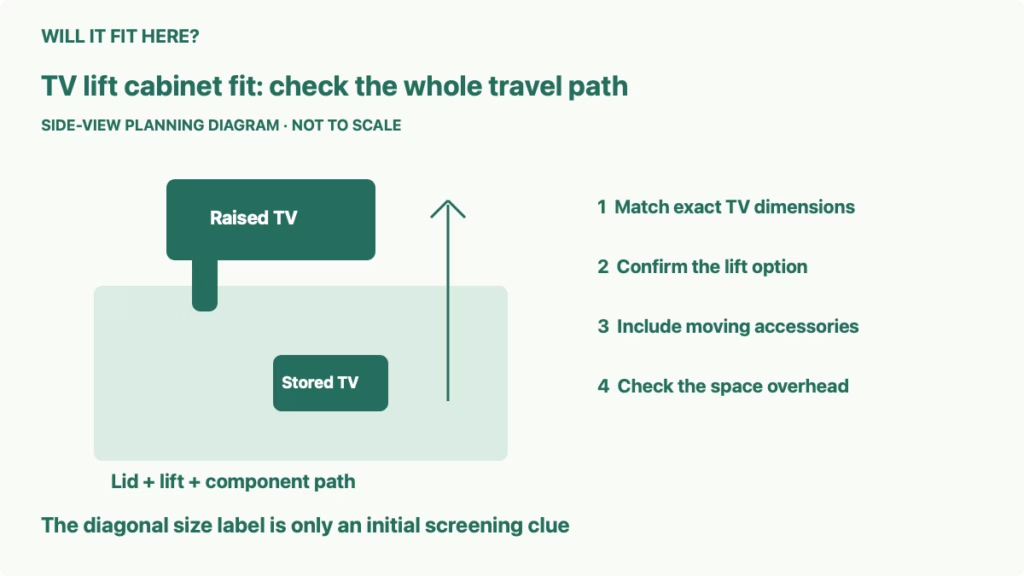
Quick answer: TV lift cabinet fit requires the exact TV width, depth, and height to meet the limits for the selected cabinet, lift option, and component arrangement. The cabinet must also have a clear lid and lifting path in your room. A label such as “up to 50-inch TVs” is an initial size guide, not a complete fit decision.
This guide is for someone choosing a hidden-TV cabinet at the end of a bed, behind a sofa, or against a wall. The question is whether an existing television can disappear inside the cabinet and rise to a usable viewing position with its cables and accessories. It focuses on measurement and purchase planning. Follow the supplied instructions for installation and operation; do not improvise modifications to the mechanism.
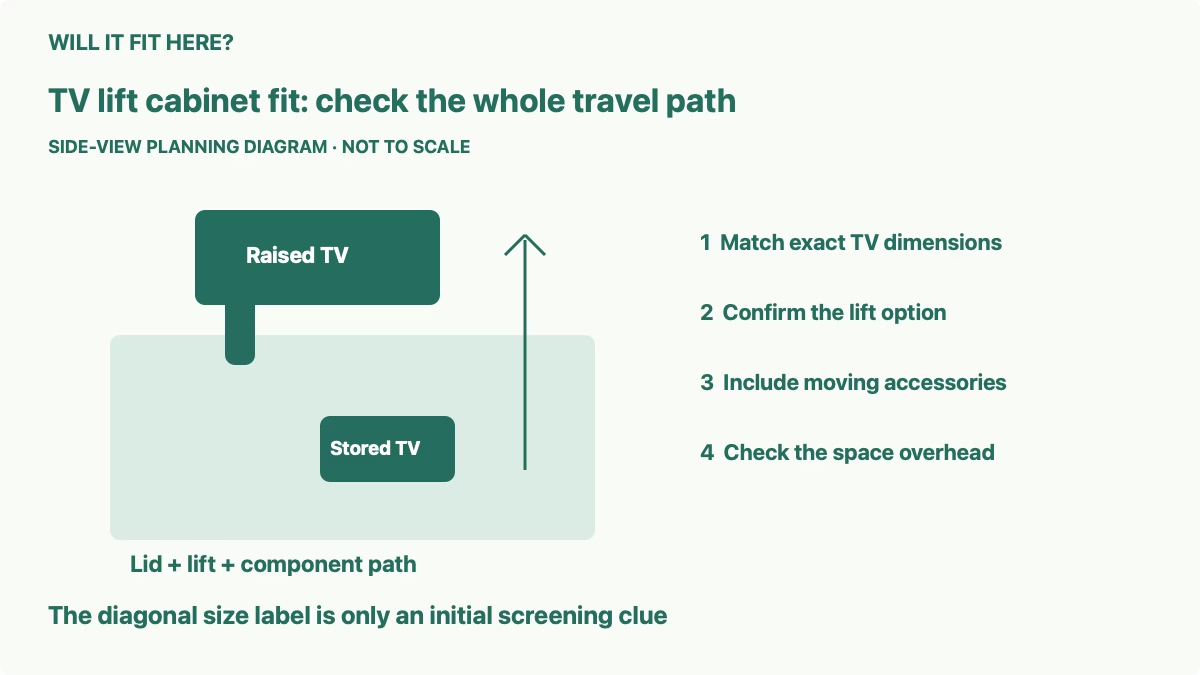
1. Compare actual dimensions for TV lift cabinet fit
Find the complete model number on your television and obtain its official dimensions without the tabletop stand. Record width, height, depth, and weight in a single unit system. Include any permanent part of the case that projects beyond the screen outline. Avoid calculating the dimensions from the diagonal because frame shape and rear housings vary.
Touchstone’s Ellis Trunk 73007 provides a useful model-specific example. Its specifications list a cabinet measuring 53¾ inches wide, 20½ inches deep, and 35 inches high. The listed TV limit without shelf components is 46 inches wide, 5 inches deep, and 32½ inches high. With shelf components, the stated TV height limit becomes 28 inches. These are different operating arrangements, so select the row that matches your intended setup.
Use the maximum TV dimensions as a compatibility limit, not as the cabinet’s overall dimensions. Subtracting the two widths does not reveal a usable side compartment: walls, brackets, and lift hardware occupy space. When a TV is close to a published limit, send its exact model and dimensions to the manufacturer for confirmation.
2. Match the lift option and moving components
A product family may offer more than one lifting mechanism. A swivel option can change the permitted depth and the motion above the cabinet. For Ellis Trunk, the product specifications give a 3½-inch maximum depth for the Whisper Lift II PRO Swivel configuration, alongside a 46-inch width and 32½-inch TV-plus-components height. Do not apply the 5-inch depth from another configuration to that option.
Make a list of everything that moves with the TV: bracket, cables, soundbar, component shelf, and the electronics placed on it. Check the instructions for what is permitted, how it attaches, and how its weight counts against the relevant limit. A soundbar that fits on an ordinary TV stand is not automatically approved to travel on a lift.
The official Ellis page describes a shelf that travels with the TV. It also presents different shelf-depth figures in its feature and specification sections. If shelf depth is decisive for your equipment, obtain a current dimensional drawing or direct confirmation rather than choosing the larger figure. That uncertainty does not justify assuming your component fits.
| Fit layer | Measurement or confirmation needed |
|---|---|
| TV inside the cabinet | Actual case width, depth, and height for the selected configuration |
| Lift and bracket compatibility | Approved TV model, mounting pattern, weight, and hardware |
| Moving component arrangement | Permitted devices, combined dimensions, and applicable load limits |
| Raised TV and lid | Complete movement path relative to windows, shelves, and room fixtures |
| Cabinet in the room | Delivery route, footprint, walking access, and viewing position |
3. Check the lid and the entire upward path
Measure overhead objects from the floor: window sill, wall shelf, sloped ceiling, artwork, and any projecting lamp. The top of the closed cabinet is not the highest point during operation. Find the manufacturer’s drawing for the fully raised position and lid movement, including the chosen lift and TV mounting position.
If the raised height is not stated for your combination, leave that part of the decision unresolved and ask the manufacturer. Do not add the cabinet height and TV height and call it the actual maximum; the starting position and lift stroke affect the result. Likewise, a lift’s quoted travel distance alone does not locate the TV’s top edge.
At the end of a bed, check the footboard against the visible screen area. A cabinet can open without obstruction yet leave the lower picture hidden behind a tall footboard. Plot the viewing line from the position where you watch TV. Moving the cabinet farther from the bed may improve the view but consume a walking route, so evaluate both together.
4. Include connections and usable ventilation
Measure the television with the connectors you expect to use. A rear-facing plug or adapter can change its practical depth even if the bare case fits. Trace the cable path between moving and stationary devices, paying attention to where the cable must bend and where it could enter a pinch point.
The linked Touchstone manual calls for cord planning and keeping cables clear of moving parts. Use the length and routing requirements in the instructions for the equipment supplied. Leave access for connecting or replacing cables as specified, and keep hands away from the mechanism and lid opening during movement.
Check the operating requirements of each electronic component too. Space for a small box is not proof of adequate ventilation in a closed cabinet. A receiver or game console may need surrounding clearance that the shelf cannot provide. Do not stack equipment or block vents simply to meet the available rectangle. If you will operate devices with the TV lowered, confirm that the cabinet and equipment instructions permit it.
5. Plan delivery and everyday access
Draw the cabinet footprint on the floor with removable tape. Check the room door, bed access, drawers, and the route between the cabinet and surrounding furniture. Include projecting handles and the space needed to reach any service panel. A hidden television still requires everyday access to its furniture.
For delivery, compare the shipping package with every doorway, stair turn, and elevator on the route. The unpacked cabinet dimensions and the shipping dimensions solve different problems. Confirm whether the delivery service brings the cabinet into the room and whether installation is included; do not assume those services from a free-shipping statement.
Keep the final decision as a set of passes: the exact TV fits the selected configuration, the approved component arrangement fits, the movement clears the room, and the cabinet reaches its location. Any missing drawing or conflicting measurement should become a specific question before ordering. This approach is more reliable than finding a cabinet with the right diagonal label.
Common questions
Can two 50-inch TVs have different fit results? Yes. Their cases, connections, weights, and mounting details can differ even when their diagonals match.
Can I use the same depth limit for a swivel lift? Only when the manufacturer specifies it for that exact option. Check the configuration-specific row.
Does unused space inside the cabinet mean I can add equipment? No. Check approved placement, movement, load limits, and the equipment’s ventilation requirements first.
For related layouts, see our guides to TV swivel clearance beside furniture, mattress fit in an existing bed frame, and coffee-table spacing near the TV stand.
Official sources and limits
Checked October 7, 2026: Touchstone Ellis Trunk 73007 official product page and its linked Whisper Lift II PRO cabinet owner’s manual. Examples apply only to the stated configuration. Resolve conflicting or missing dimensions with Touchstone and use the instructions supplied for the cabinet purchased. No hands-on testing, universal clearance, or installation approval is claimed.