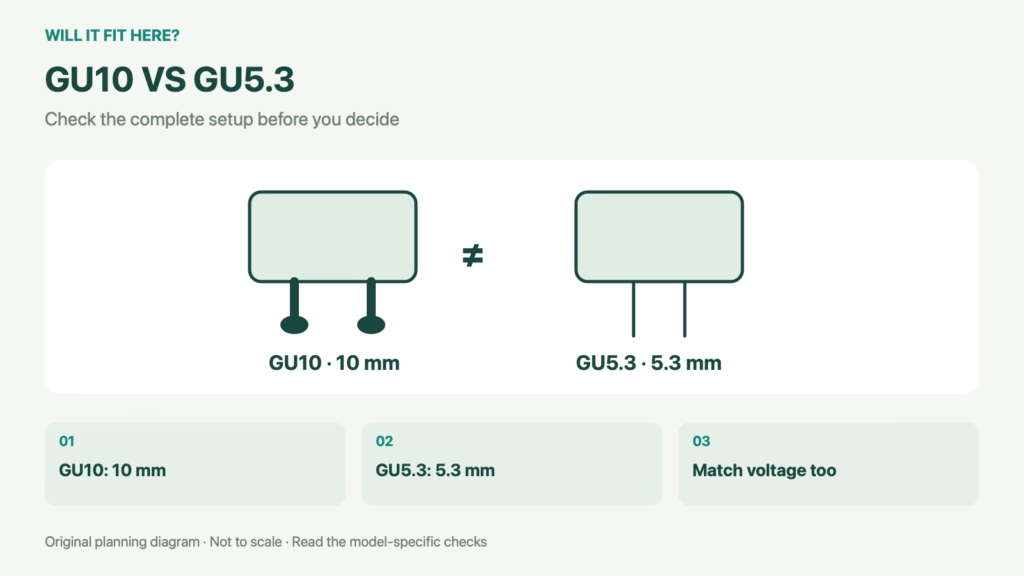
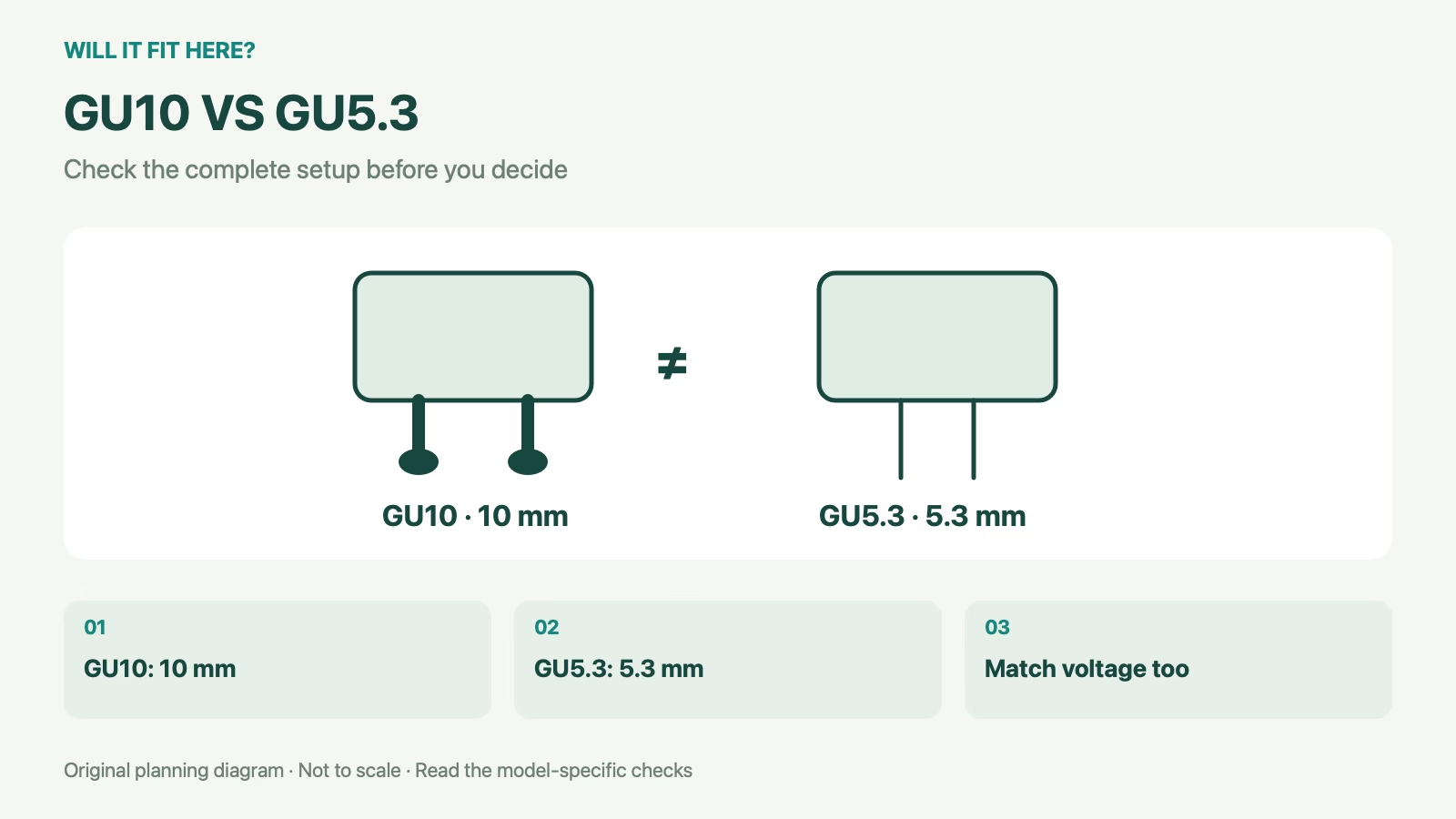
Fit verdict: The GU10 vs GU5.3 fit decision starts with physically different spotlight bases. GU10 uses two thicker locking pins spaced 10 mm apart, while GU5.3 uses slender pins spaced 5.3 mm apart. A similar-looking spotlight face does not make the bases interchangeable. Match the cap, electrical specification and complete bulb dimensions to the fixture.
Dimensions and conditions
| Check | Reference | What it means |
|---|---|---|
| GU10 base | 10 mm pin spacing | Push-and-twist locking shape |
| GU5.3 base | 5.3 mm pin spacing | Straight bi-pin connection |
| Example Hue MR16 | GU5.3; 12 V AC electronic | Check exact bulb and transformer compatibility |
1. Identify GU10 vs GU5.3 from the base
Switch off the light and follow the fixture’s instructions before inspecting a cool bulb. Read its cap and voltage markings. The visible front of a reflector lamp can look similar across products, so a photograph of the lit face is a poor identification method. MR16 describes a reflector form factor; it should not replace the actual base specification in your shopping notes. Record the full existing bulb designation and fixture information before selecting a replacement.
2. Check the complete electrical match
The correct physical base is necessary but does not establish compatibility with the supply, transformer or controls. For example, the cited Hue MR16 product specifies a 12 V AC electronic input and compatibility conditions for transformers. Check the exact replacement and the fixture’s requirements. Do not use a mechanical adapter as evidence that an electrically different lamp is suitable. If the fixture information is missing or a wiring change would be required, have the installation identified by an appropriately qualified person.
3. Measure the bulb envelope and retaining parts
Compare the replacement’s diameter and total height with the fixture’s available cavity and retaining ring. Two lamps with the same cap can still have different bodies behind the reflector. The replacement must seat normally without being forced against wiring or trim. Check the product’s permitted fixture conditions and any control compatibility stated by the manufacturer. Keep the lamp accessible for normal replacement, and do not remove a required retaining component merely to create extra space.
4. Keep a GU10 vs GU5.3 fit record
Write down the full cap designation, voltage, replacement product code and fixture model. Include the available body depth and the retaining-ring arrangement. Keep any transformer or dimmer compatibility information with those details. This makes a future replacement easier to verify and avoids choosing a bulb solely because its front face looks like the one previously installed.
GU10 vs GU5.3: a worked fit example
Example: a spotlight with a matching 50 mm face can still be the wrong purchase if its GU10 locking feet do not match a GU5.3 socket. The 4.7 mm difference in pin spacing is only part of the mismatch; the engagement shape and electrical requirements also differ. Begin with the base and electrical identity, then check the body.
Before you decide: 5 checks
- Read the existing cap and voltage markings.
- Distinguish locking GU10 from straight-pin GU5.3.
- Match supply, transformer and control requirements.
- Check full bulb height and diameter.
- Fit only according to fixture and bulb instructions.
FAQ
Are MR16 and GU10 two equivalent base names?
No. MR16 is a reflector form description; identify the actual cap such as GU5.3.
Does the same front diameter guarantee fit?
No. Base, height and electrical requirements still need to match.
Will a physical adapter solve every difference?
No. It does not establish electrical or fixture compatibility.
Related fit guides
- Logi Bolt Receiver Fit: 5 Device Checks
- 120mm Fan Fit: 5 Essential Slim-Slot Checks
- Installation & Setup fit guides
Sources
- Philips Hue explanation of GU10 and MR16/GU5.3 bases
- Philips Hue MR16 GU5.3 electrical and dimensional specification
Sources checked 3 November 2026. Product-specific facts are attributed above. Worked examples and measuring methods are planning guidance; example dimensions are not product specifications. Recheck the exact model or current travel policy before acting.