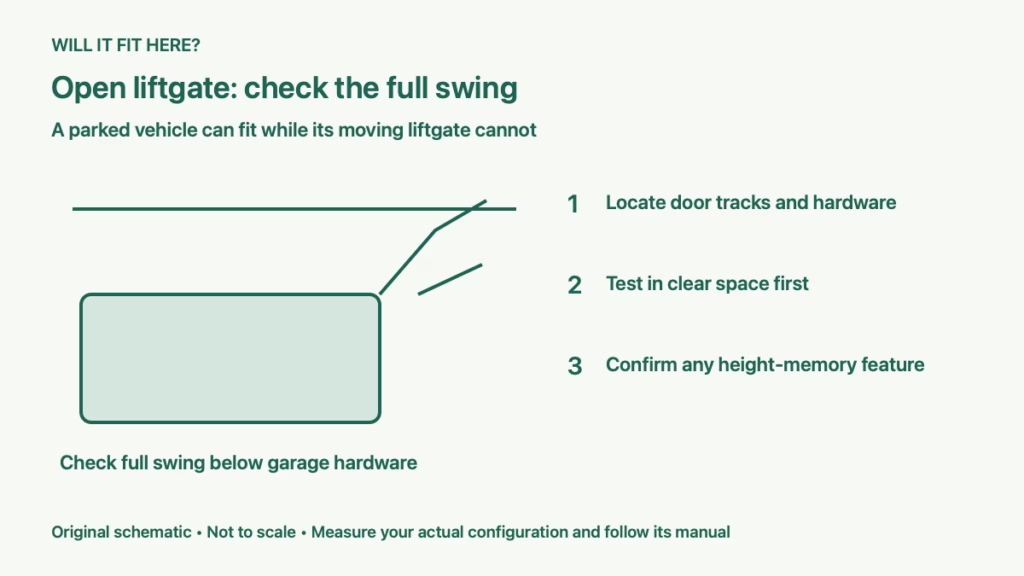
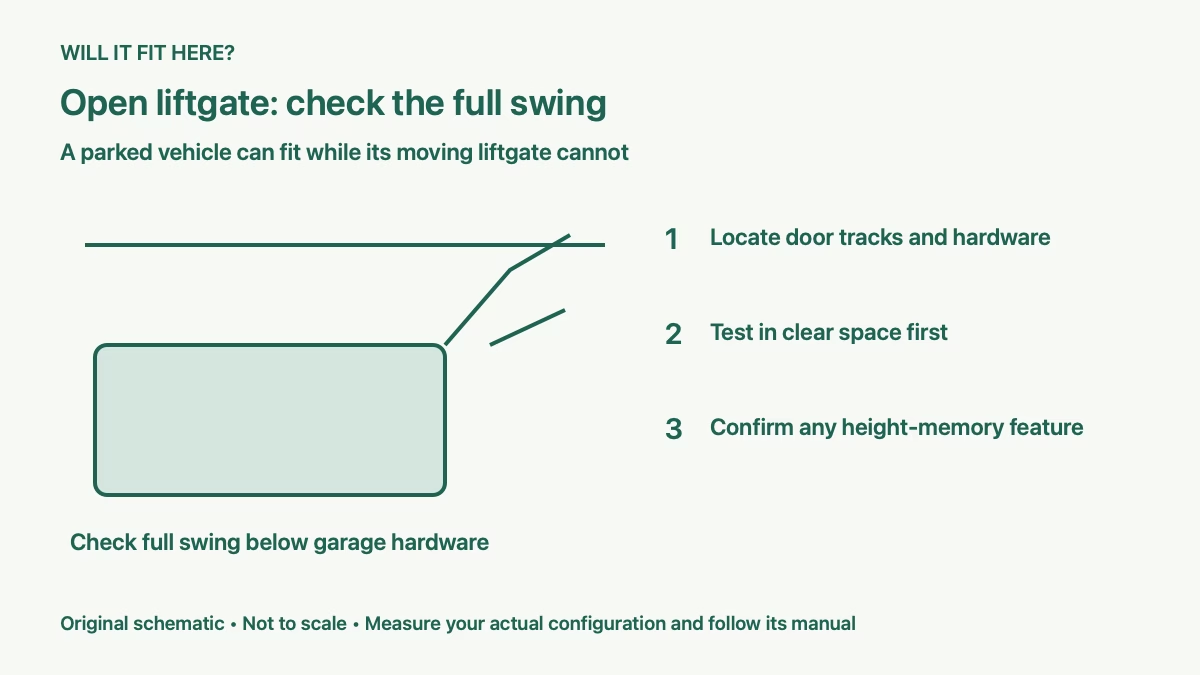
Quick answer: SUV liftgate garage clearance depends on the complete opening movement, not just the parked vehicle’s height. Check the highest point and rearward swing against the garage door, tracks, opener and stored objects. If the car has an opening-height memory feature, use only the procedure in its own manual and verify that setting in your real parking position.
1. Define your liftgate garage clearance problem
Your SUV already enters the garage, but you need to unload groceries or luggage without the open hatch touching overhead hardware. This is a different question from whether the vehicle fits through the garage doorway. The car can pass under the door while a raised panel extends higher or farther back than the parked roof.
Identify the parking location you actually use. Note whether the garage door will be fully open or fully closed during unloading. Photograph the lowest obstacles above and behind the liftgate, including door tracks, hinges, the opener rail, shelves and hanging storage. Treat each garage-door position as a separate arrangement because the available space can change.
2. Read the manual before checking garage clearance
Find the liftgate section for your exact model year and equipment. Ford’s official opening guidance cautions about operating a liftgate in a garage or enclosed area. This supports checking the space first; it does not establish the opening height of your own SUV.
Do the first full-opening observation outdoors in clear space, with the vehicle parked and people away from moving parts. Identify how to stop movement using the controls described in your manual. Do not test an unknown full-height opening directly underneath an obstacle or rely on an obstruction sensor as a measuring device.
3. Measure garage clearance through the full swing
With the hatch safely open in clear space, measure its highest point relative to the ground and its rearward extension relative to a repeatable point on the parked vehicle. Observe whether an intermediate position reaches an obstacle zone before the final position. A tall edge or projecting corner can matter even if the center of the panel clears.
Compare those measurements with the corresponding obstacle locations in the garage. Measure locally rather than using the ceiling height at the room’s center. Door hardware may hang below that ceiling, and a sloped floor changes the vehicle’s position relative to it. Keep a practical margin that covers your measurement uncertainty and parking variation; there is no single clearance margin suitable for every vehicle and garage.
4. Verify garage clearance with the height setting
Some powered liftgates let you store a lower opening position. An official Ford height-setting example describes stopping at a chosen position and programming it with the liftgate control. It applies to the equipment covered by that manual, so do not copy the button sequence to another model.
Use your own instructions and establish the lower setting in unobstructed space. Confirm which opening commands use the stored height and whether anything resets it. Then compare the programmed movement with the garage obstacles before trying it there. A low final position is only useful if the panel’s entire movement also remains clear.
5. Repeat the actual garage clearance trial
Park where you will normally unload and verify that the obstacle map still matches. Keep people and hands clear, observe from a safe position, and stop the operation if clearance is uncertain. Do not reach between moving panels and garage hardware. Check that the resulting opening is usable for loading without encouraging someone to lift the panel farther into an obstacle.
Parking farther forward or choosing to unload outside may resolve the problem more reliably than a tight setting. If you use a parking marker, still reassess after changes to roof accessories, tires, cargo, stored equipment or garage-door hardware. The garage entry measurement guide answers the separate doorway question.
When the clearance is not convincing
Do not accept liftgate garage clearance based only on a roof-height specification. You need a verified movement path and a repeatable parking position. If either remains uncertain, unload in clear space. For the inside of the vehicle, the closed-hatch cargo guide explains why opening clearance and cargo closure require different measurements.