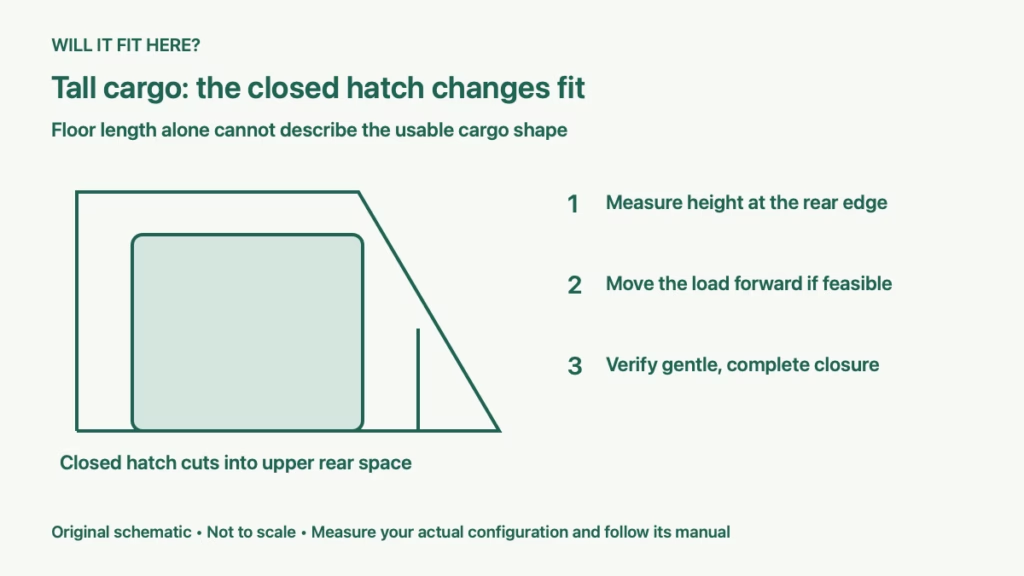
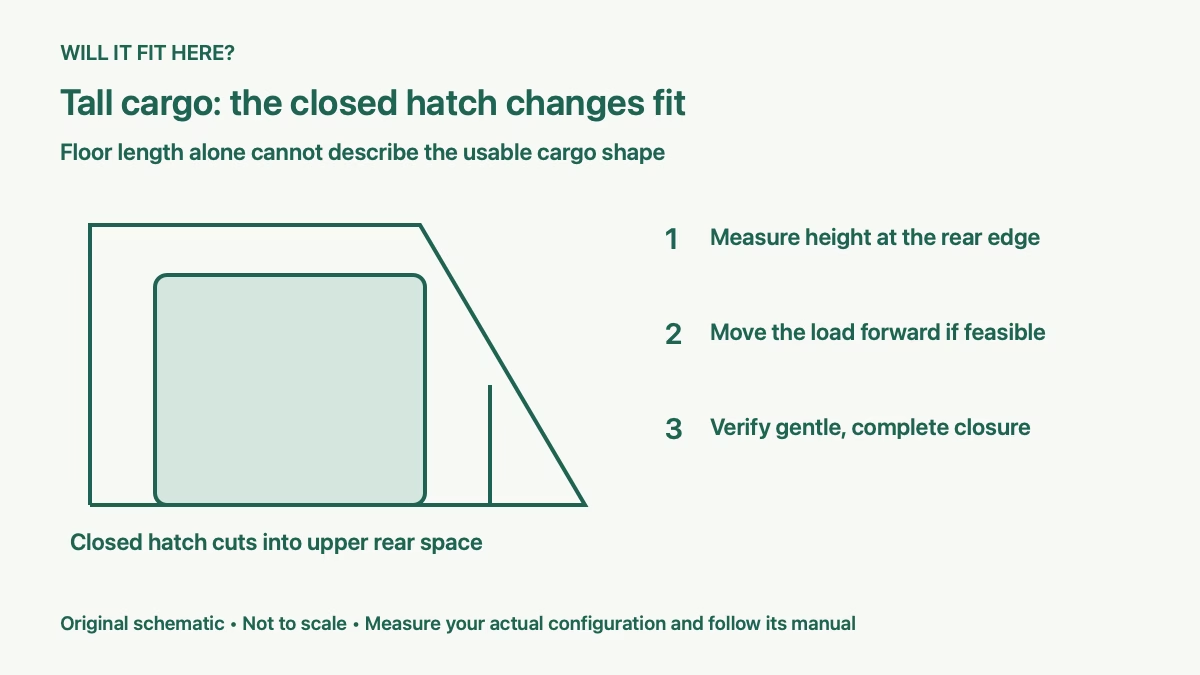
Quick answer: Tall cargo can fit on an SUV’s floor and still prevent the hatch from closing. Compare the load’s full height and depth with the usable space at that height, including the closed hatch’s slope, trim and latch area. A cargo-volume number or floor-length measurement cannot confirm this fit.
1. Identify the tall cargo shape you will actually move
You have found a cabinet, appliance box or storage chest that appears shorter than the SUV’s folded-seat floor. The remaining problem is the upper rear corner: it may occupy space that belongs to the hatch once the hatch closes. Resolve that before collecting the item, rather than relying on a seller’s statement that it fits in an SUV.
Measure the complete transport package, including feet, handles, packing corners and straps. Record height, front-to-back depth and width in the orientation permitted by the item’s manufacturer. A cabinet laid on its side becomes a different shape; an appliance may have transport restrictions. Do not choose a smaller-looking orientation until you have checked those instructions.
2. Separate the hatch opening from the closed space
First measure the clear entry opening, including its narrower curved corners. Then assess the interior with the hatch fully closed. With the vehicle parked and the engine off, use ordinary side-door access and a helper to inspect the rear cargo shape. Do not put a person in a sealed cargo compartment to take a measurement.
Check where the closed glass, inner trim, wiper housing and latch project toward the load. The cargo floor may extend farther rearward than the usable space higher up. A measurement taken along the floor can therefore overstate the depth available to a tall rectangular box. Keep protective blankets or a cargo mat in the configuration you plan to use because they change the effective height.
3. Map usable depth at the load’s height
Measure from the intended front boundary, such as a protected folded-seat back, toward the closed hatch at the height of the load’s top rear corner. Repeat at more than one height if the item has different protrusions. Also check usable width at those heights: side trim can taper inward independently of the hatch’s slope.
For an illustrative example, suppose your own measurements show 40 inches of floor depth but only 34 inches at the top of a box. A 36-inch-deep box would fail in that position even though it is shorter than the floor. These numbers explain the method; they are not dimensions of any SUV. A curved or irregular hatch may need several measurements rather than one straight slope line.
4. Test a forward position or permitted orientation
Moving tall cargo forward can create space behind its top rear corner, but it also consumes space near seat backs and occupants. Check the proposed position against the driver’s normal seating position and all passengers you need to carry. Never solve a hatch conflict by leaving the driver unable to sit or operate the vehicle correctly.
A lightweight cardboard mock-up of the item’s outline can help reject an arrangement before you lift the real load. Include the outer packing thickness. Hold or place it without interfering with the hatch mechanism, keep hands clear, and check closure gently. A template is a screening tool; the real object’s weight, handles and loading movement still require a controlled trial.
5. Require normal closure and secure transport
The hatch should close completely without being forced against the item. Ford’s official liftgate closing guidance emphasizes complete closure to keep cargo from falling out. Follow the instructions for your own vehicle rather than treating this example as a universal operating procedure.
Check cargo restraint, vehicle load limits and the item’s handling instructions separately. Space behind a closed hatch is not proof that the load can be transported securely. If the final position depends on compressing trim, leaning on glass or hoping a powered hatch will force itself shut, choose another vehicle or delivery method.
Your collection-day checklist
Bring the measured item envelope, your height-specific interior measurements and the planned seating layout. Confirm that the object can enter, turn into place and remain there with the hatch closed. The bicycle loading-route guide explains why entry and resting position need separate checks. For oversized flat material in a different vehicle, compare the pickup-bed plywood assessment.
Tall cargo fit is best answered with the actual closed interior shape. When the measurements are too close to call, a careful real trial or a larger delivery vehicle is more useful than a cargo-volume comparison.