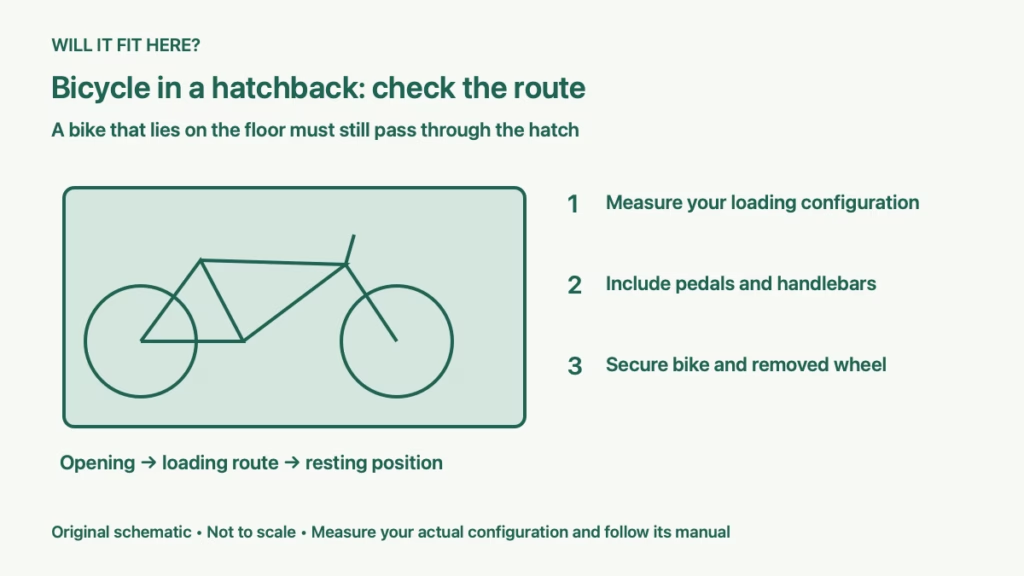
Quick answer: To check a bicycle inside a hatchback, measure the bike in the configuration you can actually load, compare it with the narrowest hatch opening, and test the entire movement into its resting position. Cargo volume and a bike’s wheel size do not prove this fit. Leave space for the removed wheel, passengers and secure restraint.
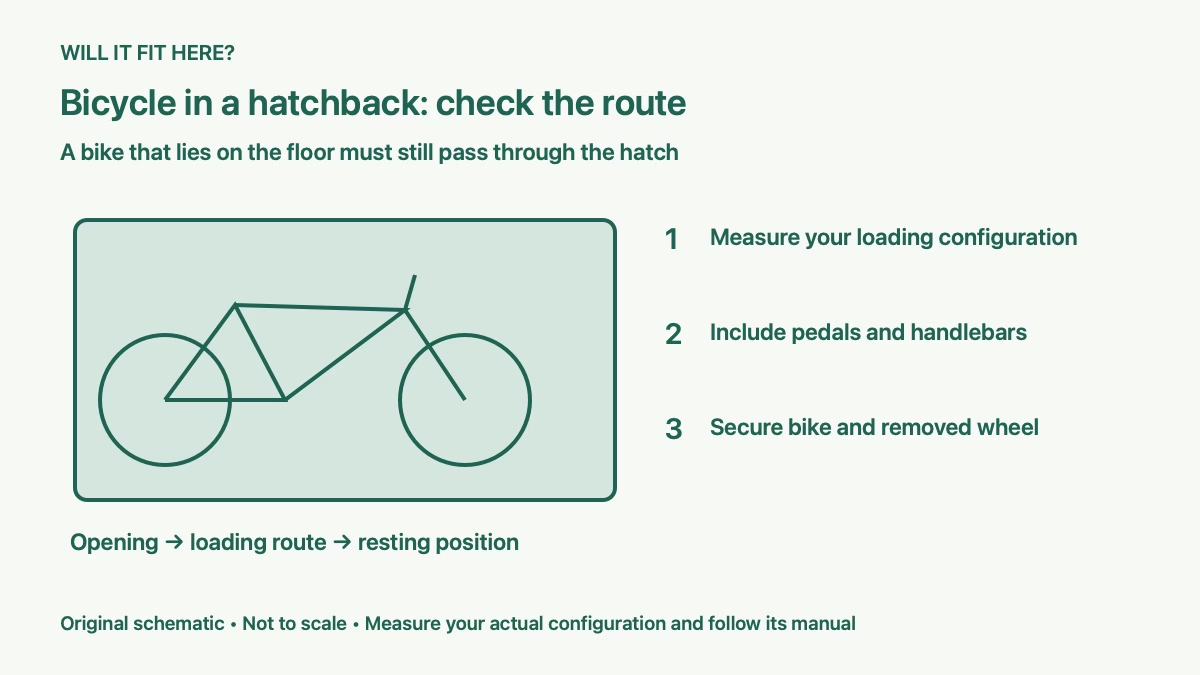
1. Choose your bicycle inside a hatchback configuration
You want to take your own bike to a trail or holiday without buying an external rack. The important question is whether one repeatable loading arrangement works with the seats and luggage you need on that journey. A photograph of a different bike in the same car is a clue, not a measurement of your frame, handlebar, saddle and accessories.
Begin with the car parked and the intended seats folded according to its manual. Remove ordinary loose cargo. Decide whether the bike will stay complete or whether the front wheel can be removed using the bike maker’s instructions. Liv’s official wheel removal and reinstallation guide explains that removing the front wheel can make a bike easier to fit in a car, and distinguishes quick-release from thru-axle systems. Your own components still determine the correct procedure.
2. Record the bike’s outer envelope
Measure the longest end-to-end dimension in the chosen configuration, then the widest and tallest protrusions in the intended loading orientation. Include pedals, brake levers, bar ends, bottle cages, racks and any bag that will remain attached. A narrow frame can still have a wide handlebar. A saddle that appears low in a side photograph may become the highest point when the bike is rotated.
Write separate measurements for an intact bike and a permitted wheel-off arrangement. Avoid adjusting a carefully fitted saddle merely because a different bike did so. If an adjustment is appropriate for your model, record its original position and follow the maker’s reassembly requirements. Measure the detached wheel separately rather than treating it as space that magically disappears.
3. Measure the hatch and usable floor
Measure the clear hatch width where the bike’s widest part will pass, not the vehicle’s outside width. Check the opening height from the load sill to the lowest trim or glass edge. Measure the floor length to the protected seat backs in your planned seat arrangement, and the width between wheel-arch intrusions. Include any raised sill or sloping folded-seat surface.
For a bicycle inside a hatchback, the opening and the storage area answer different questions. Plenty of floor space beyond a narrow opening does not guarantee entry. Conversely, a bike may pass through the hatch yet occupy the passenger seat you need. Keep the driver’s seating position correct and account for every passenger before accepting the arrangement.
4. Test the loading movement gently
Use a helper and padding where appropriate. Start with a lightweight outline or careful empty-car trial, then move the actual bike slowly along the proposed route. Check the handlebar turning point, pedal clearance at the sill, and the point where the bike must rotate toward the folded seat backs. Do not force components against trim or glass.
The widest measurement alone cannot describe this turning movement. A cardboard outline can reject an obviously impossible arrangement, but it cannot confirm that a three-dimensional bike will clear every obstacle. The final test is a controlled loading and unloading trial using the actual configuration, with space left for your hands and the padding you will really use.
5. Finish with closure and restraint
Check that the hatch closes normally without pressing on the bike. Verify that the load does not obstruct the driver’s controls or necessary visibility. Secure the bike and detached wheel using vehicle-approved anchoring and the relevant manuals; a good stationary fit is only one part of transport planning. Protect contact points and avoid putting weight on vulnerable components.
After wheel removal, follow the bike maker’s reinstallation and pre-ride checks before riding. If you cannot comfortably lift, restrain or rebuild this arrangement, choose another transport plan. For comparison with a rigid load, see the pickup-bed plywood fit checks; an open bed solves a different loading problem and still needs securement.
Make the decision before departure
A workable bicycle inside a hatchback arrangement passes three tests: entry, resting position and safe transport preparation. Save a photo and your measurements once the real trial succeeds so you can reproduce it. If luggage changes the arrangement, test again. The same outside-measurement habit helps with a folded stroller and its protective packing, but the dimensions must come from the object you actually carry.