Quick answer: An expanded suitcase meets Southwest’s standard checked-bag size limit only when its full outside height, width and depth add up to no more than 62 inches, including wheels and handles. Its packed weight must also meet the separate standard limit of 50 pounds. Opening an expansion zipper can push an otherwise acceptable suitcase over the size limit.
This guide is for someone packing a large suitcase who wants the extra capacity without an unexpected oversized-bag problem. The relevant number is the sum of the bag’s actual packed outside dimensions. A label such as “28-inch suitcase” usually does not answer that question by itself.
1. Find the Southwest rule for your actual itinerary
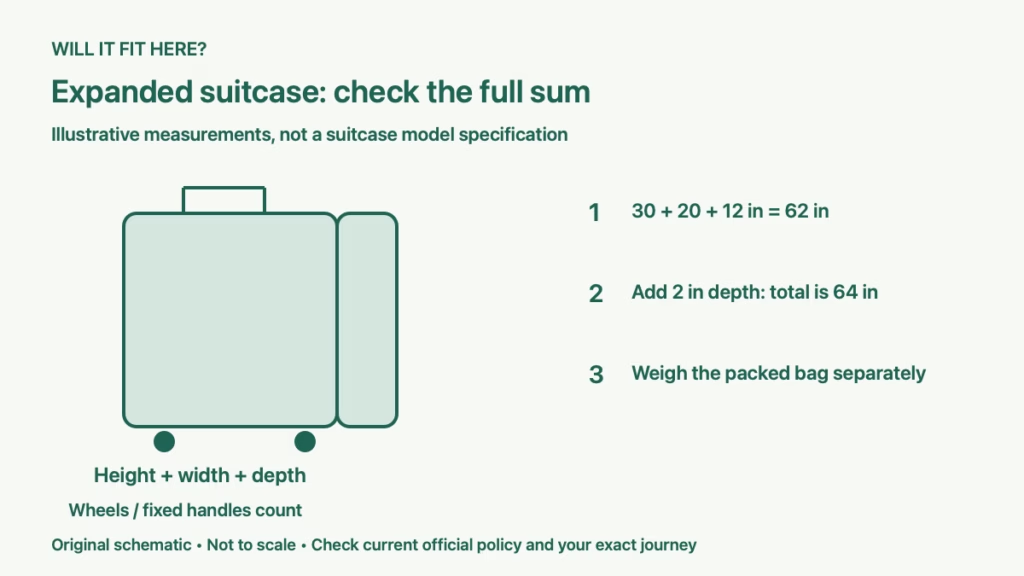
Southwest lists 62 inches as the standard checked-bag size limit and says to include wheels and handles. It also lists up to 50 pounds as the standard weight limit. Those are separate checks: a light suitcase can still be too large, and a correctly sized suitcase can still be overweight.
Check the current official policy before each trip, particularly if your booking includes another carrier or a destination with a baggage embargo. Meeting a size limit does not establish a free bag allowance. Review the fees and allowance that apply to your reservation rather than relying on an older memory of airline benefits.
2. Measure the suitcase after packing and expansion
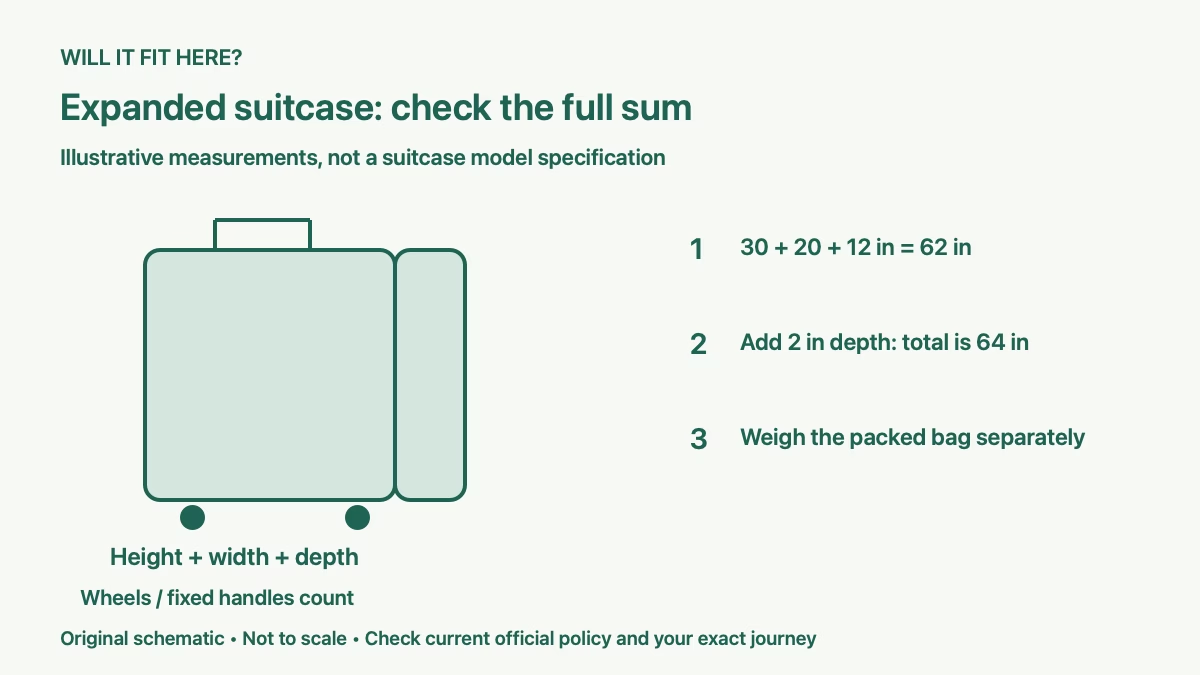
Load the case as you intend to take it, close the main zipper, and put the expansion zipper in its travel position. Measure the largest outside distance in each of the three perpendicular directions. Include the wheels, fixed handles and protruding pockets; measure bulging fabric at its widest point.
A useful home method is to place the suitcase beside a wall, hold a straight board against the opposite outermost point and measure between the wall and board. This can make projecting wheels easier to account for than laying a tape against the shell. Repeat for each dimension without pressing soft fabric inward.
3. Add the dimensions instead of comparing one side
For an illustrative example, a packed suitcase measuring 30 × 20 × 12 inches has a total of 62 inches. If expansion increases its depth to 14 inches while the other sides stay the same, the total becomes 64 inches. These are arithmetic examples, not specifications for a named suitcase or a guarantee that an airport measurement will match yours.
Keep the measurements in one unit. Do not add an inch measurement to a centimeter measurement. If you must convert, use 2.54 centimeters per inch and keep enough precision to avoid rounding a marginal bag into apparent compliance. When the result is very close to the limit, recheck the protrusions and consider a smaller case.
4. Repack before changing the expansion setting
If the expanded bag is too large, remove enough contents to close it in its unexpanded position, then measure again. Simply moving the expansion zipper does not necessarily remove a packed bulge. Check the pocket containing shoes or a toiletry kit as well as the central shell.
Measure your actual result rather than subtracting the manufacturer’s advertised expansion amount from your total. The extra depth may vary with loading. A photo of the packed bag and your dimension notes can help you repeat a successful packing arrangement, but neither replaces the airline’s measurement.
5. Weigh it and plan for the return journey
Use a luggage scale for a separate packed-weight check. Include anything you add just before leaving, such as a coat or charger. Shopping on the return journey may make the same suitcase heavier or require reopening its expansion section, so leave usable packing capacity if that is part of your plan.
If the suitcase remains outside the standard limit, review Southwest’s current oversized or overweight baggage guidance and any route restrictions. Do not assume paying a fee makes every bag acceptable. A smaller suitcase or a different packing arrangement may be the simpler solution.
Checked luggage is a different question from cabin fit
The 62-inch sum is a checked-baggage rule, not an overhead-bin measurement. If you are choosing which bag to take into the cabin on another leg, see our Delta 22-inch suitcase measurement guide. For liquids in a cabin bag, use our TSA quart-size toiletries fit checks.
Official source and measurement caveat
The standard size, wheel-and-handle inclusion and weight limits were checked against Southwest’s official checked-baggage policy for this October 6, 2026 guide. The home-measurement method and numerical example are practical aids. Verify your booking’s current allowance, fees and restrictions before traveling.