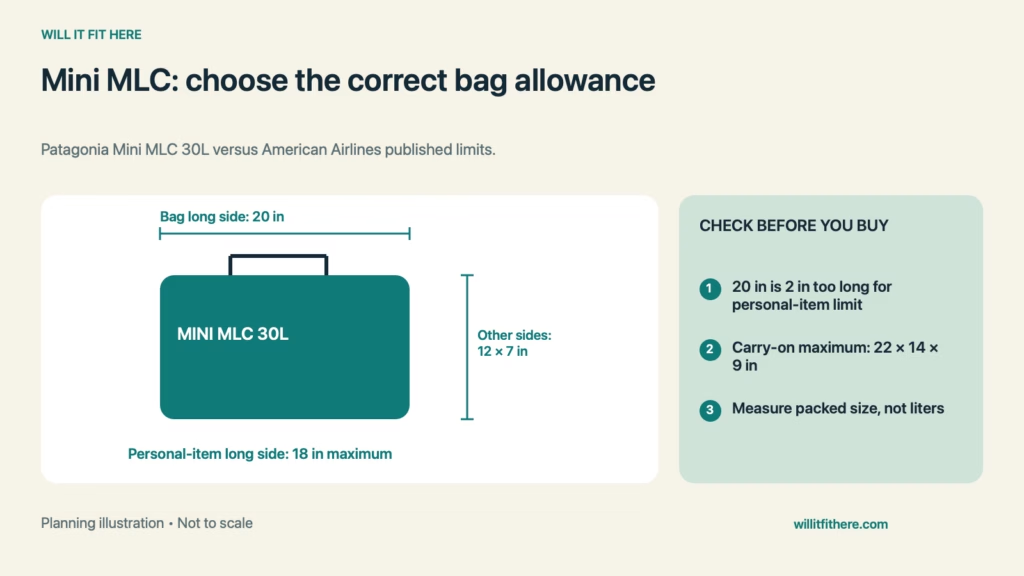
Fit verdict: Mini MLC 30L Fit on American Airlines is more straightforward as your main carry-on than as your personal item. Patagonia lists the Black Hole Mini MLC 30L, style 49266, at 20 × 12 × 7 inches. American’s personal-item limit is 18 × 14 × 8 inches, so the published bag is 2 inches too long. It is within the airline’s separate 22 × 14 × 9-inch carry-on limits before overpacking or attached items are considered.
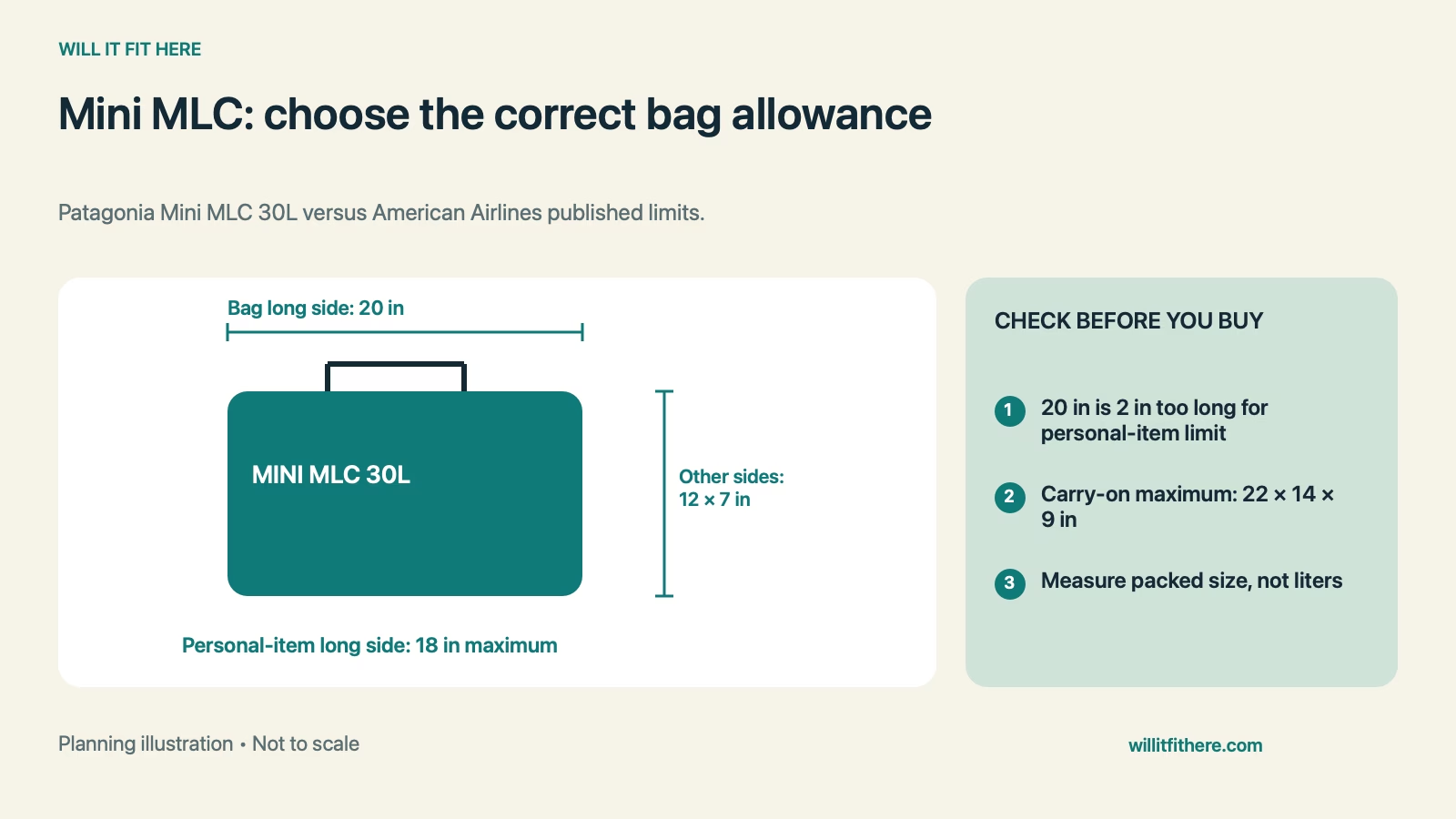
This is a comparison of published specifications and packing measurements, not a hands-on bag test. Worked measurements below are hypothetical, and airline acceptance remains subject to current rules and the actual packed bag.
Dimensions and baggage roles
| Item or rule | Published dimensions |
|---|---|
| Patagonia Black Hole Mini MLC 30L, style 49266 | 20 × 12 × 7 in |
| American personal item | 18 × 14 × 8 in maximum; must fit under the seat |
| American standard carry-on | 22 × 14 × 9 in maximum, including handles and wheels |
| Nominal personal-item length difference | Bag exceeds the longest limit by 2 in |
| Nominal carry-on margins | 2 in on each corresponding dimension |
1. Confirm the Mini version and its actual outline
Start Mini MLC 30L Fit with the product label. This guide covers the 30-liter Mini, not a larger MLC, a different Black Hole backpack, or an older bag whose dimensions you have not checked. Capacity measures storage volume; it does not describe a rectangular exterior. Two bags labeled 30 liters can have different heights and depths. Lay yours on a flat surface with its normal travel contents inside and note the three maximum outside dimensions.
2. Decide which of your two bag allowances it uses
The critical Mini MLC 30L Fit question is whether you also plan to bring a rolling carry-on. If the backpack uses your main carry-on allowance, a second large roller does not become a personal item simply because the backpack can sometimes slide beneath a seat. Plan the pair together. The smaller bag should independently meet the personal-item rule, and the larger bag should meet the carry-on rule. Check the operating airline on every segment before relying on American’s limits.
3. Measure packed corners, not the empty fabric
Place a straightedge against the tallest and widest points without pressing the bag flat. Include anything carried in an exterior pocket or clipped outside. A rigid laptop, overfilled packing cube, or shoes placed across the top can stop a soft backpack from shortening. Tuck loose straps as you would for boarding, but do not count on squeezing fragile electronics to satisfy a measurement. Photograph the ruler beside the packed bag for your own packing reference, not as a substitute for an airport size check.
4. Do not trade spare width for excess height
Mini MLC 30L Fit fails the published personal-item comparison on its longest dimension. The spare width and depth do not cancel that excess. A diagonal measurement across a cardboard outline is also not evidence that the whole three-dimensional pack will fit a sizer or the usable space under a seat. If you want to investigate a lightly packed configuration, measure the resulting complete envelope honestly. The manufacturer’s stated 20-inch size should not be advertised as automatically compliant.
5. Plan for the aircraft as well as the allowance
A carry-on-sized bag still needs a workable boarding plan. American notes that certain aircraft and airports have extra restrictions, and some regional flights use valet baggage handling. Keep items that must remain with you easy to remove if crew require the larger bag to travel separately. Do not assume a backpack receives different treatment from a suitcase of the same size. Check the current flight information and follow crew instructions rather than relying on another traveler’s previous experience.
Mini MLC 30L Fit: a worked packing example
Suppose your packed backpack measures 20 × 12.5 × 8 inches. Against the main carry-on limits, the remaining margins are 22 − 20 = 2 inches, 14 − 12.5 = 1.5 inches, and 9 − 8 = 1 inch. Against the personal-item limits, the first dimension is still 20 − 18 = 2 inches over. This Mini MLC 30L Fit example passes the dimensional carry-on comparison but fails the personal-item comparison. It does not establish that your chosen aircraft has available cabin storage.
Before leaving home
- Check the 30L model and the operating airline.
- Choose whether the backpack or a roller is your main carry-on.
- Measure the fully packed exterior on all three axes.
- Remove attachments that extend beyond the measured outline.
- Keep a plan for crew-directed baggage handling.
FAQ
Does fitting under a seat make it a personal item?
No. Mini MLC 30L Fit must satisfy the airline’s size rule as well as the available underseat space. A successful fit on one aircraft does not change the published limit.
Can I compress it to 18 inches?
Possibly in some packing configurations, but this guide has not tested that. Measure your actual bag without damaging its contents; do not assume the listed 20-inch model can always shorten enough.
Does the 30-liter label decide airline acceptance?
No. Use the packed exterior, the correct baggage category, and your flight’s current allowance. Liters are useful for choosing packing capacity, not for replacing dimensional checks.
Related fit guides
For a separate airline comparison, see Delta carry-on measurements including wheels. For organizing the smaller travel essentials, see TSA toiletry-bag packing checks.
Official sources
Specifications and baggage rules checked November 6, 2026. Recheck your exact product and operating airline before travel.