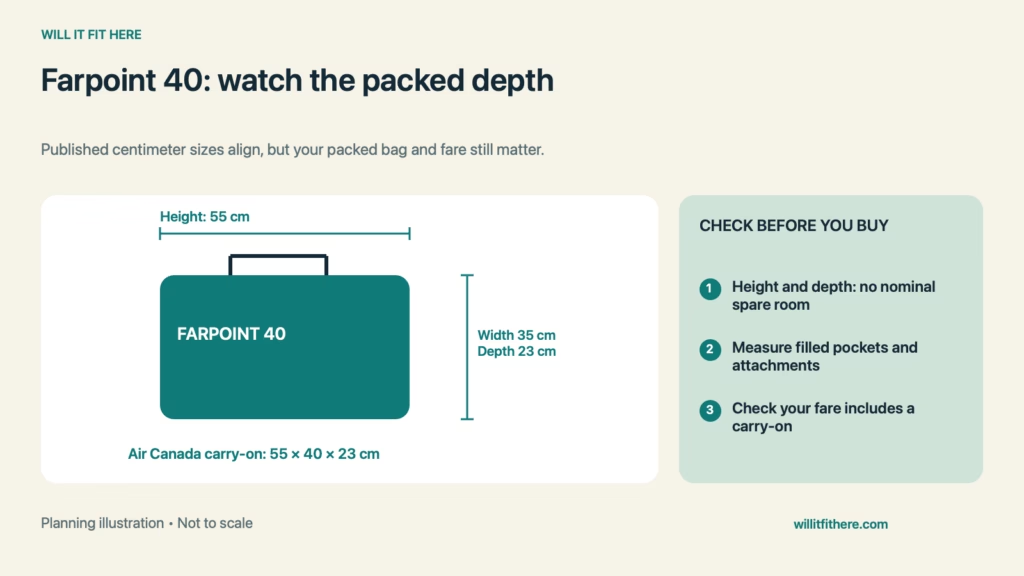
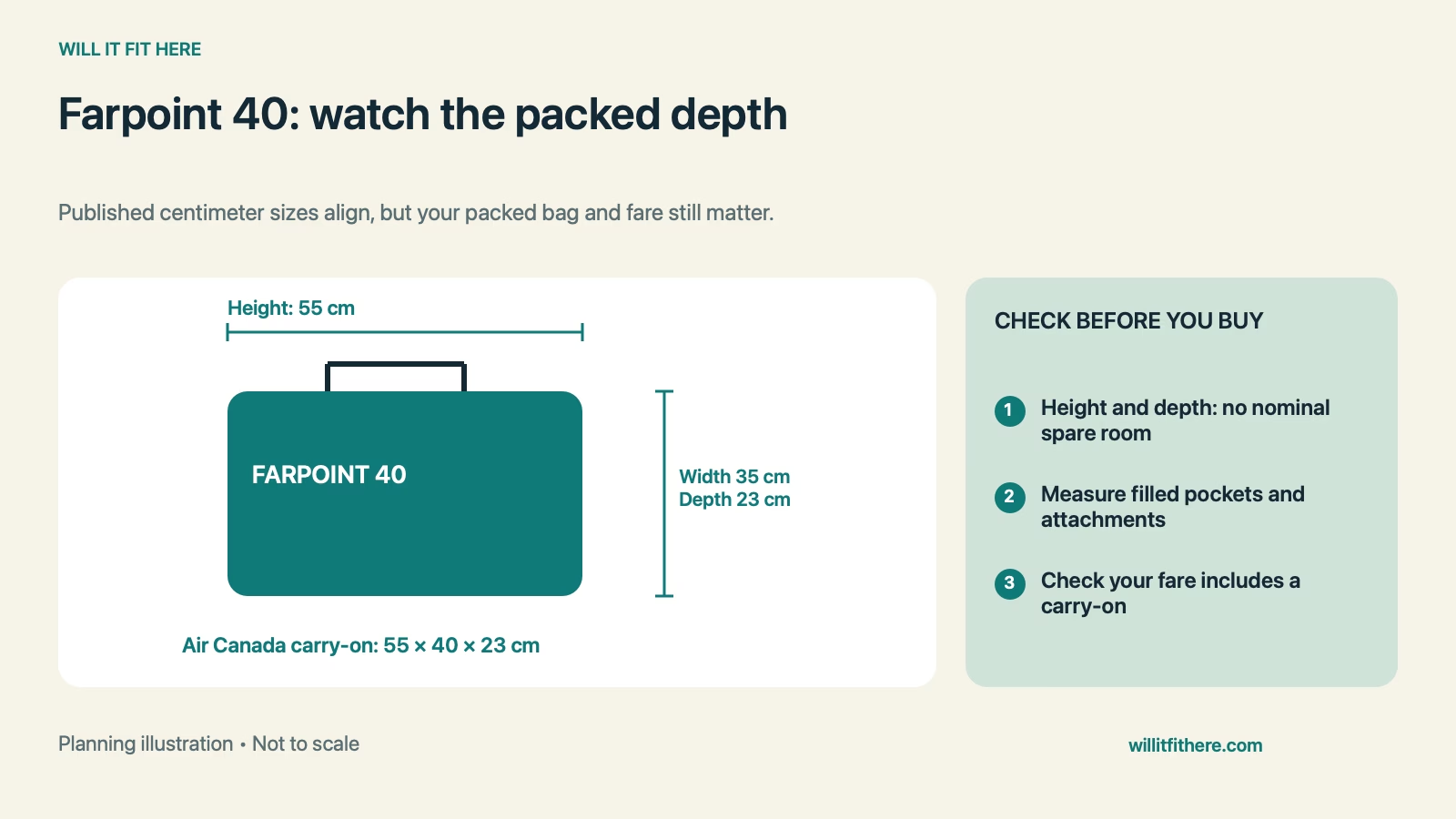
Fit verdict: Farpoint 40 Fit on Air Canada is a close dimensional match, not a blanket boarding guarantee. Osprey’s current Farpoint 40 page lists 55 × 35 × 23 cm. Air Canada’s standard carry-on limit is 55 × 40 × 23 cm when arranged in the same order. That leaves 5 cm across the width but no published margin in height or depth. Your ticket must also include a standard carry-on.
This guide compares official specifications and planning measurements. It is not a hands-on test of a backpack, airline sizer, or aircraft bin. The worked example is hypothetical.
Published sizes and the narrow margins
| Measurement | Centimeter comparison |
|---|---|
| Osprey Farpoint 40, current S26 product page | 55 H × 35 W × 23 D cm |
| Air Canada standard carry-on maximum | 55 H × 40 W × 23 D cm |
| Nominal height margin | 0 cm |
| Nominal width margin | 5 cm |
| Nominal depth margin | 0 cm |
| Fare check | Some Economy Basic itineraries include only a personal item |
1. Identify the Farpoint generation you own
Begin Farpoint 40 Fit with your bag’s exact product information. This comparison uses Osprey’s current S26 listing, not an older manual or the Farpoint 55 with a detachable daypack. A similar name does not establish identical construction. If your label or retailer description points to another generation, check its official specification and measure the actual bag. Keep the same orientation throughout your notes: height, width, and packed depth. This prevents accidentally comparing a pack’s widest face with the airline’s depth limit.
2. Measure depth at the fullest point
Farpoint 40 Fit is especially sensitive to front-to-back bulging. Place the packed bag between two parallel vertical surfaces or use a square and straightedge to find its maximum depth. Include a filled exterior pocket, laptop compartment, handles, and anything attached outside. Measuring an empty bag tells you little about how a packed toiletry pouch pushes the front panel outward. Check the top, middle, and bottom rather than measuring only the thinnest section beside a compression strap.
3. Pack for the outline rather than the advertised liters
Use packing cubes that keep the main compartment flat, and relocate hard objects that create isolated bulges. Close the bag normally before tightening compression straps. Straps can control soft clothing, but they cannot reliably shrink a rigid object or change the pack’s structural length. Do not use the 5 cm of spare nominal width as permission for extra depth. Each dimension has its own limit, so a narrower bag can still be too thick.
4. Check the fare before treating the pack as cabin baggage
Farpoint 40 Fit has two separate gates: physical size and baggage entitlement. Air Canada states that some Economy Basic itineraries purchased from January 3, 2025 allow only a personal item, with exceptions described on its current policy page. Read the allowance attached to your booking and connecting flights. Do not assume a 40-liter travel pack qualifies for the smaller personal-item category because you can carry it on your back. If a standard carry-on is excluded, resolve that before reaching the gate.
5. Check handling and the units used by the sizer
Air Canada says carry-on baggage must be manageable enough to put overhead without assistance. Try lifting your packed bag safely at home without using a fragile shelf as a test fixture. Also notice that the two brands round their inch specifications differently: Osprey lists 21.7 × 13.8 × 9.1 inches, while Air Canada publishes 21.5 × 15.5 × 9 inches. The centimeter comparison above uses their stated centimeter limits; those rounded inch figures should not be treated as extra tolerance. Actual measurements and the airline’s sizer decide a borderline case.
Farpoint 40 Fit: a worked packed-depth example
Imagine your travel-ready pack measures 55 × 36 × 24 cm. Its width remains 40 − 36 = 4 cm below the maximum, but depth exceeds the limit by 24 − 23 = 1 cm. Moving a rigid pouch inward might reduce the bulge, but measure again after repacking rather than assuming success. This Farpoint 40 Fit example fails the size comparison until every outside dimension is within the applicable limit. A width surplus does not offset the depth failure.
Departure checklist
- Match the model generation to the specification.
- Measure the fully packed bag, including pockets and handles.
- Keep height and depth within the published limits.
- Confirm your ticket includes a standard carry-on.
- Review operating-airline rules on connecting segments.
FAQ
Is the Farpoint 40 guaranteed to pass Air Canada’s sizer?
No. Farpoint 40 Fit is nominally compatible in the published centimeter comparison, but two dimensions have no spare margin. Packing, measurement, and the airline’s current rules still matter.
Can I use the manufacturer’s load range as an airline allowance?
No. A backpack’s recommended carrying load describes the product, not permission from an airline. Check the flight’s baggage rules and whether you can safely handle the packed weight.
Does adding a small daypack change the calculation?
Yes. An attached bag changes the outside envelope. If carried separately, it becomes a separate item that must fit your allowance and meet the applicable size rule.
Related fit guides
Compare another airline’s shape limits in Qantas cabin-bag allowance checks, and review US carry-on versus Ryanair and easyJet dimensions before a multi-airline trip.
Official sources
Specifications and policies checked November 6, 2026. Confirm your exact backpack and booked allowance before departure.