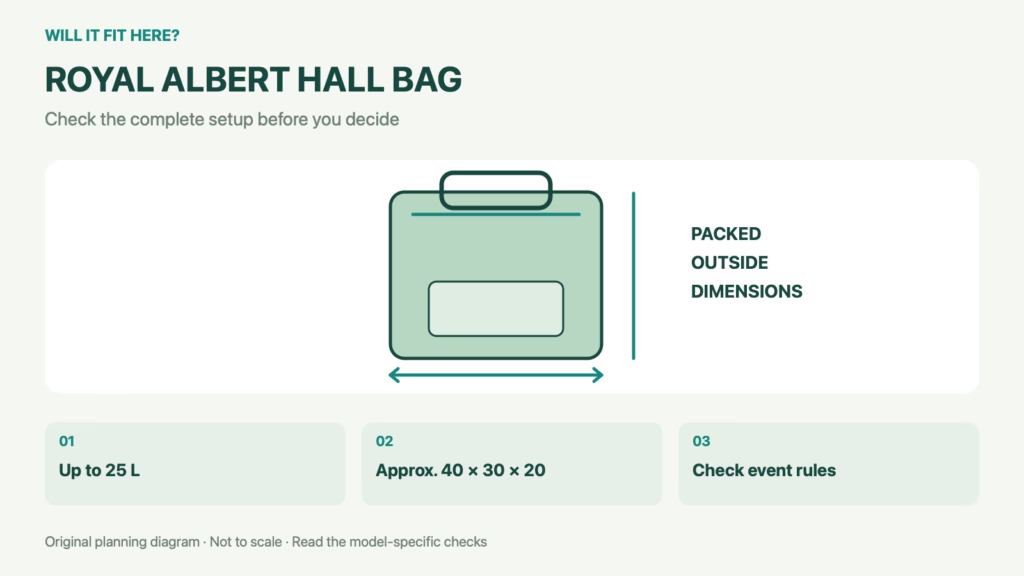
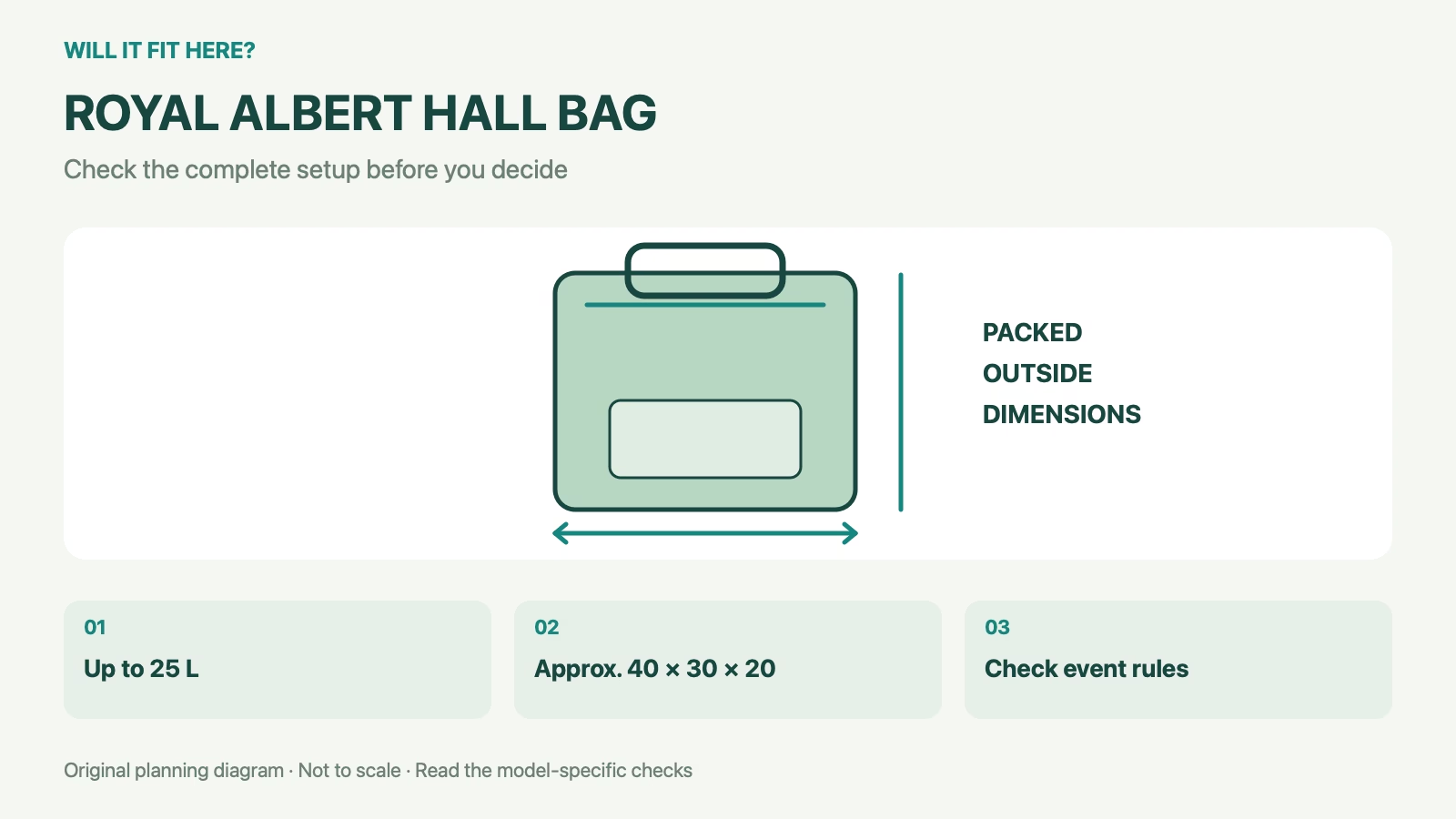
Fit verdict: The Royal Albert Hall bag guidance says bags should be no more than 25 L in capacity, with an approximate size reference of 40 × 30 × 20 cm. Read both parts of that guidance and check your event information. A capacity label alone does not prove that an awkwardly shaped or heavily packed bag is suitable for entry.
Dimensions and conditions
| Check | Reference | What it means |
|---|---|---|
| Capacity guidance | No more than 25 L | Official venue FAQ |
| Approximate size reference | 40 × 30 × 20 cm | A guide, not an exact 25 L cuboid |
| Event conditions | Check the event and venue information | Do this before choosing your travel bag |
1. Identify the Royal Albert Hall bag you will carry
Choose the actual bag for the visit, rather than relying on the luggage you normally use for commuting. Read its capacity label and then measure it packed. A large outer pocket, rigid back panel or item strapped to the outside can make the overall shape more awkward than the nominal capacity suggests. Include everything you plan to take from the station or hotel. Leaving a coat inside a bag for the journey can materially change its packed outline.
2. Keep capacity and dimensions distinct
The venue’s approximate dimensions multiply to 24 L for a perfect rectangular box. That does not make the FAQ inconsistent: real bags are not perfect cuboids, and the reference is approximate. It also does not create an extra allowance on one side. Use the published guidance conservatively and ask the venue in advance if your bag is unusual. A retailer’s capacity figure is not a measurement of how much room the bag will occupy beside a seat or during an entry check.
3. Make a plan for the rest of your luggage
Check the event-specific instructions and the current venue FAQ before travelling. If your chosen bag exceeds the guidance, arrange an alternative before arrival instead of assuming staff will store it. Separate essential items from the rest of your travel luggage so that changing bags is practical. Keep the packed shape easy to inspect and carry. Recheck after adding purchases or other items later in the day; the bag presented at the door is the one that matters.
4. Keep a Royal Albert Hall bag fit record
Save the event information with a note of the chosen bag and its packed dimensions. If the bag needs to carry extra clothing on the way home, account for that before leaving. A small spare tote can also become an additional item to consider under venue rules. Check the complete collection of belongings you intend to present at entry.
Royal Albert Hall bag: a worked fit example
Illustrative comparison: a 40 × 30 × 20 cm rectangular envelope is 24,000 cm³, or 24 L. That calculation helps explain the approximate reference; it does not certify a bag sold as 25 L. Compare your packed bag with the venue guidance and confirm any uncertain case directly before the event.
Before you decide: 5 checks
- Read the current venue FAQ and event notes.
- Check the bag’s stated capacity.
- Measure its packed outside shape.
- Include external pockets and attached items.
- Arrange excess-luggage storage elsewhere in advance.
FAQ
Is 40 × 30 × 20 cm exactly 25 L?
No. A rectangular envelope with those dimensions is 24 L; the venue labels the dimensions approximate.
Does a 25 L label guarantee entry?
No. Check the actual bag and all applicable venue conditions.
Can I assume oversized luggage will be stored?
No. Establish a suitable plan before arrival.
Related fit guides
- Rijksmuseum Bag Fit: 5 Entry Checks
- British Airways Two-Bag Cabin Fit: Backpack and Suitcase Checks
- Travel fit guides
Sources
Sources checked 3 November 2026. Product-specific facts are attributed above. Worked examples and measuring methods are planning guidance; example dimensions are not product specifications. Recheck the exact model or current travel policy before acting.