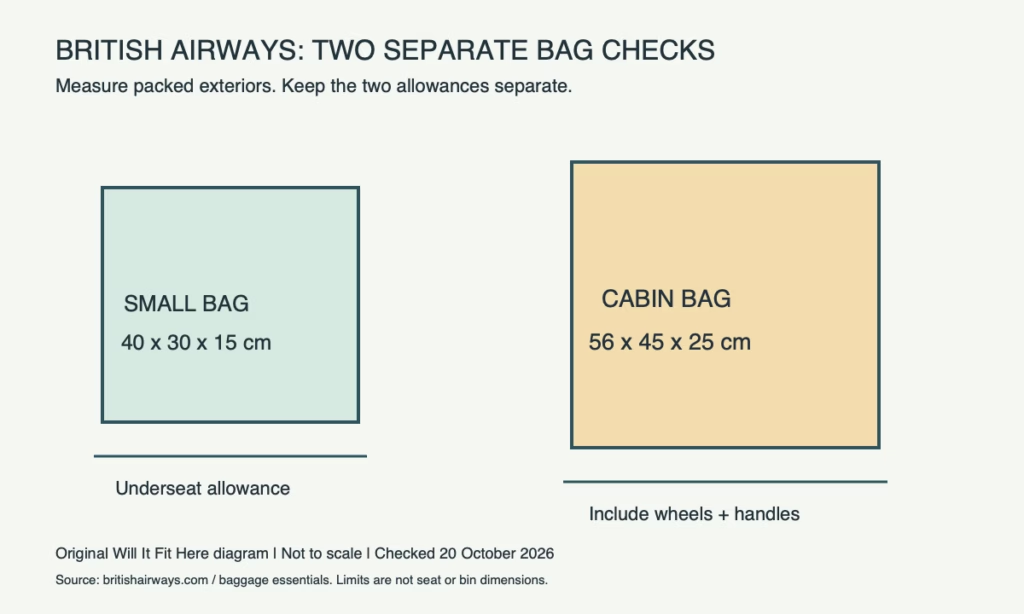
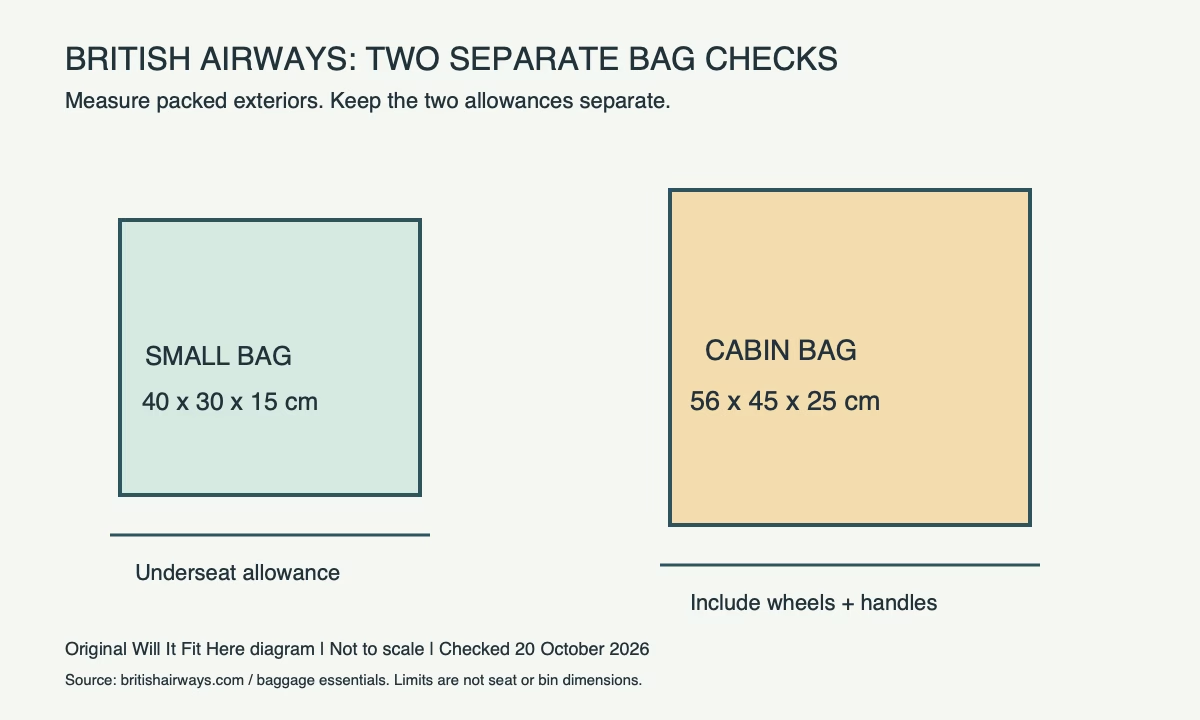
Quick answer: A backpack and a suitcase can qualify as British Airways’ two cabin pieces when each fits its own allowance. For the BA-operated services covered by its current baggage page, the smaller bag is limited to 40 × 30 × 15 cm, while the larger cabin bag is limited to 56 × 45 × 25 cm, including wheels and handles. A roomy suitcase allowance does not make an oversized backpack acceptable. Check the operating airline and your booking before packing.
Decide which bag does which job
The awkward combination is often a normal cabin suitcase plus a deep commuter backpack. Put the two bags side by side and label them “small bag” and “cabin bag” before comparing measurements. Do not add their capacities together or average their dimensions.
BA distinguishes the small bag that must fit under the seat from the cabin bag that goes overhead and may need to travel in the hold. Its page also says partner-airline allowances may differ. Read the “operated by” line for every flight, particularly on a connecting ticket.
| Piece | Published size envelope | What to measure |
|---|---|---|
| Small handbag or backpack | 40 × 30 × 15 cm (approximately 15.75 × 11.81 × 5.91 in) | Packed body, bulging pockets and fixed attachments |
| Larger cabin bag | 56 × 45 × 25 cm (approximately 22.05 × 17.72 × 9.84 in) | Entire exterior, including wheels and handles |
The centimetre limits above are the reference for this comparison. Converted inches are arithmetic approximations, not a larger alternative allowance. Neither row establishes the usable dimensions beneath a particular seat.
Measure the backpack after packing
Place the packed bag on a level surface without pressing it flat. Use two straight objects, such as books, against its opposite faces and measure the gap. Repeat for all three directions. A curved back panel, water bottle or full front pocket can be the widest point.
As an illustrative example, a bag measuring 39 × 29 × 18 cm meets the first two small-bag comparisons but exceeds the 15 cm depth limit by 3 cm (about 1.18 in). Its litre rating cannot resolve that mismatch. Remove contents and measure again; do not assume soft fabric will compress while full.
Include the suitcase’s hard parts
Retract the telescoping handle, then measure from the lowest wheel to the highest fixed part. Check side handles, protective feet and the expanded zipper. A manufacturer’s “body size” can omit exactly the parts that meet a baggage sizer first.
A hypothetical 55 × 40 × 26 cm case is too deep for the listed 25 cm envelope even though its other sides are smaller. Turn the bag to test an orientation, but compare all three external dimensions together. A diagonal measurement or a sum of sides is not the three-side rule in this table.
Run a two-piece departure check
- Confirm each operating airline and the allowance attached to the booking.
- Measure and photograph both packed bags beside a ruler for your own packing record.
- Keep the small bag easy to detach from the suitcase’s trolley sleeve.
- Plan how you would remove essential items if the larger bag must be checked.
- Confirm current weight and restricted-item rules directly with BA; dimensions alone do not establish acceptance.
Try lifting and carrying your packed bags at home without straining. An allowance is not a recommendation to load to the limit. If lifting is an accessibility concern, arrange the airline’s assistance rather than relying on another passenger.
Common questions
Can the backpack be my larger cabin bag? Yes, a backpack can be assessed against that envelope, but then the other piece must qualify as the smaller bag. The bag’s style does not create an extra allowance.
Does a compliant suitcase definitely stay overhead? No. Keep a practical plan for a hold transfer, and follow airline instructions at the gate.
Can I use the same combination on another airline? Measure again against that operator’s separate rules. Our US carry-on versus Ryanair and easyJet comparison explains why a familiar bag label is not enough.
Official sources and scope
Checked October 20, 2026: British Airways baggage essentials and BA packing tips. Recheck the booking and current operator rules before travel. Measurements used in worked examples are hypothetical; no aircraft storage measurement or firsthand flight test is claimed.