Quick answer: Roof basket fit depends on the approved rack, crossbar spacing, mounting hardware, roof clearance and the load carried by the complete system. Compare the basket’s usable interior with your packed gear separately. A basket that covers the roof neatly can still have incompatible clamps or an unsuitable bar spread.
You want open roof storage for bulky camping equipment, but the existing crossbars are already installed. Before ordering a basket, the useful question is whether its mounting points can reach the permitted bars and whether the hardware clears the roof. This guide helps you gather those measurements and documents before purchase; follow the exact instructions for installation.
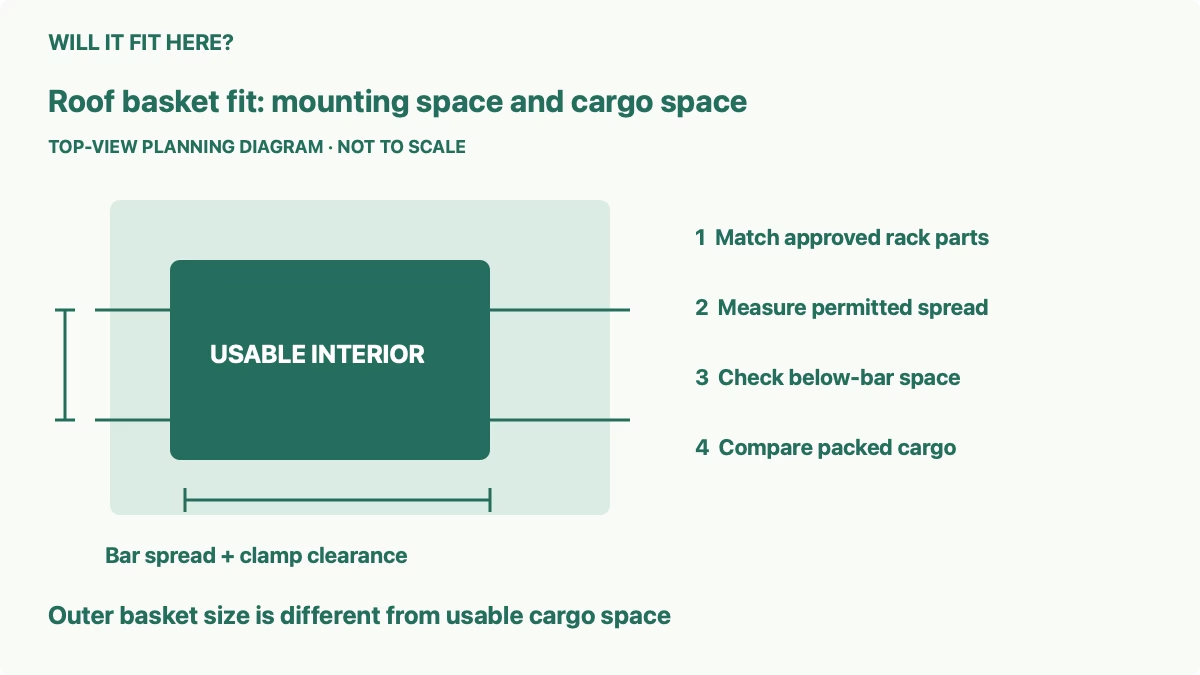
1. Identify the rack before checking roof basket fit
Record the vehicle model year, roof type, bar model, feet and fit kit. Photograph the bar labels if needed so a retailer can confirm the exact components. Factory rails alone do not establish which basket mounting method is approved. A vehicle without an approved rack arrangement needs that question resolved before basket dimensions become useful.
Read the vehicle’s roof-cargo restrictions alongside the rack and basket instructions. Check for model-specific exclusions, restrictions on glass roofs and any prescribed rack positions. A broad statement about fitting many vehicles does not confirm a particular combination of roof, feet and crossbars.
Keep compatibility and geometric fit as separate entries on your worksheet. If the hardware appears to surround a bar but the manufacturer does not permit that combination, physical contact is insufficient evidence. Ask the relevant manufacturer to confirm the exact arrangement, including any adapter part number, before buying.
2. Measure the permitted crossbar spread
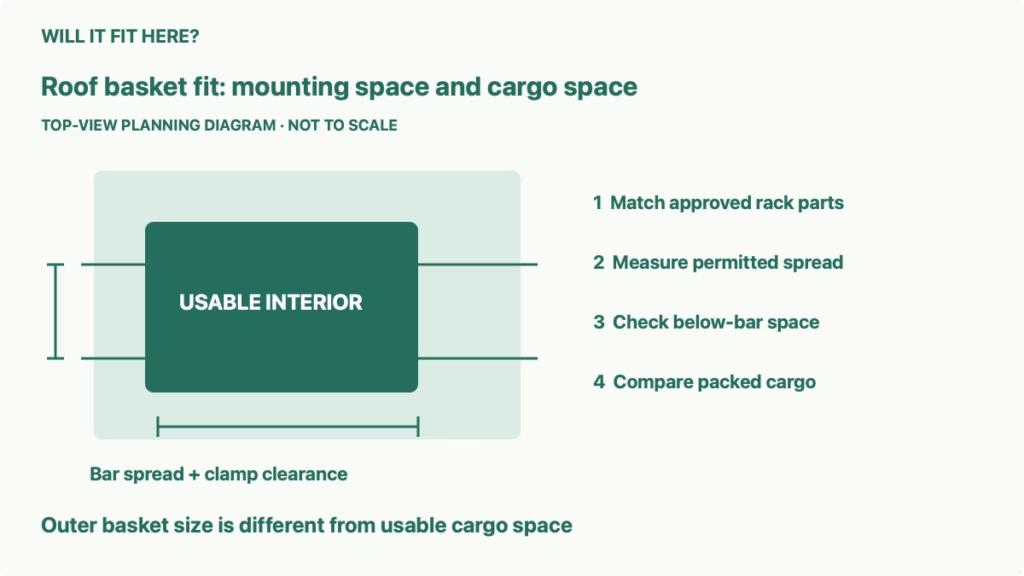
Crossbar spread is the front-to-back distance used by the mounting drawings. Check their reference points before measuring. A clear gap between two bar edges differs from a distance between their centers. Write the reference beside the measurement so your comparison uses the same definition.
The current Thule Canyon XT specifications list a minimum bar spread of 20 inches and a maximum of 37 inches. These are a range for that basket, not a general standard for every roof basket. Confirm the instructions associated with the exact product and mounting method before applying either boundary.
On a vehicle with fixed points, the possible spread may already be determined. On an adjustable rack, only consider locations allowed by the vehicle and rack instructions. Do not shift the feet outside their permitted positions to make a basket’s brackets reach. A longer basket does not automatically change the permissible rack spread.
Measure both bars at the intended mounting locations if they are angled or have a varying profile. Note whether accessories already occupy those areas. The total bar length is not the same as the usable mounting span between feet, end caps or other attachments.
| Measurement | What it answers |
|---|---|
| Crossbar spread | Can the approved basket mounting positions reach both bars? |
| Bar profile and lower space | Can the specified mounting hardware fit without roof contact? |
| Outer basket size | Where will its edges sit relative to the roof and hatch? |
| Usable interior | Will the packed cargo fit inside the carrying area? |
| Installed loaded height | Will the complete vehicle clear the intended overhead route? |
3. Check the clamps and space beneath each bar
Compare the width and height of the actual bar section with the basket’s approved hardware. Surrounding clamps, U-bolts and T-track mounting have different requirements. Do not treat a T-track feature as permission to use an arbitrary bolt, slot nut or adapter. Match the parts described for the basket and the rack.
Look below the bars as well as above them. The roof, rack feet and any antenna can occupy the space needed by brackets or fasteners. Obtain the relevant clearance drawing instead of estimating from a product photograph. Record unresolved clearance as a question for the manufacturer or installer.
The Canyon XT product page lists a T-track mounting option as included. That describes a feature of the product; it does not confirm compatibility with every slot geometry or rack. Use the linked instructions to determine which mounting arrangement applies to the crossbars you own.
Keep the bar ends and feet on your sketch. A basket can be narrower than the full bar while its bracket locations interfere with a foot. Check each proposed mounting point, including room to inspect and maintain the supplied fasteners as directed, before deciding the assembly is workable.
4. Separate basket dimensions from cargo dimensions
The Canyon XT page lists an outer size of 50.25 × 41 × 6 inches and an interior of 41 × 39 × 5 inches. Use the appropriate set for each question. Outer dimensions describe the basket’s overall envelope; the interior is the more relevant starting point for bags or storage cases.
Measure gear in its packed condition, including rigid handles and protruding straps. A bag’s empty advertised size can understate its loaded outline. Draw the intended arrangement and identify where the approved restraints can secure it. Passing an interior-size check does not establish that a load can be restrained correctly.
Check the rear position against hatch movement and the front position against roof features. Keep any required clearances from the exact vehicle and accessory instructions. Avoid opening a hatch into an uncertain obstruction merely to discover the collision point; establish a conservative plan or ask an installer to assess it.
Extensions change the carrying outline and may change the applicable mounting instructions. Evaluate the complete configuration you intend to use. Do not substitute the base basket’s measurements for the extended version or assume a larger interior creates additional vehicle roof capacity.
5. Check total load and installed height
Work through the vehicle, rack and basket limits using the load definitions in their instructions. The basket’s capacity is not the same as the vehicle’s permitted roof load. Include the weight of the required components where instructed, and resolve conflicting guidance before loading.
The current Canyon XT page lists basket weight as 29 pounds and load capacity as 150 pounds. Those figures provide inputs for the complete check; they do not authorize carrying 150 pounds on every compatible-looking roof. A lower applicable limit elsewhere in the system can govern the planned load.
Installed height includes the vehicle, rack, basket and loaded cargo. Record the highest point in the intended configuration before using a garage, car park or overhead route. A six-inch basket-height listing does not account for crossbar elevation or gear projecting above the rim.
Keep a purchase decision sheet with the approved components, measured spread, compatible hardware, roof clearance, gear arrangement and applicable load limits. Proceed when each relevant requirement is resolved. Follow the supplied instructions or use a qualified installer; this worksheet cannot approve improvised brackets or changes to the roof.
Common questions
Does any 20–37-inch spread fit? That range is one Canyon XT specification. Approved rack use, reference points and hardware still matter.
Can I use the outside dimensions to choose bags? Compare packed gear with the usable interior and the required restraint arrangement.
Does a basket’s load rating override the vehicle limit? No. Evaluate the complete system under the manufacturers’ applicable requirements.
For related checks, see rooftop tent crossbar planning and SUV liftgate clearance.
Official sources and limits
Checked October 7, 2026: Thule Canyon XT specifications and its linked mounting instructions. Confirm the exact vehicle and rack requirements separately. No firsthand mounting test or approval of a specific roof is claimed.