Quick answer: A rolling TV cart can pass a doorway only if the complete mounted assembly and its permitted movement fit the entire route. Compare the screen, wheelbase, shelves and cables—not just the base width. Do not tilt a loaded cart or improvise a lifting method to overcome a narrow opening.
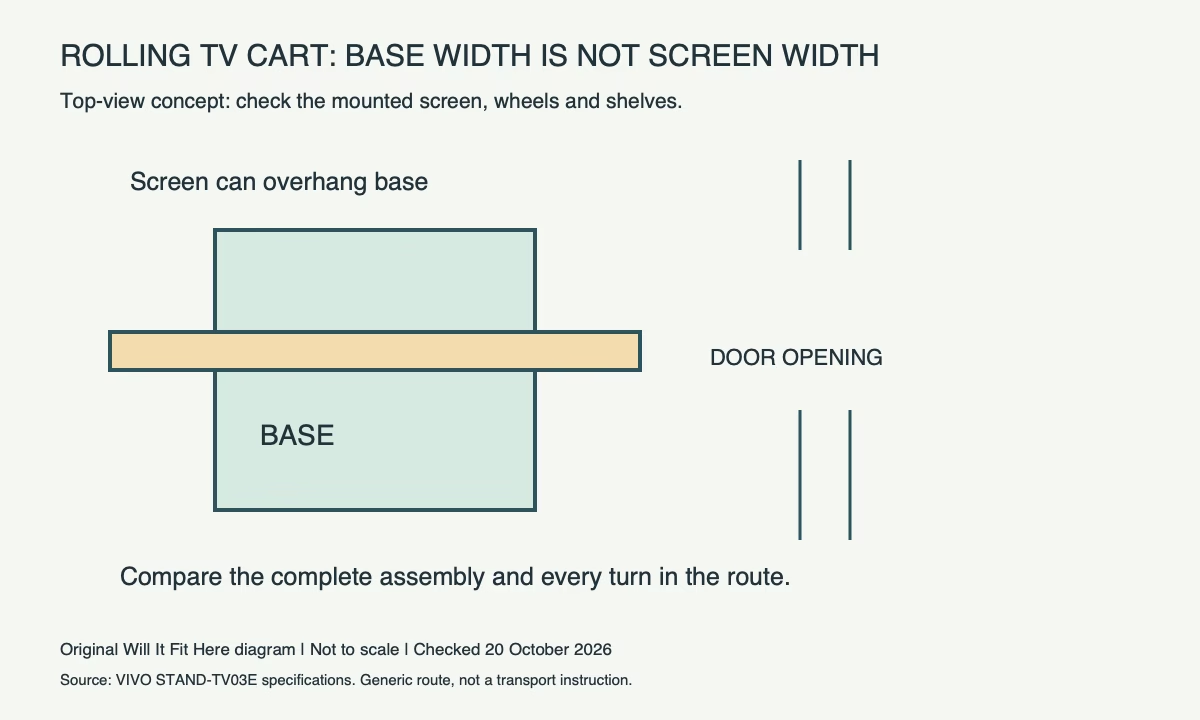
Measure the widest part at each height
Record the actual TV body width, height and depth after mounting. Add the base’s full wheel-to-wheel extent, handles and any shelf contents. A door handle or closer can obstruct the screen at a different height from the wheels.
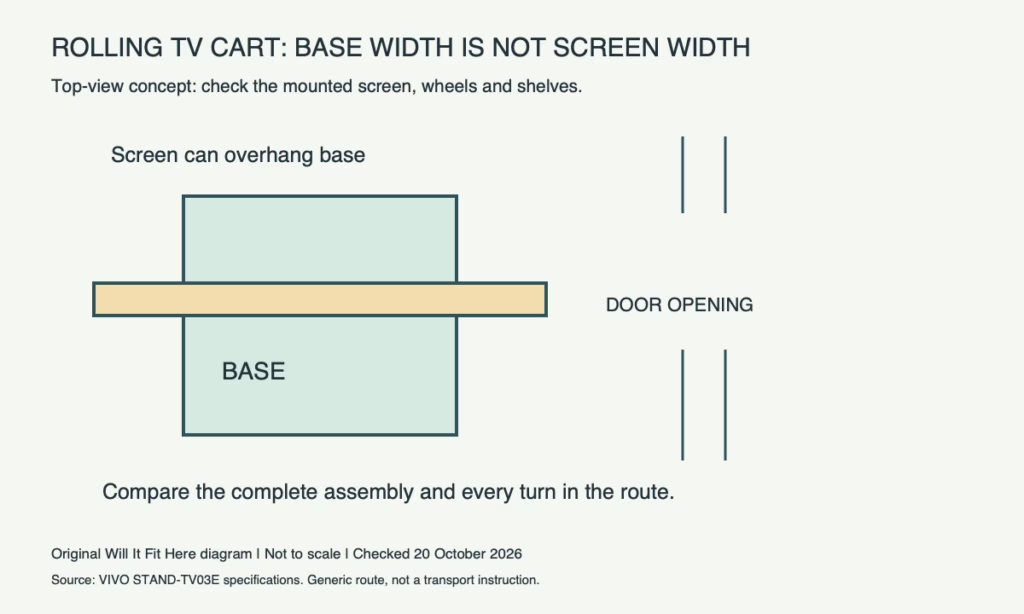
For a specific US example, VIVO lists the STAND-TV03E cart base width as 27.5 in, about 69.85 cm. An ideal 65 in 16:9 screen is roughly 56.65 in wide before its bezel. That calculation explains why a base that fits a 32 in opening does not prove a face-forward screen fit. Actual TV body dimensions remain necessary.
Trace the full route, including turns
Measure the clear door opening with the door in the position it will actually occupy. Check thresholds, carpet edges, lifts, low door closers and the space on both sides. A narrow corridor may prevent the assembly turning into an opening that looks wide enough in isolation.
A cardboard plan of the base and screen overhang can help test the floor geometry. Use the manual’s permitted transport configuration when planning; do not treat the model as permission to roll the cart sideways, lower it while loaded or detach the TV without appropriate help.
- Display weight, hole pattern and mounting hardware meet the cart manual.
- Screen, base and shelf fit the clear route at their actual heights.
- All turns and thresholds can be negotiated as the manufacturer permits.
- Power and signal leads are disconnected or managed as instructed.
- Wheel locks and the final supporting surface suit the stationary setup.
Screen-size range is not the whole compatibility test
VIVO’s current STAND-TV03E page lists a 32–83 in screen range and 110 lb mount capacity, with separate VESA and shelf limits. Those figures apply to that series and do not guarantee compatibility with every screen in the range. The exact cart version and manual control.
Common questions
Can I angle the screen through the doorway? Only use a movement and handling arrangement the manufacturers permit. A geometric possibility is not a stability approval.
Will lowering the screen solve the route? It may change clearance at a door closer, but does not reduce screen width. Follow adjustment instructions before changing height.
Does an elevator’s cabin diagonal settle the issue? No. Its entrance and turning space matter too; see our boxed TV elevator guide for a separate protected-delivery problem.
Official source and scope
Checked October 20, 2026: VIVO STAND-TV03E specifications and assembly-manual link. The 65 in rectangle is a geometric example, not a named TV specification. No firsthand rolling or stability test is claimed.