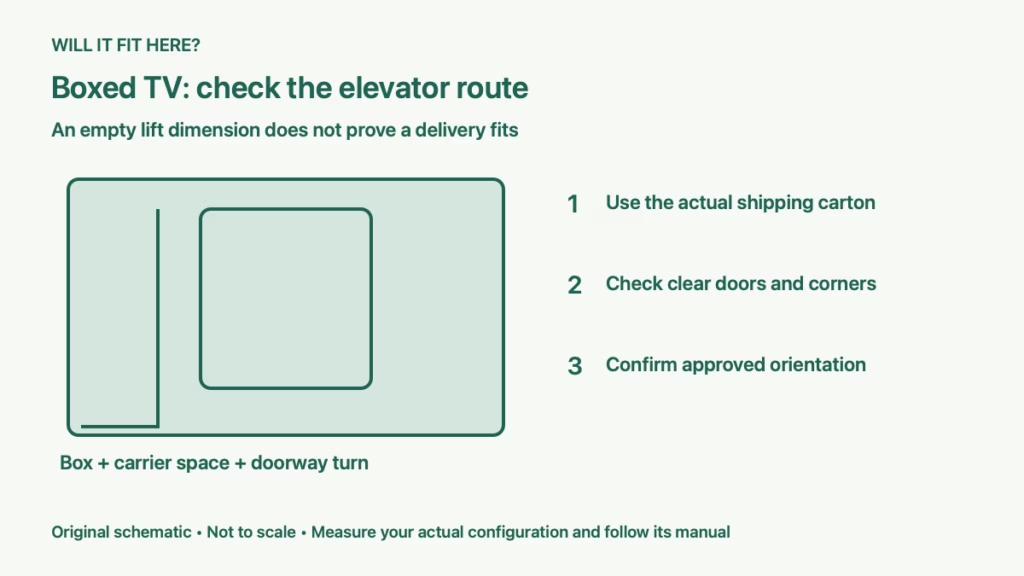
Quick answer: A boxed TV fits an apartment elevator only when its actual shipping carton can pass through the clear entrance, turn into the cabin and remain in the transport orientation specified for that television. Cabin width alone is not enough. Confirm the complete route and the delivery team’s handling plan before ordering.
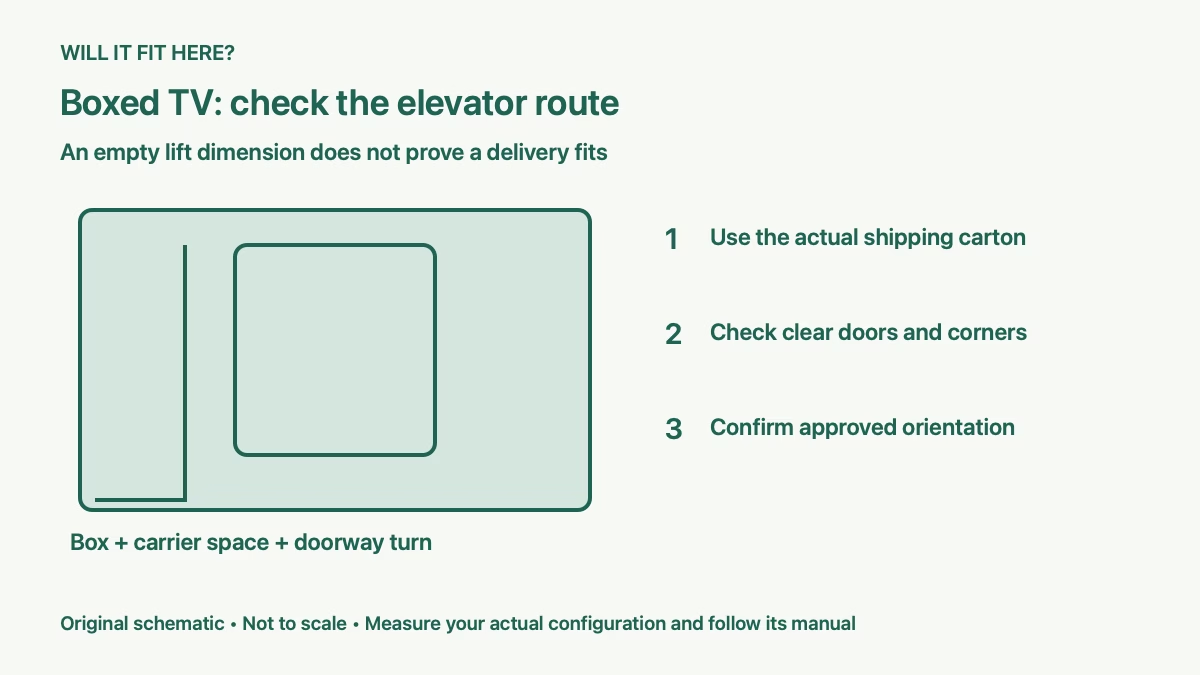
This checklist is for an apartment buyer who can get the television to the building but is uncertain about the final elevator journey. It covers the packed item and the people moving it, rather than whether the unboxed screen will fit its stand.
1. Get the exact boxed TV measurements
Ask the retailer for the shipping-carton width, height and depth for the complete model number and screen size. Product dimensions without a stand are a different measurement. Include external handles, straps or extra shipping protection that will remain in place during delivery.
If you already have the carton, measure its outermost points without squeezing it. Record the labelled orientation and any handling instructions. A box from last year’s similarly named television is not reliable evidence. Use the LG manuals and documents finder or the appropriate manufacturer’s support resource to locate instructions for the actual set.
2. Measure the clear elevator entrance
Measure the opening between the fully open door edges, not the decorative surround. Record usable height under the header and any floor threshold. Ask building management which passenger or service elevator deliveries may use and whether protective padding will reduce its usable opening.
The boxed TV’s depth often matters when its broad face moves through the doorway sideways. But passing the doorway in that orientation does not prove the carton can turn into the cabin. Leave room for the carriers’ hands and approved handling equipment; an exact numerical match with no practical margin is a failed plan.
3. Check the cabin and the turn together
Measure the usable cabin width, depth and height at the narrowest obstructions. Include handrails, control panels, protective blankets and any lower wall projection. Then sketch the entrance position. A door near the corner creates a different turn from one centered on the wall.
Make a lightweight cardboard outline or taped floor template of the carton, without using the actual television as a trial object. Walk the planned route with the delivery team or provide the measurements in advance. Keep the specified carton orientation throughout the mock-up. A diagonal calculation for the empty cabin cannot establish the moving box’s turning path.
Our delivery-route measurement guide explains the same opening-versus-turning distinction for large furniture. For the journey to the building, use the boxed television car-fit checks separately.
4. Follow the boxed TV handling instructions
Do not assume a boxed TV can be laid flat, tipped onto an edge or unpacked in the lobby simply because that changes its dimensions. Follow the model’s instructions, carton arrows and the delivery provider’s approved method. If you cannot find an explicit answer about orientation, obtain it from the manufacturer or retailer.
Unpacking may remove protective packaging needed for carrying, and the screen may need more people and a different grip than the box. Discuss that alternative before delivery rather than improvising at an elevator door. Never use the glass panel as a handle or force the carton against the lift walls.
5. Confirm the route outside the elevator
A boxed TV still has to cross the loading entrance, lobby, elevator landing and apartment door. Measure the tightest corridor turn and the space immediately outside the lift. Record any door that must remain open and obtain permission for a delivery slot or service-elevator reservation.
Send the retailer a short worksheet: carton dimensions, required orientation, clear elevator opening, usable cabin dimensions, landing turn and apartment entrance. Ask the delivery provider to confirm the handling route. If the boxed TV cannot pass, choose a permitted alternative route, different delivery service or smaller model before committing.
Decision: Treat a boxed TV as deliverable only after the carton, turning route, people and building arrangements all work together. Measurements are a planning aid; they do not guarantee delivery when the actual packaging or access conditions differ.