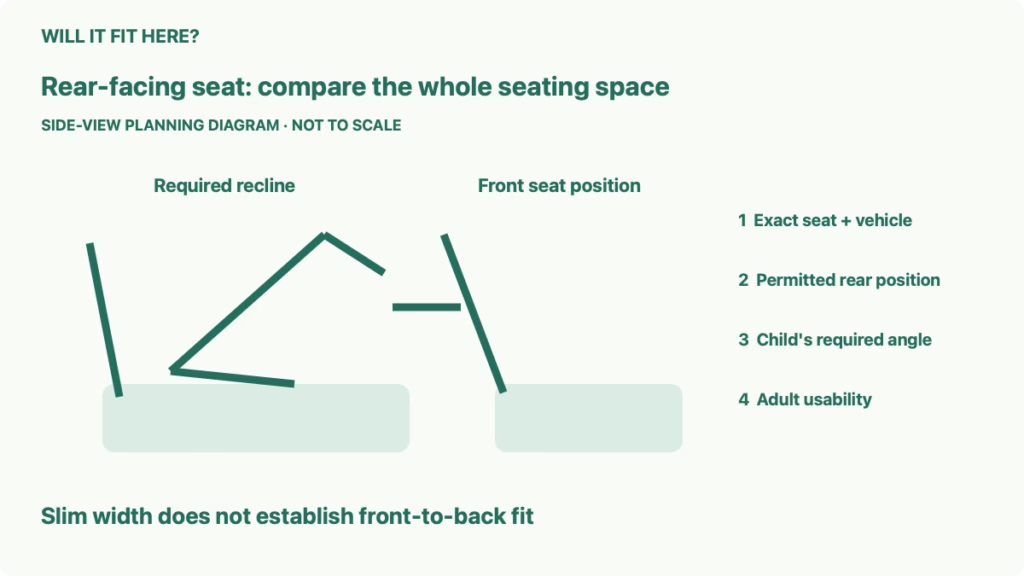
Quick answer: Rear facing car seat fit depends on the permitted rear seating position, the child’s required recline, the vehicle seat shape and the front occupant’s usable space. A narrow seat can still need substantial front-to-back room. Check the exact car seat and vehicle instructions, then arrange a trial fit before purchase when possible.
You have found a slim convertible seat, but the passenger already sits close to the dashboard. The useful purchase question is whether the seat works rear-facing at the required angle while the adult can use the front seat correctly. This guide gives you a planning worksheet for that conversation. It does not replace either manufacturer’s installation instructions or a trained child passenger safety technician.
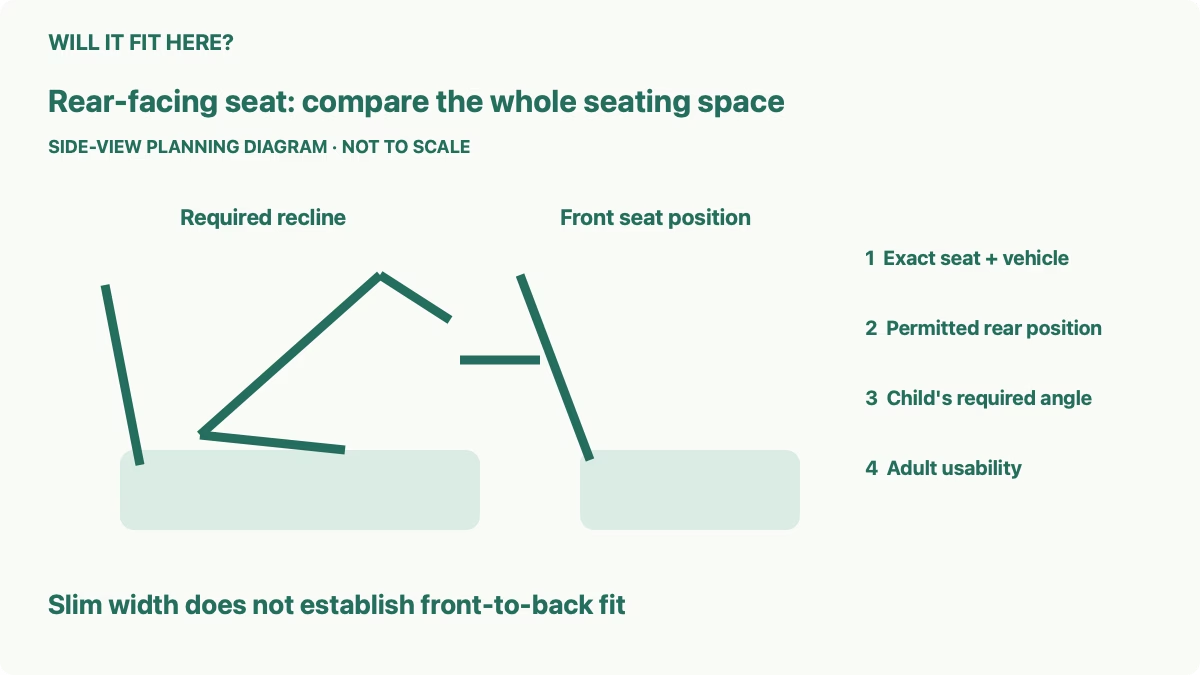
1. Start rear facing car seat fit with the exact models
Record the vehicle’s model year, body style and seating configuration, plus the car seat’s full model name and version. Similar product names can have different parts or instructions. Use the guide supplied with the seat, checking the manufacturer’s current support page for the matching document.
Identify the rear seating positions permitted by both manufacturers before comparing dimensions. A center position is not automatically suitable simply because it looks spacious. Seat shape, approved restraint arrangements and vehicle instructions can rule out an otherwise attractive location.
The Britax Poplar user guide warns against placing a rear-facing child seat in a front seating position with a passenger airbag. It also says some vehicles have no compatible seating positions and advises contacting the vehicle manufacturer when in doubt. Treat compatibility as a requirement, not something that a tape measurement can establish.
Keep the worksheet tied to the intended vehicle and position. A favorable result in another vehicle, or in the same model with different seats, cannot confirm your arrangement. If a retailer offers a trial, agree on the exact seat version and the intended rear location before starting.
2. Separate slim width from front-to-back space
The current Britax Poplar product page describes its Slim17 design as 17 inches wide. That dimension helps frame a side-to-side comparison; it does not tell you how much room remains for a front passenger when the seat is rear-facing. The reclined shell occupies a different envelope from its width.
Seat cushions are sloped and compressible, and front seatbacks are angled rather than vertical. A horizontal gap measured at one height may miss the place where the child seat shell comes closest to the front seat. Photograph the side profile for your own notes without including a child or private information.
Write down the measurement reference points. An empty space between seat cushions is different from room between the reclined shell and the front seatback. Advertised product depth may describe a particular configuration rather than the exact installed outline you need.
Ask the car seat manufacturer which configuration its published dimensions represent. If it cannot provide a dimension for your required angle, mark the fore-aft check as needing a trial fit. Do not invent a clearance from a marketing photograph or use the 17-inch width as a substitute.
| Planning item | Question to resolve |
|---|---|
| Approved rear position | Do both manuals permit the intended seating location? |
| Side-to-side width | Does the seat conflict with adjacent seats or required access? |
| Required rear-facing angle | Which permitted recline applies to this child and seat? |
| Front occupant position | Can the adult sit and use the vehicle as its manual requires? |
| Front seat interaction | What do both manufacturers say about contact and clearance? |
3. Compare space at the required recline
A rear-facing seat’s recline is a safety condition, not an adjustment to trade away for legroom. Determine the applicable condition from the exact seat guide and the child’s needs. Leave that decision to the instructions and qualified advice rather than choosing the most upright-looking position for a smaller footprint.
In the Poplar guide checked for this article, the rear-facing recline indicator must remain entirely in its blue section. The guide also requires level ground for assessing the indicator and says the base must be flat on and parallel to the vehicle seat. Those are model-specific conditions, not a universal angle for other seats.
The same guide recommends its most reclined position for a child without head and neck control. That is why a fit demonstrated with a more upright configuration may fail to answer the purchase question for a younger child. Ask for the trial to reflect the configuration actually needed.
Do not add a cushion, spacer, aftermarket accessory or improvised support to make a fit work. Follow the matching guide and ask the manufacturer or technician about unresolved conditions. This planning article deliberately does not describe installation adjustments.
4. Preserve the front occupant’s proper seating space
Set out who normally occupies the front seat: the driver, a frequent passenger or several adults of different heights. Their proper seat position matters. A seat that fits only when an adult adopts an unsuitable position has not solved the family’s space problem.
Review the vehicle manual’s seating, restraint and airbag instructions. Record the adult’s normal usable position, seatback setting and access needs for the trial. Avoid turning a generic knee-room preference into a universal safety distance; the relevant requirements come from the vehicle manufacturer.
Do not assume front seat contact is permitted or prohibited for every combination. Resolve that question using both manuals and the manufacturers, particularly where vehicle sensors or restraint instructions are involved. An empty-looking gap cannot approve an otherwise incompatible arrangement.
If the passenger needs to slide the seat regularly, assess the permitted positions they will actually use. A single static trial with the seat unusually far forward is incomplete. Keep all trial work stationary, and seek qualified help before carrying a child in an uncertain installation.
5. Turn the trial into a purchase decision
Bring the relevant manuals and your worksheet to a retailer or child passenger safety technician who can assess the exact arrangement. Ask about the rear-facing configuration, permitted seating position, front seat interaction and adult usability. A demonstration on a shop bench cannot answer all of those vehicle-specific questions.
Document which model and vehicle position were checked, which manual versions were used and which questions remain. Distinguish a preliminary geometry check from a completed installation inspection. Passing one does not automatically establish the other.
If the arrangement fails, compare another permitted rear location or a different appropriate seat with qualified guidance. Do not turn the child forward-facing merely to create more room. The decision must continue to follow the child’s applicable limits and the restraint instructions.
Before ordering, confirm the retailer’s trial and return conditions. Packaging dimensions and an online compatibility comment are weak substitutes for assessing your actual vehicle. Proceed when the required configuration works and both manufacturers’ conditions have been resolved.
Common questions
Does a 17-inch-wide seat save front legroom? Width describes side-to-side size. Required recline and the installed shell shape determine the different front-to-back question.
Can I use a fixed one-inch gap? This article does not prescribe a universal front seat gap. Follow the exact car seat and vehicle requirements.
Is an online fit report enough? It can suggest a model to investigate, but cannot verify your vehicle, seating position, child or configuration.
For other vehicle-space planning, see SUV liftgate clearance and roof basket fit checks.
Official sources and limits
Checked October 7, 2026: Britax Poplar product information and the linked Poplar user guide, P15154500 A-1, especially printed pages 8 and 17. Confirm your exact version and vehicle manual. No firsthand fit test, universal clearance or approval of an installation is claimed.