Quick answer: A slim smart plug may leave an adjacent socket visible yet still conflict with the next plug’s moulded body, cable or a surrounding cover. Compare the actual two-plug arrangement and the supporting outlet, not the smart plug alone.
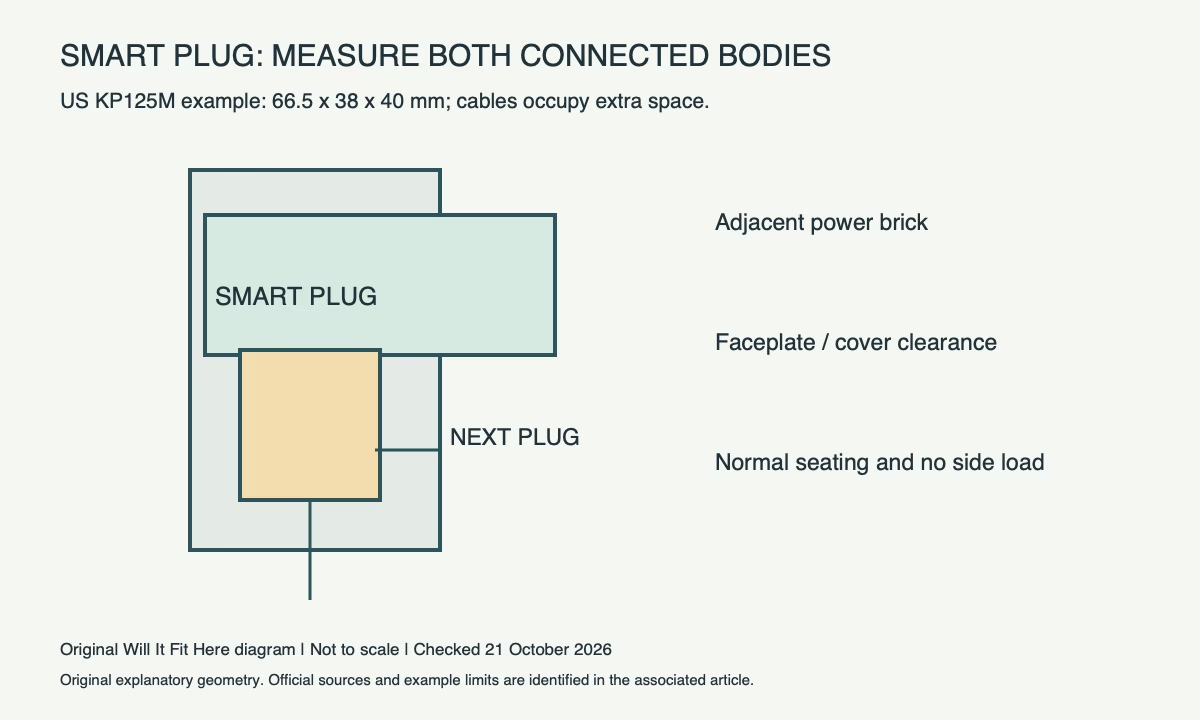
Use the exact regional model
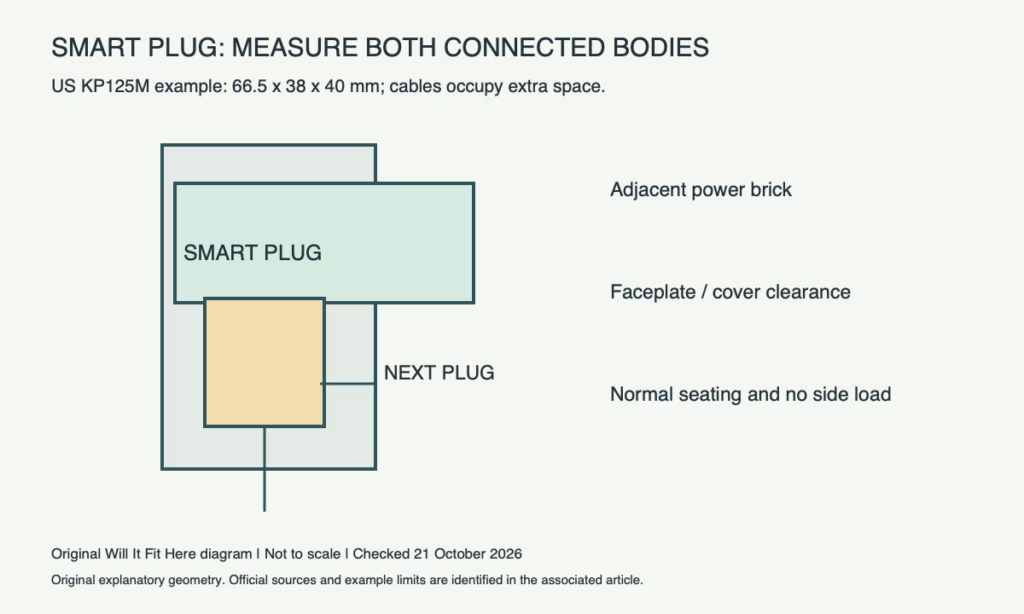
TP-Link’s US KP125M specification lists 2.6 × 1.5 × 1.6 in, with metric figures of 66.5 × 38 × 40 mm. The values are rounded and should be read in the orientation shown by the manufacturer. They do not describe every regional Kasa plug or the complete connected cable envelope.
The US model’s cited rating is 100–120 V, 50/60 Hz, with load-specific limits. A shape match is not electrical compatibility, and a general resistive-load rating is not permission to connect every appliance. Follow the plug and appliance instructions.
Measure both plug bodies together
Record the smart plug’s installed outline and projection, then measure the neighbouring plug’s moulding and strain relief. Check the faceplate, any recess or outdoor cover, and the cable’s natural exit direction. A transformer block can occupy the free socket’s space even when the smart plug is marketed as compact.
| Hypothetical same-axis check | Value |
|---|---|
| Clear vertical space beside the installed smart plug | 35 mm |
| Neighbouring plug body needing that space | 40 mm |
| Conflict | 5 mm before cable movement |
The 35 and 40 mm arrangement is illustrative, not the spacing of a standard outlet or the KP125M’s installed clearance. Measure the actual socket and both accessories. Rotating a plug is only an option if the outlet, grounding, equipment and instructions permit it.
Check access and support
Make sure the button remains accessible, each plug seats normally and the outlet is not loose or damaged. Include the appliance cord’s approach without pulling sideways on the smart plug. Behind furniture, measure from the wall to the full connected assembly rather than to the smart plug’s casing alone.
Do not stack improvised adapters, force a plug against a faceplate or treat a cover that barely closes as proof of suitability. Use the product only in its approved environment and obtain qualified help for a damaged outlet or an uncertain electrical application.
Before you decide
- Exact US KP125M or other actual regional model identified.
- Both moulded plug bodies and cables included.
- Each plug seats normally without side loading.
- Ratings, appliance instructions, environment and button access remain suitable.
Common questions
Does “does not block the adjacent socket” fit every power brick? No. The neighbouring plug’s body and cable can still conflict.
Can I use the US measurements for an Australian Kasa plug? No. Confirm the regional model’s dimensions, pin arrangement and electrical requirements.
Official sources and scope
Checked October 21, 2026: TP-Link US KP125M product information, TP-Link KP125M official specification. Confirm the exact product, route or current policy before acting. No firsthand fit test is claimed.
Related guide: Standing Desk Cable Slack: 5 Useful Setup Checks. This addresses a separate fit check; its measurements do not transfer to the products above.