Quick answer
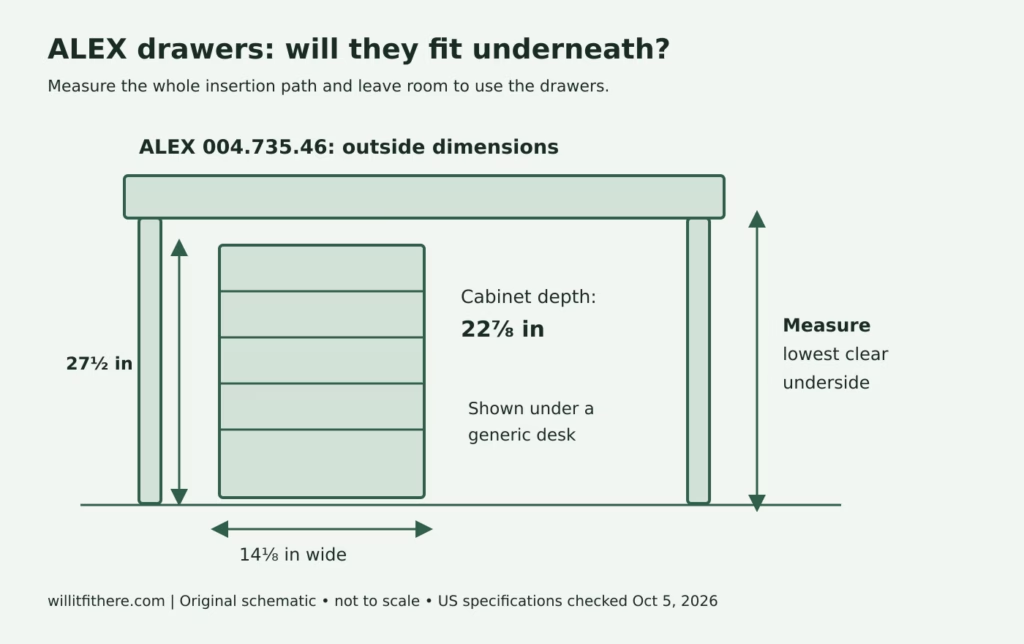
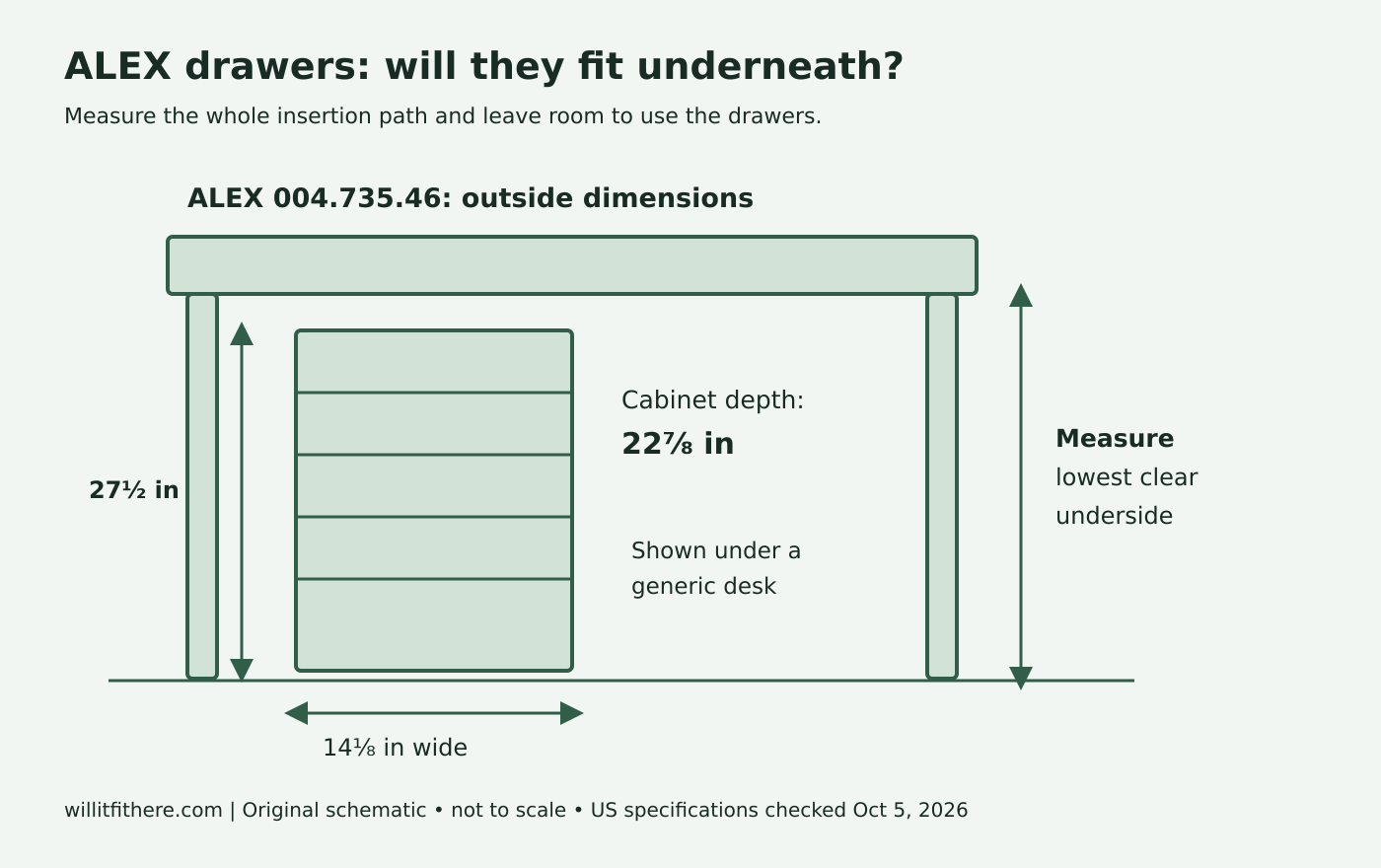
The white ALEX drawer unit 004.735.46 measures 14⅛ inches wide, 22⅞ inches deep and 27½ inches high. It can fit beneath a desk only when the unobstructed space is larger along the entire insertion path and in the final position. Measure to the lowest apron, drawer housing or frame member, not to the desktop’s top surface.
Which ALEX drawer unit are you buying?
This guide concerns the five-drawer white ALEX cabinet, article 004.735.46. Check the article number if your unit has a different drawer arrangement, finish, base or accessories. A family name is not enough to establish cabinet dimensions.
There are also complete ALEX desks with built-in drawers. They are different products. Wanting an ALEX cabinet under an ALEX desk does not imply that the two were designed to nest. In particular, the compact ALEX desk used later in this guide is too low underneath for this cabinet.
Decide whether the drawer unit will simply stand under an existing desk or become part of a supported tabletop combination. This article checks the first situation. It is not a structural approval for using the cabinet to support an arbitrary desktop.
Use the cabinet’s outside dimensions
| Measurement | ALEX 004.735.46 | Compare against |
|---|---|---|
| Width | 14⅛ in | Narrowest clear gap between legs and other obstructions |
| Depth | 22⅞ in | Usable front-to-back space, with rear projections included |
| Height | 27½ in | Lowest clear underside along the entire route |
Metric reference: the listed drawer-unit dimensions convert to approximately 35.9 cm wide × 58.1 cm deep × 69.9 cm high. The compact ALEX desk’s 24⅜-inch underside height converts to approximately 61.9 cm. Values are approximate conversions of the cited US inch measurements, not separate regional product specifications.
These are the assembled outside dimensions listed by IKEA US. The drawer’s internal storage depth answers a different question and should not be substituted for the cabinet depth. Nor should the box measurements from the packaging section be used for desk planning.
Write the three values next to your room measurements in the same order: width, depth, height. Many shop listings change the order, which makes an otherwise accurate number easy to compare with the wrong axis.
Measure your desk in six places
- Measure from the floor to the underside at the front opening, including the apron or built-in drawers.
- Repeat at the middle and back, where crossbars and cable trays can be lower.
- Measure the clear width at the floor and near the cabinet top. Splayed legs can make these two widths different.
- Measure from your chosen cabinet-front line to the rear obstruction. Include wall trim and cable plugs that project into that space.
- Check the path for sliding the cabinet into place. An opening at the front can be tighter than the final cavity.
- Mark the cabinet footprint and sit at the desk. Check your knees, feet and chair movement with the cabinet taking up that space.
Use the finished floor or rug that the cabinet will actually stand on. Compare surfaces consistently: a cabinet on a rug and desk feet on a hard floor do not share the same height reference. Do not assume carpet compression provides dependable clearance.
Worked example: two desks with very different results
For a hypothetical desk with 28¼ inches of clear underside height, the vertical difference is 28¼ − 27½ = ¾ inch. If its clear side bay is 16 inches wide, the width difference is 16 − 14⅛ = 1⅞ inches. With 24 inches of usable depth, the depth difference is 24 − 22⅞ = 1⅛ inches. All three static comparisons are positive.
Those are example measurements, not a recommendation for a particular desk. You still need to check the entry path, floor, cables and opening drawers. The remaining fractions are total spare space on each axis, not an allowance on both sides.
Now compare the actual 39⅜-inch ALEX desk, 104.735.55. IKEA lists only 24⅜ inches under the furniture. The cabinet is 27½ − 24⅜ = 3⅛ inches taller than that clearance. It does not fit beneath the stated underside, regardless of the desk’s nearly 30-inch overall height.
Check drawers, chair space and cables
A cabinet that parks neatly under a tabletop can still be awkward to use. Sketch where the drawer front travels, then add space for your body to stand or sit while reaching inside. Measure an assembled display unit if the listed specifications do not give drawer travel; internal drawer depth is not the same measurement.
Check the closest desk leg against an open drawer’s corners. Also check the chair base: casters can hit the cabinet before your knees feel cramped. If the desk has two possible side bays, try both arrangements with a cardboard footprint before deciding.
Leave cable routing accessible rather than trapping plugs between the cabinet and a rear panel. No universal rear gap is supplied here; use the actual connector and cable bend, and follow the equipment maker’s instructions. A ruler-width gap may be enough for a bare wire but not for its plug.
Avoid these under-desk fit mistakes
- Using the desk’s overall height instead of its lowest underside height.
- Counting a diagonal insertion maneuver as proof of usable final clearance.
- Assuming a removable-looking brace can be removed without affecting the desk.
- Adding feet or casters without rechecking the resulting outside height.
- Pushing the cabinet back far enough that the desk overhang makes the top drawer difficult to reach.
- Treating a close numerical match as a tolerance guarantee.
Do not cut, remove or relocate structural parts to turn a failed clearance check into a pass. If you want the drawer unit to support the worktop, choose a manufacturer-supported combination and follow its assembly directions. Space under a desk and support for a desk are separate questions.
Before-buy checklist
- Confirm article 004.735.46 or record the dimensions of your actual variant.
- Measure the lowest underside at the front, center and back.
- Verify leg spacing at more than one height.
- Check 22⅞ inches of cabinet depth against the actual rear obstruction.
- Test drawer access and the chair footprint.
- Account for the real floor surface and any approved accessories.
- Use a supported assembly configuration if the cabinet will carry a tabletop.
If a measurement is close enough that a small floor or frame variation would change the result, check the exact assembled products before buying. An arithmetic pass is a useful screening result, not a guarantee that two independent pieces of furniture will nest.
Sources and measurement notes
Product information checked October 5, 2026. These are US-market articles; use the number on your own product or order when checking another finish, size or production version.
- IKEA US ALEX drawer unit, 004.735.46 — 14⅛-inch width, 22⅞-inch depth and 27½-inch height.
- IKEA US ALEX desk, 104.735.55 — 24⅜-inch height under furniture for the compact desk example.
The room examples and subtraction checks are planning calculations, not hands-on product tests or manufacturer fit guarantees.
Planning several pieces in one room? Compare this static cabinet check with the moving footprint in our FRIHETEN open-bed clearance guide.