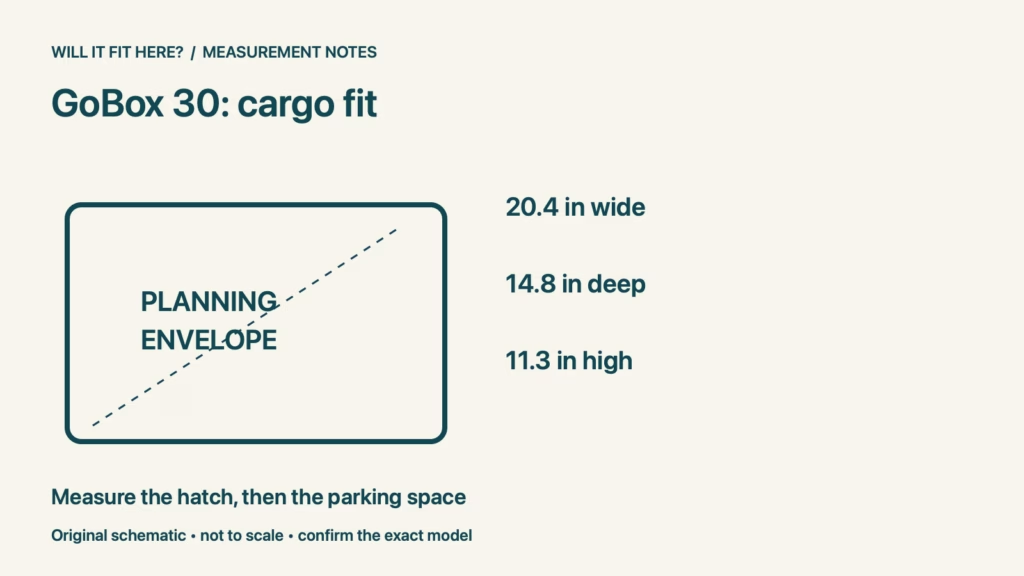
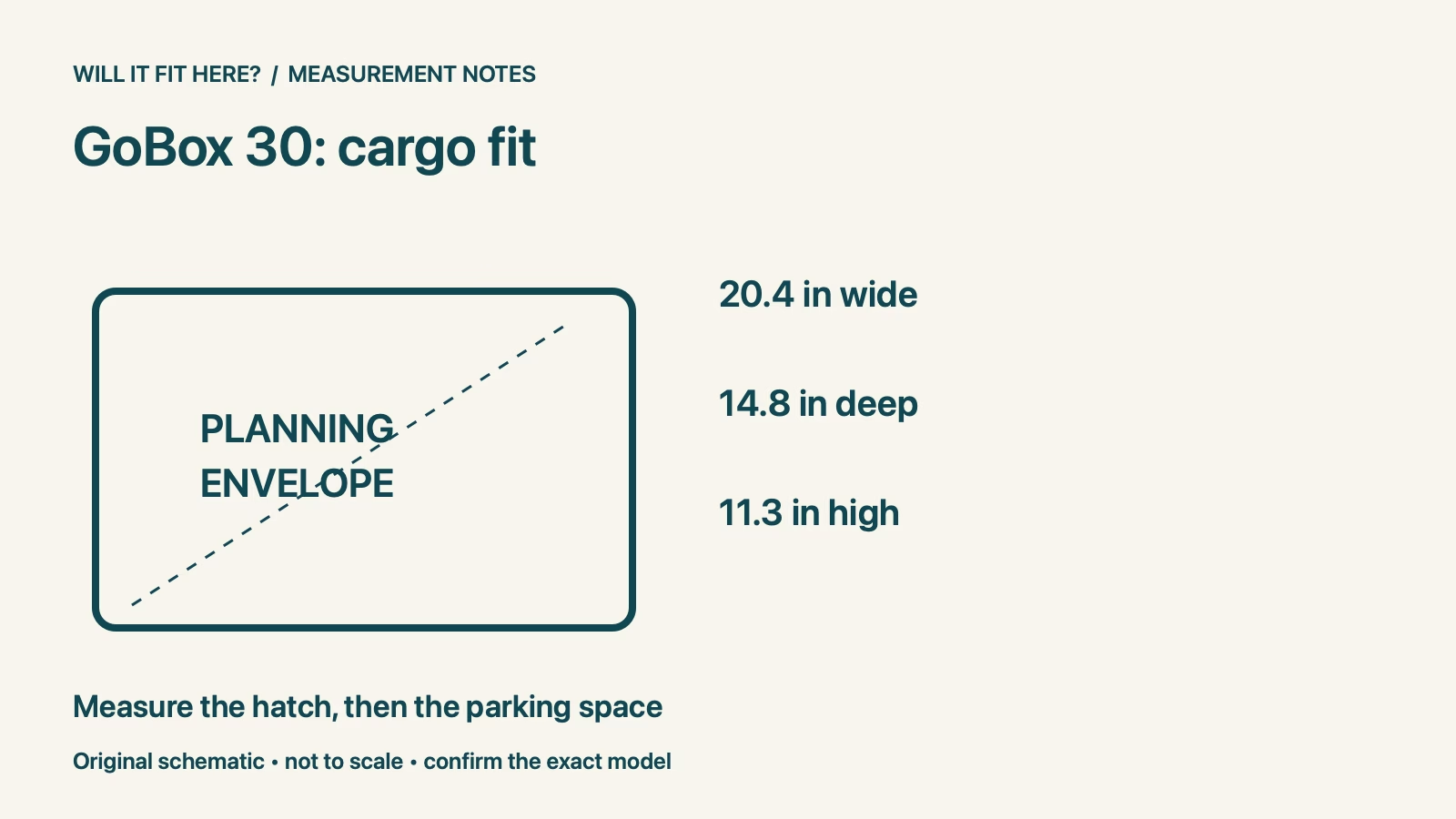
Fit verdict: GoBox 30 fit in a vehicle starts with its external dimensions: YETI lists 20.4 × 14.8 × 11.3 inches, in width × depth × height order. A cargo bay larger than that can still fail at the hatch opening, a sloping seatback or the lid-opening step. Compare the exact case with the route into the vehicle and its secured travelling position.
Dimensions and conditions
| Check | Reference | Planning consequence |
|---|---|---|
| Case exterior | 20.4 × 14.8 × 11.3 in | Use for the closed loading envelope |
| Reference product | LoadOut GoBox 30 | Do not substitute another capacity or version |
| Function | Gear case, not a cooler | Storage purpose does not define vehicle fit |
1. Start the GoBox 30 fit check at the opening
Measure the clear opening with the hatch fully raised and the cargo floor in its normal position. Do not take a single width reading at the widest point and stop. A rounded corner or latch housing can make the usable rectangle much smaller. Make a lightweight cardboard outline of the case end you intend to pass through first. Move it along the actual approach while keeping the other dimension in mind; a flat template checks only one slice of a three-dimensional loading path.
2. Measure the final position at case height
A measurement across the carpet can overstate the room available higher up. Seatbacks lean, wheel-arch trim curves and the hatch glass may move inward as the door closes. Mark the intended footprint on the floor with removable tape, then check the surrounding space at the top of the case. Include a protective mat if you use one. Close the hatch gently with an empty trial object first, without relying on powered closing to push cargo into place.
3. Decide whether the lid must open inside
There are two different useful outcomes: the closed case travels securely, or the case can be opened and its contents reached without unloading it. Decide which one you need. A shelf above the case, another bag on top or a nearby seatback can prevent the second outcome even when the first is easy. The closed height is not an open-lid requirement. Check the real hinge movement and the hand space needed to release the latches before treating the location as a working storage station.
4. Plan restraint and lifting before filling it
A neat fit between two other bags is not a cargo restraint plan. Use the vehicle and case instructions to choose an appropriate way to secure the load; do not assume a convenient handle is a rated tie-down point. Keep access to vehicle equipment that you may need during the trip. Practise lifting the empty case over the sill, then consider the weight of the intended contents. A case that needs an awkward twist to load may be inconvenient when full, even though the dimensions pass.
GoBox 30 fit: a worked fit example
Suppose an unobstructed cargo space measures 22 inches wide, 16 inches deep and 13 inches high. Subtracting the published closed dimensions leaves 1.6, 1.2 and 1.7 inches respectively. Those are total geometric differences, not per-side allowances or a guarantee of practical fit. If centred, the width difference becomes only 0.8 inch per side. Repeat the comparison at the opening and along the loading path, and separately test the lid and restraint arrangement.
Before you decide: 5 checks
- Confirm the exact GoBox 30 version.
- Compare all three external dimensions.
- Check the opening and hatch slope.
- Test latch and lid access.
- Plan secure transport and a manageable lift.
FAQ
Does a 30-litre cargo volume prove GoBox 30 fit?
No. Volume does not describe the shape of the opening or the usable rectangular space.
Can I use the closed height as the lid-opening height?
No. Measure the lid movement in the intended position or plan to unload the case before opening it.
Is this the same as fitting a YETI cooler?
No. YETI identifies this product as a gear case, and another product has its own exterior dimensions.
Related fit guides
Sources
Sources checked 4 November 2026. Specifications apply to the named version and market. Example spaces and calculations are illustrative planning guidance, not manufacturer clearance requirements. Recheck the exact model or current operator policy before buying, installing or travelling.