Result — Conditional. Compare the current Tundra 45’s exterior, not its interior capacity, with both the trunk opening and the space needed to lower it inside. You also need room to hold, secure and open it in the intended location.
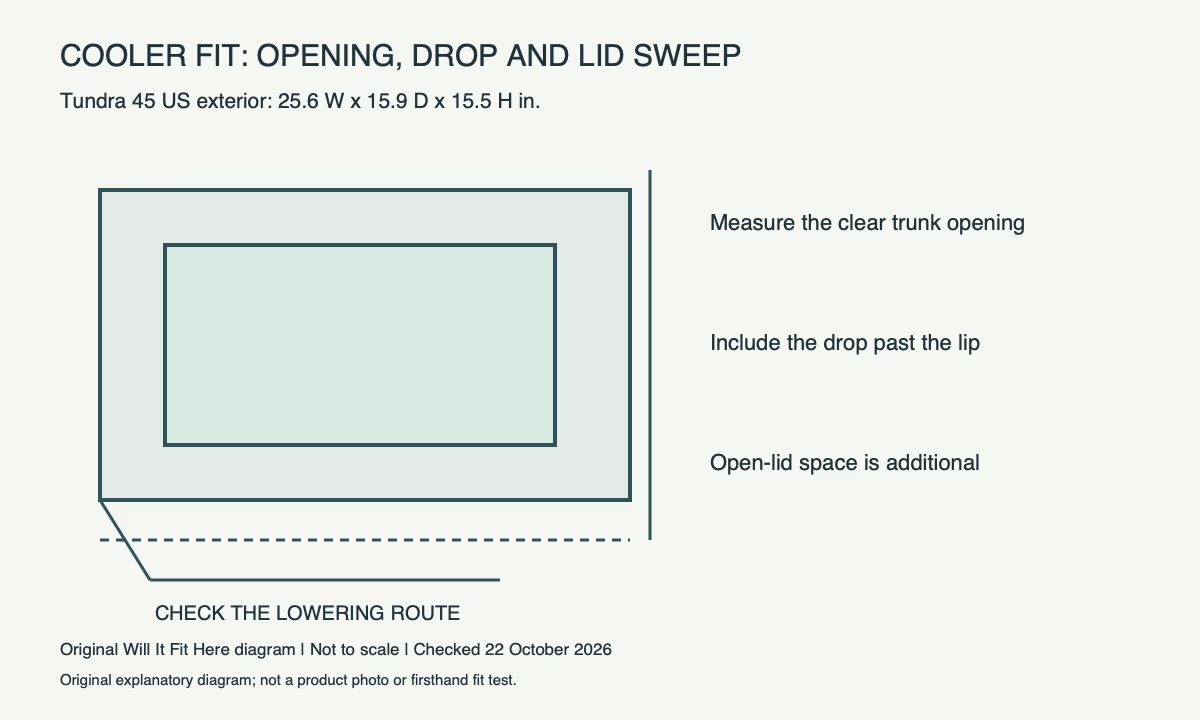
Dimensions: the number 45 is not a trunk measurement
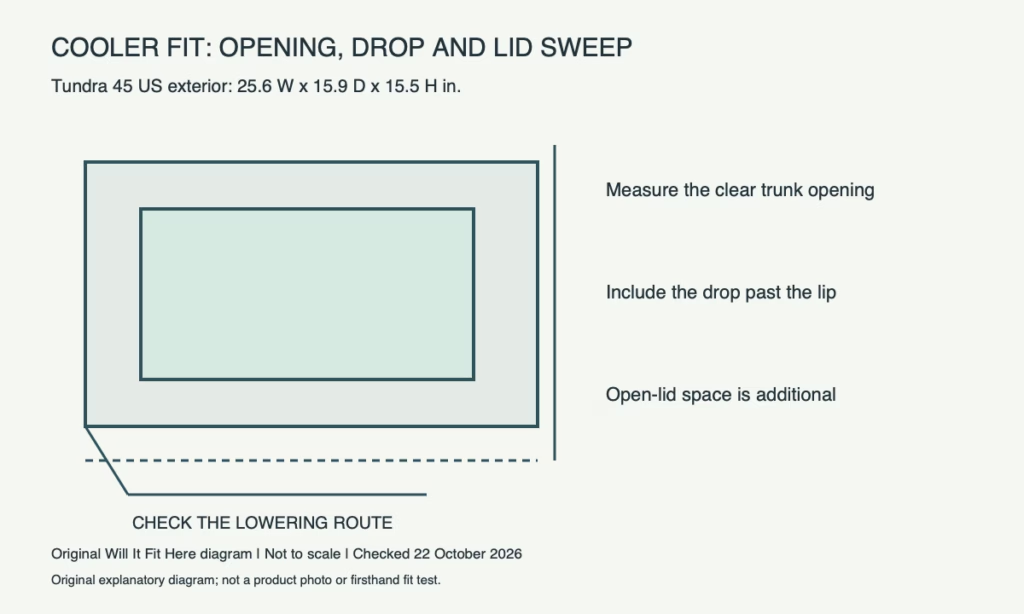
YETI’s current US Tundra 45 page lists an exterior width of 25.6 inches, depth of 15.9 inches and height of 15.5 inches, or 65.0 × 40.4 × 39.4 cm. Its interior is smaller: 18.3 × 9.4 × 10.7 inches. Use the exterior for vehicle access. The cited empty product weight is 24.60 lb; ice and contents add to the load you must handle and restrain.
Measure a route through the trunk lip
Measure the opening’s clear width and height with the lid held in its normal fully open position. Look for trim, weather seals, the latch and hinge arms. Then measure the cavity behind the opening: distance to the rear seat, height under the parcel shelf and floor width between wheel housings. A large cargo-volume figure cannot describe this route.
| Checkpoint | What to compare |
|---|---|
| Clear trunk opening | Cooler exterior in a permitted carrying orientation |
| Drop behind the lip | Room to lower the box without catching its bottom edge |
| Floor position | Full support for the base and room for restraint |
| Handles and latches | Space for hands and normal operation |
| Lid sweep | Actual opened-lid envelope, measured separately |
A useful calculation without a false promise
Suppose a hypothetical opening is 26.0 inches wide at the height where the cooler must pass. Against the listed 25.6 inch width, that leaves 0.4 inches total, or about 10.2 mm. Centred evenly, that is only 0.2 inches per side. It does not include your hands, trim flexibility, measurement uncertainty or a turning movement. Treat it as a close match that needs a physical mock-up, not a recommended clearance.
Make a cardboard envelope using the outside dimensions, mark its orientation, and test the approach gently. If it passes only when severely tilted, consider what happens with a loaded cooler and whether the manufacturer’s handling guidance allows that movement. Do not use the vehicle’s painted lip as a lifting pivot.
Decide where you will use the cooler
A cooler that can be transported closed may need to come out for access. Measure the open lid on the actual product if you want to use it in place; the closed height does not supply a lid-sweep number. Leave the latches and drain accessible as needed. Check the vehicle’s permitted cargo securement and load limits, using the cooler’s designated tie-down provisions and compatible restraint instructions.
Repeat the test with any protective mat, slide or basket that will remain underneath or around it. Those additions can raise the box into a narrower part of the trunk and change the answer even though the floor area is unchanged.
Before you decide
- Use current US exterior dimensions and identify accessories.
- Measure the clear opening and the lowering route behind the lip.
- Check hand access, support and securement for the loaded cooler.
- Measure actual lid sweep if access inside the trunk is required.
FAQ
Does a 26-inch opening guarantee this 25.6-inch cooler fits?
No. Height, approach angle, hand space and the route behind the opening must also work.
Can I use the 18.3-inch interior width for planning?
No. That is storage space inside the cooler; the trunk must admit the exterior.
Official sources and scope
Specifications and guidance checked on 22 October 2026. The named model and region control; follow the matching current instructions for your product. Worked examples are identified as hypothetical.