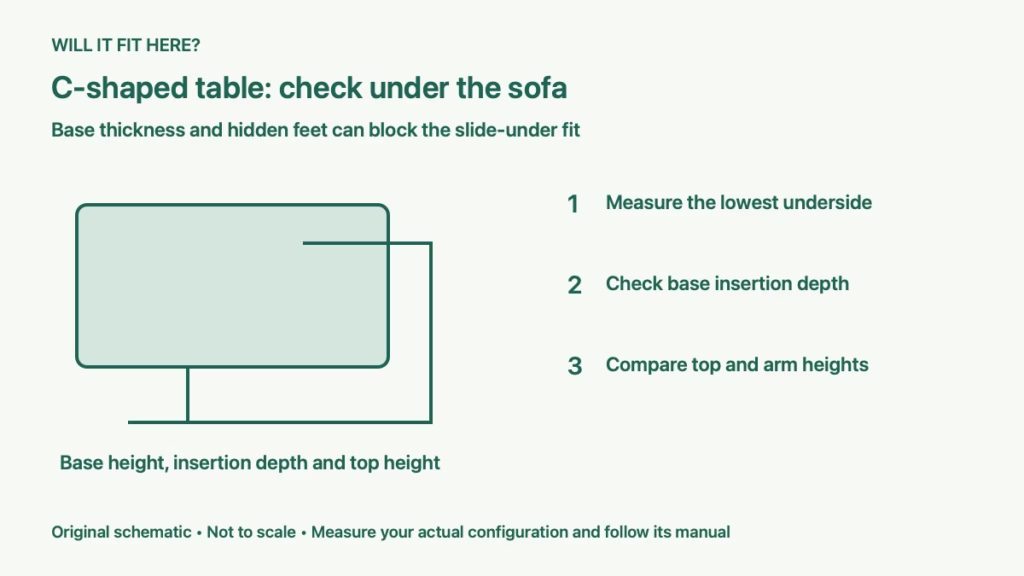
Quick answer: C-shaped side table fit depends on the sofa’s lowest underside clearance, the table’s complete base thickness and insertion depth, and the clearance below its tabletop. Overall height alone cannot tell you whether a table will slide under an arm. Measure the exact table and sofa, then test a rigid mockup before buying.
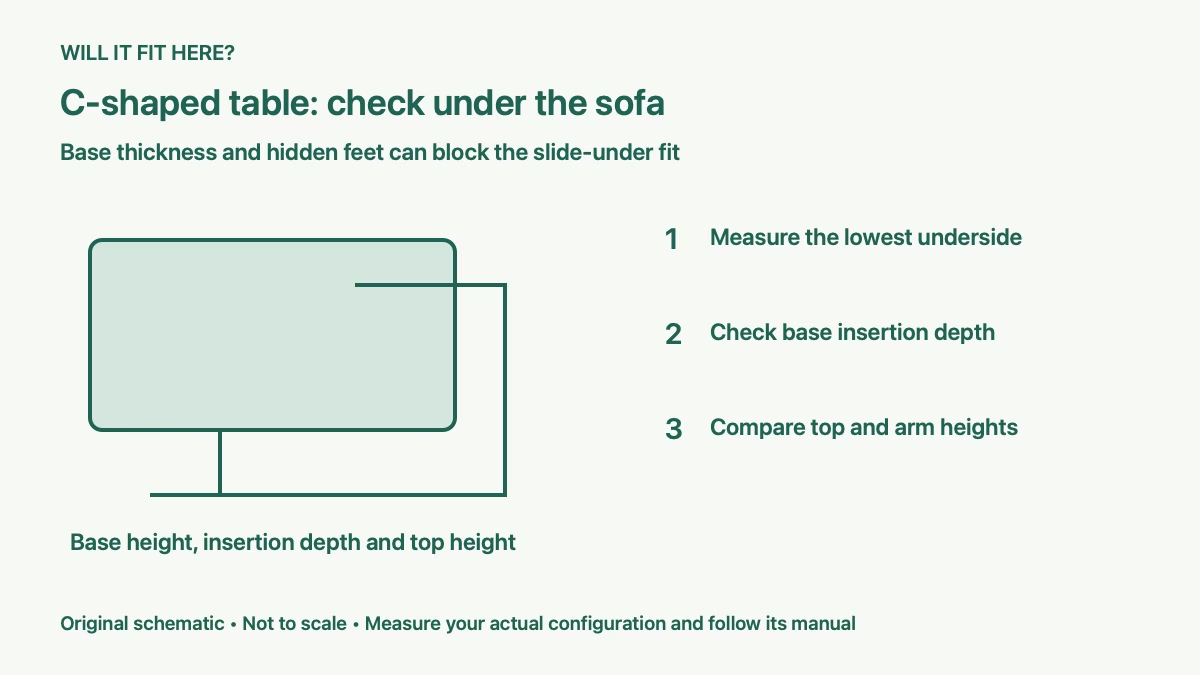
Open full-size diagram in a new tab
This guide is for someone who wants a drink or laptop surface close to a sofa without filling the walkway. A C-shaped frame can solve that problem only if its bottom and top both clear the furniture in the intended position.
1. Measure C-shaped side table fit at the lowest underside
Measure from the supporting floor or rug to the sofa’s lowest obstruction along the entire proposed insertion route. The visible front gap may hide a center support, wooden rail, recliner mechanism or hanging fabric farther back. Look underneath without tipping heavy furniture unsafely.
Repeat with the sofa occupied. A soft rug can let feet sink, and a loose bottom cover may hang lower than the structural frame. Use the smallest usable clearance, rather than the leg height printed in a sofa listing.
For a reclining sofa, follow its manual and keep furniture away from the moving mechanism and cords. Our recliner clearance guide covers the larger operating envelope. A slide-under table must not obstruct movement at any permitted position.
2. Ask for base thickness and insertion depth
Compare the underside measurement with the table base’s highest point, including glides, feet, adjustment screws and any raised brace. A thin-looking metal plate can sit on pads that add height. Ask the retailer for a measured base profile if the technical drawing omits it.
C-shaped side table fit also needs enough open depth under the sofa for the base to reach its intended position. Measure the base footprint and the distance from its leading edge to the vertical support. A hidden sofa foot can stop insertion long before the tabletop reaches your seat.
For example, Scandinavian Designs lists the Leende C-Table at 20 inches wide, 12 inches deep and 24 inches high. Those overall dimensions help plan the room footprint, but the listed dimensions do not establish the base thickness or clear height beneath the top. Confirm the missing measurements for the exact item.
3. Compare tabletop underside with the sofa arm
If the top must pass over an arm, compare the arm’s highest occupied position with the clear height under the tabletop. Subtracting nothing from overall height overestimates that clearance: the tabletop, fasteners or an apron may occupy part of it.
As a hypothetical example, a table that stands 25 inches tall with a 1-inch-thick top has at most 24 inches below the top before accounting for other hardware. It will not clear a 24½-inch arm simply because its advertised overall height is greater. Measure actual parts and allow enough free space to move without rubbing upholstery.
If the table approaches over the seat rather than the arm, repeat the check against the cushion and your legs. Choose the approach first; the same table can fit at the front of one sofa but fail at its side.
4. Test reach and stability in the intended position
Make a floor template for the base and a separate height template for the top. Position them where you actually sit, then check knee room, comfortable reach and the route used to stand up. Do not place a heavy laptop on an unstable cardboard model; test reach with a safe temporary surface.
Check that the vertical support clears the sofa edge and that the base remains supported on a suitable flat surface. A rug edge can leave one part rocking. Follow assembly and load instructions for the table; do not use it as a seat, step or support when standing.
C-shaped side table fit is useful only if it stays usable during ordinary movement. Include another person sitting beside you, a charging cable and the place you will move the table when cleaning.
5. Compare alternatives when one clearance fails
If a sofa rail blocks the base, choose a beside-sofa table instead of forcing it underneath. If the top cannot clear the arm, a front approach may work only when it preserves leg room and the walking route. Avoid altering sofa legs or removing structural parts just to accommodate a table.
For a larger central surface, use our coffee table fit checks. For a sectional, our chaise orientation guide helps identify the actual route that must remain open.
Decision: C-shaped side table fit passes when the full base slides into a clear, supported space, the tabletop clears the chosen approach, and seated reach and standing movement remain comfortable. Record the missing product dimensions before ordering.