Quick answer: A child car seat can be suitable for an aircraft only when its aircraft approval, the child’s size, the restraint’s installation instructions and the particular airline seat all agree. A narrow base or an airline’s advertised seat width cannot establish that by itself. Confirm the restraint model and aircraft arrangement with the operating airline before travel.
Start with the approval label
For US air travel, the FAA says a child restraint system must be certified for aircraft use and directs families to check the label and manufacturer’s manual. Approval for use in a car alone does not supply aircraft approval. Check the exact mode you intend to use, including the child’s permitted size and the direction required by the restraint instructions.
Keep the model name, manual and approval-label information accessible. For a foreign carrier or a connection outside the US, ask that operator about its accepted approvals and seating rules. Do not infer acceptance from another family’s experience on a different airline.
Compare the whole shell with the usable seat
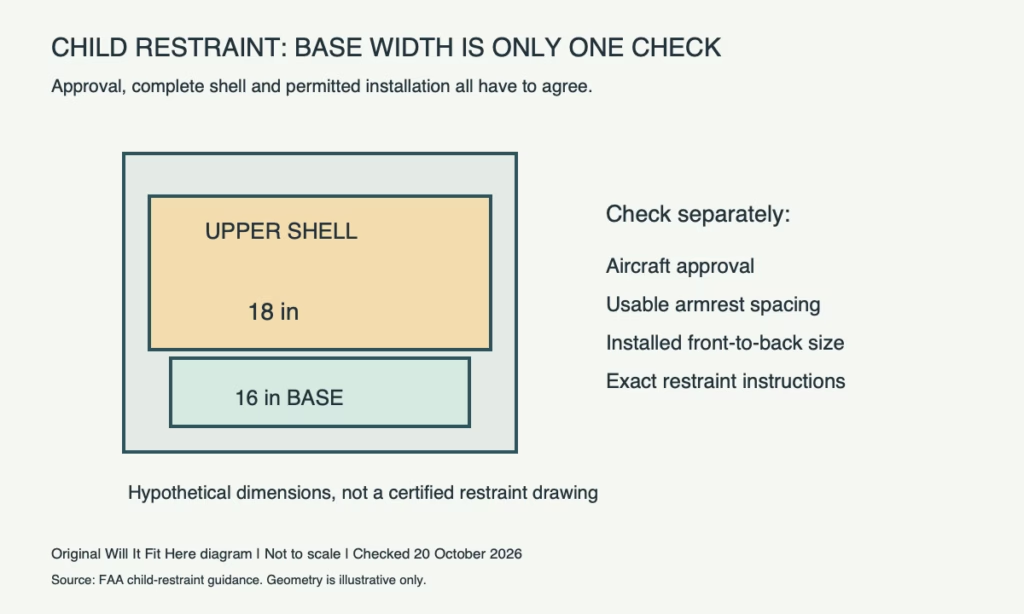
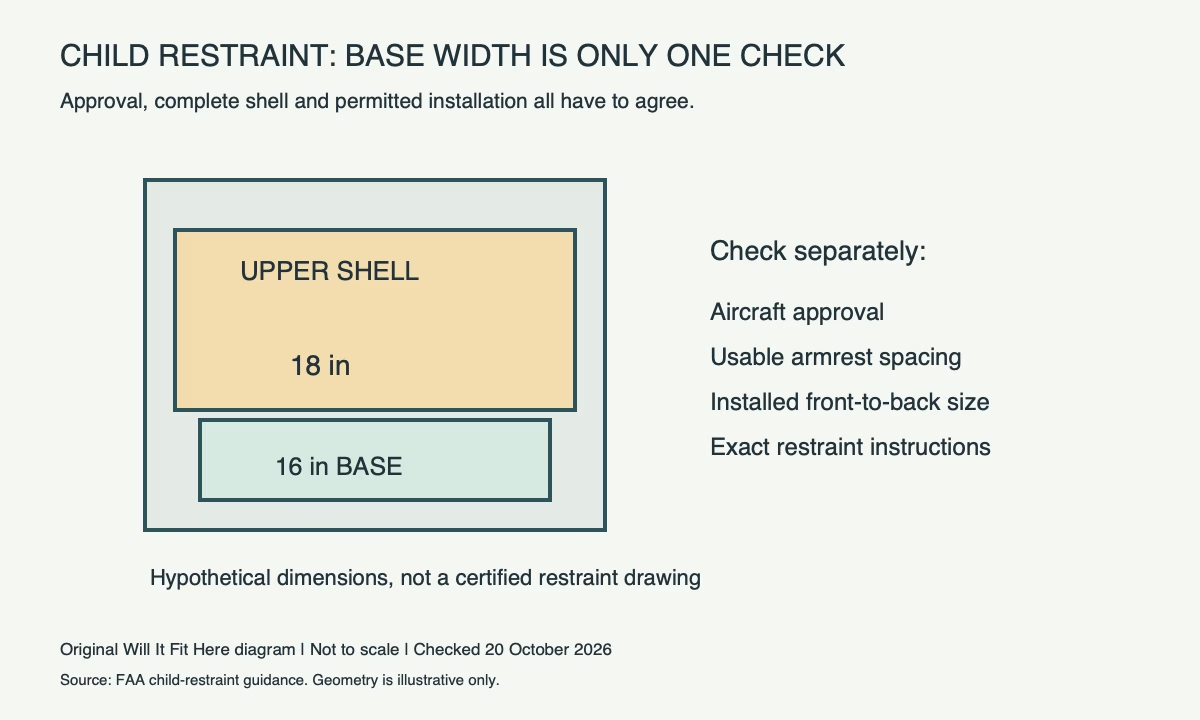
Measure the restraint’s base width and its widest fixed shell separately. Record cup holders or accessories as instructed by its manufacturer; remove them only if the instructions permit it. A narrow base can support a substantially wider upper shell.
As a hypothetical comparison, a 16 in base is 40.64 cm wide, while an 18 in upper shell is 45.72 cm. An advertised 17 in seat width equals 43.18 cm. These three figures cannot establish an approved installation because they describe different heights and may use different armrest reference points.
Ask the airline about the actual aircraft, cabin and seat position, fixed versus movable armrests, and any location restrictions. Aircraft substitutions can change those details. Do not use seat pitch as a substitute for front-to-back restraint clearance.
A preflight fit checklist
- Exact restraint model and aircraft-use approval confirmed.
- Child within the manufacturer’s limits for the intended mode.
- Aircraft installation section of the manual reviewed.
- Base width, maximum shell width and installed front-to-back extent recorded.
- Operating airline asked about the booked aircraft and permitted seat locations.
- Airport handling plan prepared so the restraint remains protected and manageable.
Follow the restraint’s instructions and crew guidance when installing. Do not improvise by changing its structure, required belt path or approved direction to make it fit. If the arrangement is unclear, resolve it with the airline and restraint manufacturer.
Common questions
Is a booster the same as an aircraft-approved car seat? No. Check the FAA’s restrictions and the product’s exact approval; appearance and portability are insufficient.
Does fitting in my car prove aircraft fit? No. Aircraft seat geometry and installation methods differ. Our rear-facing car-seat space guide covers a separate vehicle problem.
What if an approved restraint does not fit the assigned seat? Speak to the airline. The FAA’s linked guidance addresses accommodation in another seat in the same class when the qualifying conditions apply.
Official source and scope
Checked October 20, 2026: FAA Kids’ Corner, child-restraint guidance. The airline and exact restraint manual remain necessary. Numeric comparisons are hypothetical; no model-specific installation or firsthand fit test is claimed.