Result — Conditional. A Finnair small bag must meet the current 40 × 30 × 15 cm maximum and go under the seat. Economy Superlight ordinarily includes that small bag without the larger carry-on bag. Confirm the operating airline, exact ticket and any applicable benefit as well as the packed dimensions and weight.
1. Identify your Finnair small bag entitlement
Read the allowance attached to the actual booking rather than inferring it from the words economy or cabin baggage. Finnair’s current table distinguishes a small underseat bag from a larger carry-on. Superlight ordinarily has no larger carry-on included, although a purchased allowance or an eligible tier benefit can change that. A physically compliant trolley does not become included simply because it is compact. Record the allowance for each passenger and operating segment before choosing which bag to pack.
2. Dimensions: measure the bag when fully packed
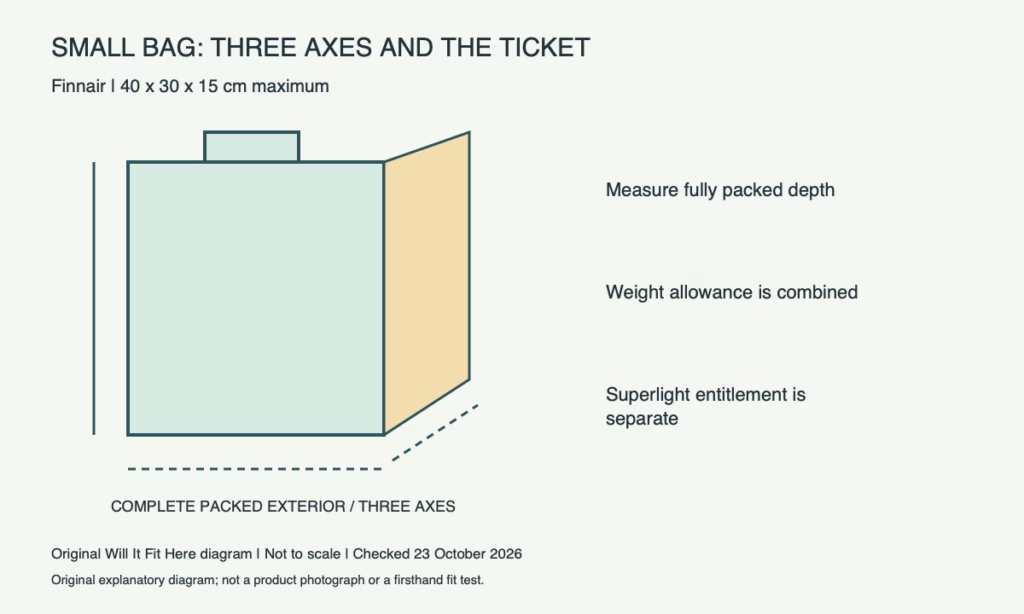
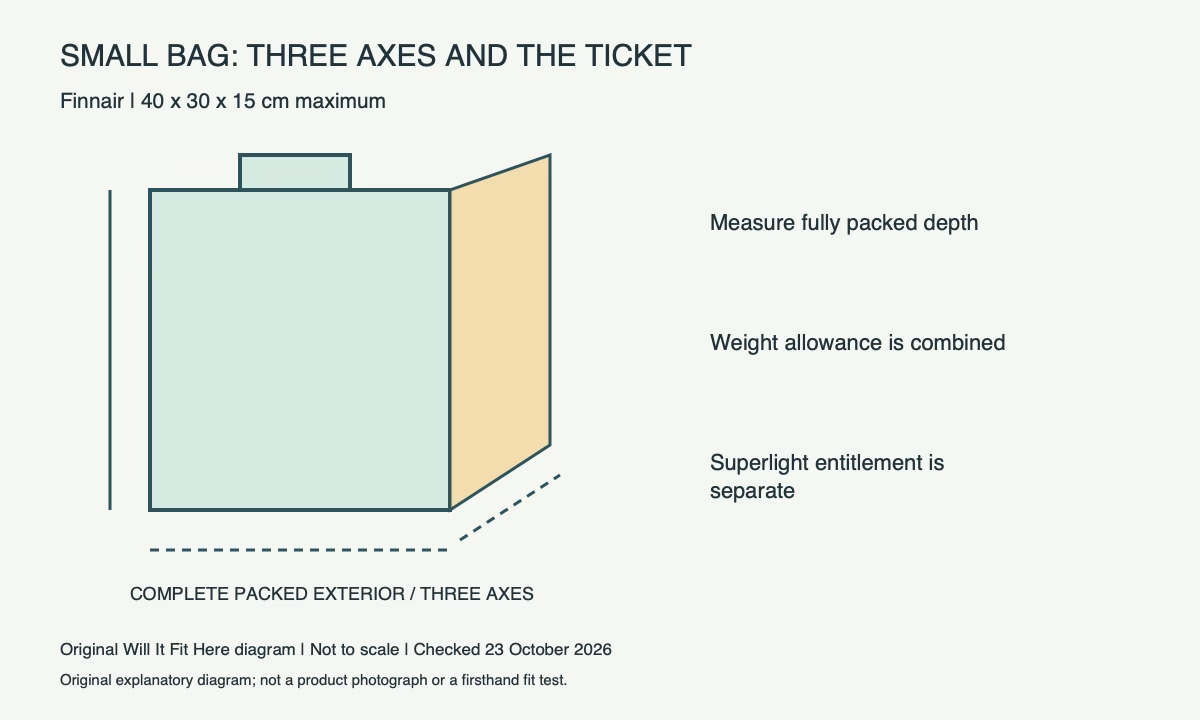
The small-bag limit is 40 × 30 × 15 cm, equivalent to 400 × 300 × 150 mm. Pack the actual contents and measure the complete outside envelope without squeezing it into an artificially thin shape. Include protruding pockets, rigid handles and any other part that changes its external dimensions. A nominal 15-litre capacity or a laptop-screen-size label cannot substitute for the three measurements. A backpack’s soft front can bulge beyond its empty catalogue depth after a charger or jacket is added.
| Check | Reference / action |
|---|---|
| Check | Current Finnair reference |
| Small bag | 40 × 30 × 15 cm; under the seat |
| Larger carry-on | 55 × 40 × 23 cm; entitlement separate |
| Economy / premium economy | 8 kg combined allowance |
| Business | 12 kg combined allowance |
| Economy Superlight | Small bag ordinarily included; larger bag/benefits checked separately |
3. Compare each axis rather than adding them
Finnair publishes separate maximum dimensions, not an interchangeable total of three sides for this bag. In a hypothetical packed example measuring 39 × 29 × 17 cm, the length and width are within the listed values but the depth exceeds 15 cm by 2 cm. Unused length does not cancel that depth difference. Repack and measure again if the bag’s shape changes. Do not describe a near miss as an airline-approved tolerance when no such allowance has been confirmed.
4. Check weight and the larger carry-on separately
The published combined allowance is 8 kg for economy and premium economy, or 12 kg for business, for the relevant small-bag and carry-on combination. Those are combined figures, not a separate allowance for each bag. Finnair lists the larger carry-on at 55 × 40 × 23 cm. Its different size and storage role do not replace the small-bag limit. Weigh what you actually intend to bring, and check how airport purchases count under the current policy before adding another shopping bag.
5. Confirm underseat stowage and every operator
The small bag belongs under the seat in front, with normal access and the crew’s instructions governing actual stowage. An allowance is not a measured drawing of every underseat cavity. Seat position and aircraft fittings can affect the usable space, so do not claim that an external-size pass guarantees every seat location. Finnair also directs passengers to check other operating airlines’ rules on mixed itineraries. Recheck the booking after a schedule or operator change instead of carrying one airline’s dimensions across the whole journey.
Before you decide
- Read the exact booking and operating carrier.
- Measure every axis of the fully packed small bag.
- Check combined weight and any separate carry-on entitlement.
- Plan underseat stowage and recheck connecting operators.
FAQ
Can a shallower length compensate for a 17 cm-deep bag?
No. Compare every published maximum independently. The small-bag rule is not a linear-dimension allowance.
Does buying a carry-on increase the allowed small-bag dimensions?
Do not assume so. It supplies a separate allowance; confirm the size and combined weight rules for the booking.
Official sources and scope
Checked on 23 October 2026. These references apply to the identified product, version and region. Follow its matching current instructions. Any worked measurement example is hypothetical.