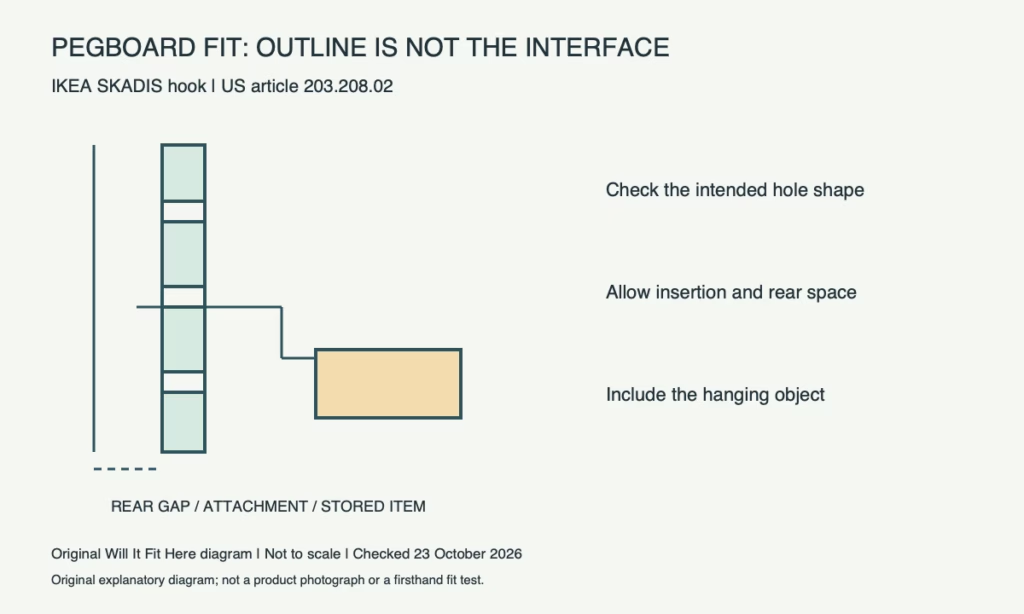
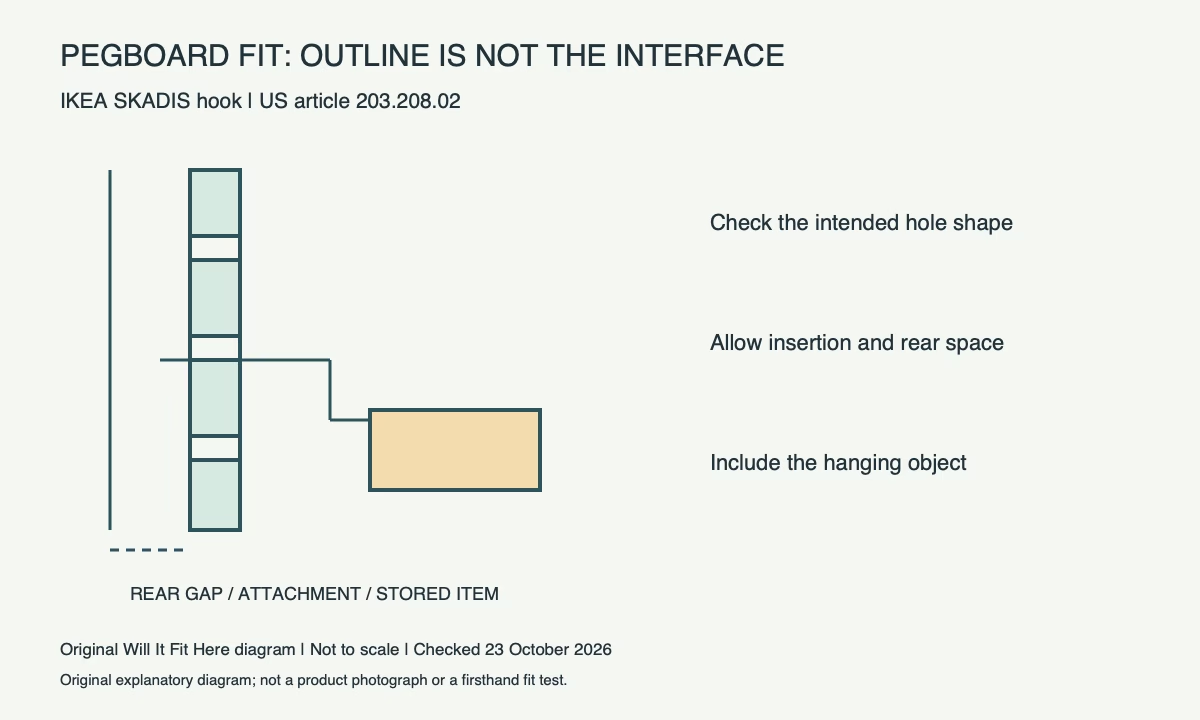
Result — Conditional. A SKADIS hook belongs to IKEA’s SKÅDIS accessory system. The hook’s advertised height and depth describe its outline; they do not certify compatibility with a generic round-hole pegboard. Check the intended board, the attachment shape and the space needed to insert and remove the hook before planning a storage layout.
1. Identify the SKADIS hook and board
This guide uses IKEA US hook article 203.208.02, supplied as a five-pack, and the matching SKÅDIS board system. Other hooks in the range can have different shapes and projections. Keep the article number beside your measurements so a replacement order does not silently change the accessory. For a second-hand board, confirm its identity rather than assuming every white perforated panel is an IKEA product. This is a system-fit check, not a tested universal adapter recommendation.
2. Dimensions: separate the outline from the attachment
IKEA lists this hook as 1 inch deep and 2¼ inches high. Those are approximately 25.4 and 57.15 mm by exact conversion of the displayed US values, not engineering tolerances for a mounting hole. The package dimensions describe the packed five hooks and should not be substituted for the installed projection. Measure your actual hook at its widest attachment points if you are investigating another board; the product page does not publish a universal round-hole or hole-spacing compatibility specification.
| Check | Reference / action |
|---|---|
| Check | Reference / action |
| Hook scope | IKEA US article 203.208.02 |
| Listed installed outline | Depth 1 in; height 2¼ in |
| Board interface | Identify the intended SKÅDIS attachment |
| Generic pegboard | Measure and obtain explicit compatibility; outline is insufficient |
| Working space | Allow insertion, removal and the stored item |
3. Check the insertion movement and rear gap
Observe the intended attachment procedure with the matching board before filling the surrounding holes. The final hanging position can occupy less space than the path used to insert or lift out the hook. Check the board’s rear spacing and the position of mounting hardware, especially near an edge or a wall bracket. A paper outline can help plan front-facing spacing, but it cannot reproduce a metal attachment’s retention. Do not bend the hook or enlarge holes to manufacture an unsupported fit.
4. Include the item that will hang from it
Sketch the stored object around the installed hook, including a handle, loop or strap and the movement used to remove it. Two hooks can fit the hole pattern while the two stored objects collide. A pair of scissors, for example, needs an accessible removal path as well as a resting position. This is a layout example rather than a weight-capacity claim. Check the manufacturer’s limits for the exact accessory and board, and choose an intended attachment for the item.
5. Verify the complete wall or desk installation
The supporting board has its own installation requirements. IKEA’s board instructions note that wall materials differ and the appropriate wall-fixing system must be selected for the actual wall. A correctly engaged hook cannot compensate for an unsuitable board attachment. Inspect normal access to nearby desk equipment, cabinet doors or a walkway after arranging the storage. Recheck the layout when a deeper basket or shelf joins the board, since that accessory may change both reach and surrounding clearance.
Before you decide
- Identify the hook article and intended board.
- Distinguish installed projection from package size.
- Check engagement and the full insertion/removal movement.
- Verify board fixing and the complete stored-object layout.
FAQ
Does a ¼-inch pegboard label establish compatibility?
No. It is not a specification for the complete SKÅDIS attachment shape, spacing, board thickness and retention method.
Can I measure only the hook’s front projection?
That helps plan the stored object, but attachment and insertion clearance still need separate checks.
Official sources and scope
Checked on 23 October 2026. These references apply to the identified product, version and region. Follow its matching current instructions. Any worked measurement example is hypothetical.