Quick answer: Emirates cabin bag fit starts with the packed outside dimensions, your cabin class and the departure route. The standard carry-on size on the current official page is 55 × 38 × 22 cm for Economy and Premium Economy, with different weight allowances. A suitcase labelled “22-inch carry-on” does not automatically meet that envelope.
You already own a small rolling suitcase and want to know whether it can go into the cabin on an Emirates journey. Before replacing it or opening its expansion zip, compare the complete packed case against the rules for every flight. This guide separates dimensional fit, weight and piece count so that one passing measurement does not hide another problem.
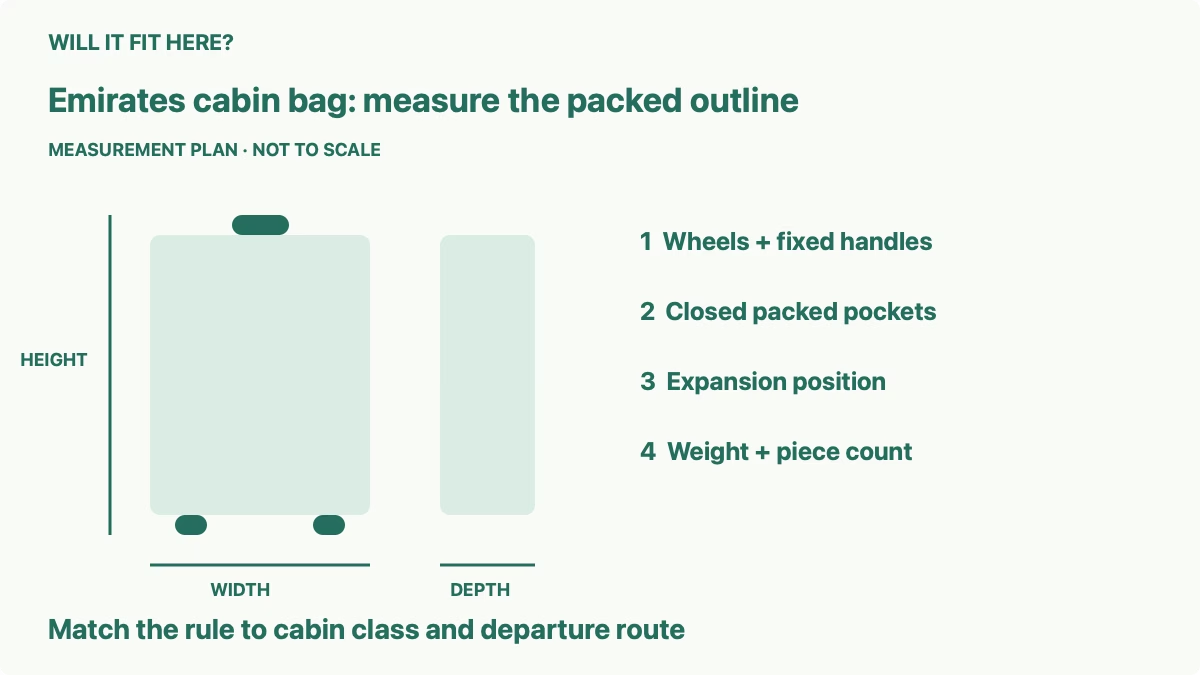
1. Identify the allowance for Emirates cabin bag fit
Start with the booking rather than the luggage label. Record the operating airline, cabin class and departure country for each leg. A ticket sold through one airline can include a flight operated by another, and an outbound allowance is not necessarily the right rule for the return journey.
The Emirates page checked on October 7, 2026 lists an Economy carry-on allowance of 7 kg and a Premium Economy allowance of 10 kg. Both show 55 × 38 × 22 cm for the carry-on. Business and First Class have a different two-piece description, with separate limits for the carry-on and briefcase or garment bag.
Do not turn that class difference into permission to bring a second rolling case. Read the exact item descriptions. If your proposed combination is a suitcase plus a laptop bag, identify which allowance covers each item and obtain clarification when the published wording does not settle your arrangement.
Save a note of the rule and the date you checked it. Recheck before travel, especially after a cabin change, itinerary alteration or airline change. A fit decision made when booking is only useful while the relevant conditions still match the trip.
2. Measure the complete packed suitcase
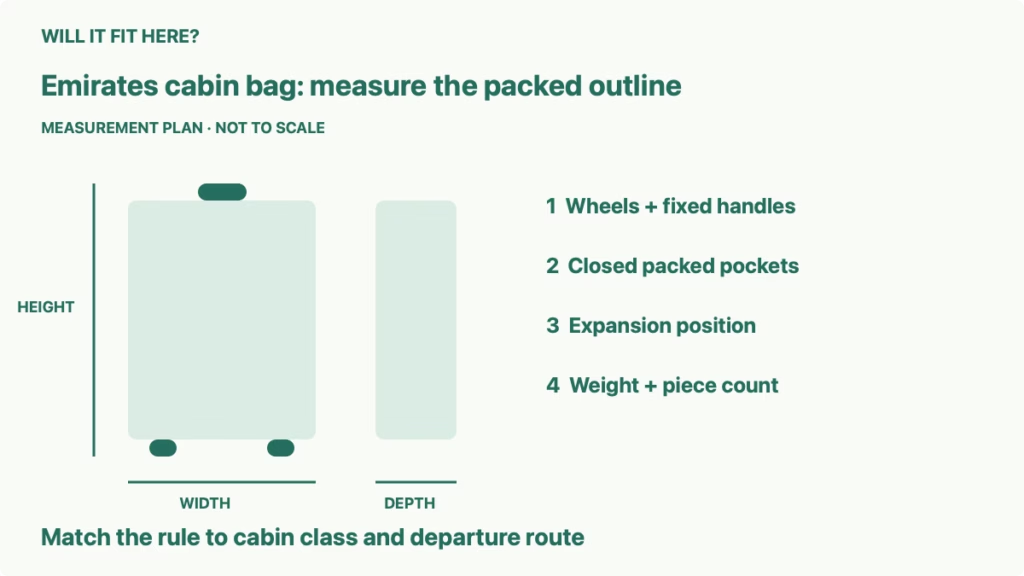
Pack the case as you intend to carry it, close every compartment and put the telescopic handle in its travel position. Measure the greatest outside height, width and depth. Include wheels, fixed handles, protective corners and any pocket that extends beyond the main shell.
A seller’s quoted shell height may leave out the wheels. A nominal 55 cm case can therefore have a taller total outline. Look for an explicit overall dimension in the product specification, then compare it with a measurement of the actual packed item rather than assuming two similarly named cases are identical.
Keep the three measurements separate. A bag that is narrower than the allowance does not earn extra depth. For a hypothetical example, a packed 54 × 37 × 24 cm suitcase exceeds a 22 cm depth limit even though its other two measurements are smaller. That example describes a comparison, not an airline-approved product.
Use two flat reference surfaces or a straightedge to find the furthest projection without crushing the case. Record the largest reading where a soft pocket bulges. If a result is right at the boundary, resolve the measurement uncertainty before treating it as a comfortable fit.
3. Check expansion and loaded weight separately
An expansion zipper changes the relevant packed depth. The closed specification cannot approve the expanded case. Measure with the zipper in the position you will actually use and account for items that push the front panel outward after the last-minute packing changes.
Weigh the fully packed bag, including its own empty weight. A case can meet every size limit and still exceed the applicable weight allowance. The empty suitcase, charger, toiletries and anything added at the airport all contribute to the carried item.
A useful worksheet has separate pass or unresolved boxes for height, width, depth, weight and item count. Leave an unresolved result visible instead of averaging it into an overall answer. Fix the failed condition by changing the packing or choosing another compliant transport option.
Do not rely on a claim that a soft case can always be squeezed smaller. Its packed contents may prevent that, and physical compressibility does not override the airline’s acceptance decision. Select a bag whose normal closed state meets the applicable dimensions without an improvised adjustment at the gate.
| Check | What to record |
|---|---|
| Height, width and depth | Largest packed exterior measurements |
| Weight | Complete loaded item, not contents alone |
| Piece count | Every separate cabin item in your combination |
| Route and class | The allowance applying to each departure |
| Stowage | Airline-approved cabin placement |
4. Resolve the India and Brazil exceptions
The current Emirates page includes a departure rule for customers boarding in India: Economy and Premium Economy passengers are allowed one carry-on piece with a maximum sum of length, width and height of 115 cm. The page says that this particular restriction excludes First and Business Class.
Treat a combined-dimension rule as another condition to check, not a reason to enlarge one side of a suitcase. The usual 55 + 38 + 22 cm dimensions total 115 cm, but another shape with the same total may still conflict with the standard side limits or practical stowage. Ask Emirates about a borderline shape.
The same official page states that flights departing Brazil allow up to 10 kg of cabin baggage. Departure direction matters: do not automatically use an outbound Brazil exception for a return flight departing somewhere else.
Write the departure-specific rule next to the corresponding flight on your worksheet. When a connection has more restrictive conditions, pack for the combination you can actually carry through the whole journey. Confirm the requirements with the operating airline when different carriers are involved.
5. Plan the cabin placement and fallback
Emirates requires cabin baggage to fit under the seat in front or in an overhead locker. The allowance is not a measurement of every locker opening or seat space. A compliant bag still has to be stowed in an approved location as directed by the crew.
Do not use aisle space, an emergency exit area or the floor behind your legs as a solution to a bag that will not stow properly. Choose your packing arrangement before boarding. Keep the items you need during the flight accessible within a permitted item combination.
Check what you must retain in the cabin if the bag needs to be checked, using the airline’s current dangerous-goods instructions. This guide does not provide battery or liquid approval. Those rules are separate from whether the suitcase fits the baggage size envelope.
Decide on a fallback before leaving home: repack into a smaller suitable bag, reduce loaded weight or arrange an appropriate checked-baggage option. A measurement worksheet makes that choice clearer than guessing which staff member will overlook an oversized case.
Common questions
Is every 22-inch suitcase suitable? No. Compare its total packed exterior in centimetres; the marketing size alone leaves out important details.
Can I trade spare width for extra depth? Individual side limits still need checking. A smaller width does not cancel an oversized depth.
Does Premium Economy allow a larger suitcase? The current page shows the same carry-on dimensions as Economy and a different weight allowance.
For other journeys, see the Travel fit guides and toiletry-bag fit checks. Recheck the rules for your own departure airports and airlines.
Official source and limits
Checked October 7, 2026: Emirates cabin baggage rules. Rules can change and depend on itinerary. Measurements and examples here are planning methods, not a guarantee of airline acceptance or a firsthand boarding test.