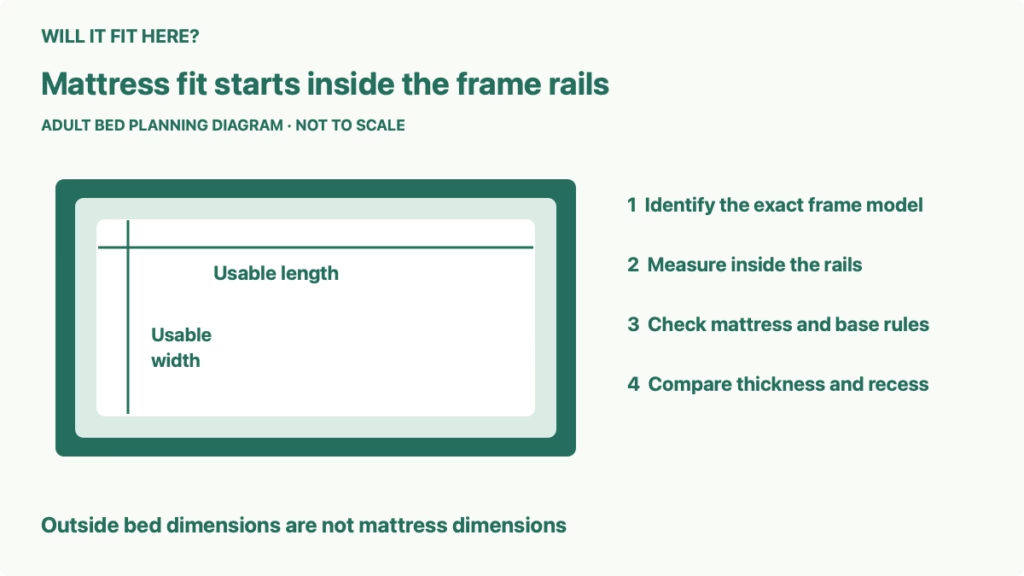
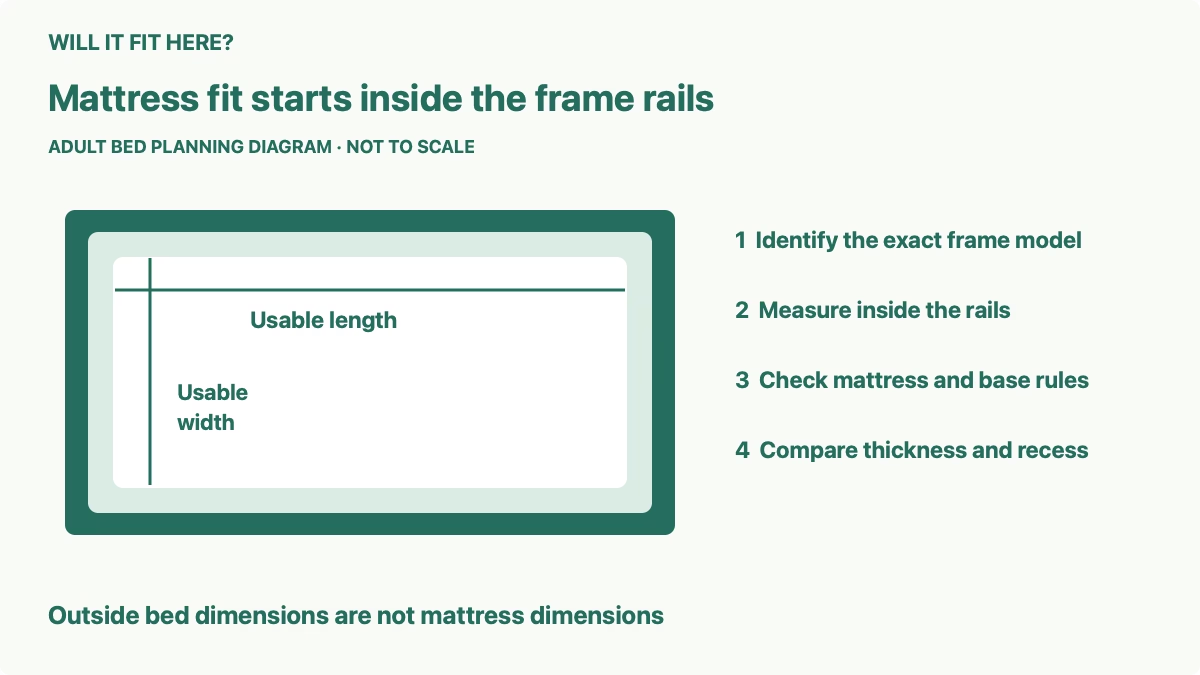
Quick answer: Mattress fit in an existing adult bed frame depends on the intended mattress dimensions, the space inside the rails, the support base and the permitted mattress thickness. Measure the inside opening and identify the exact frame model before buying. The frame’s outside length and width describe its room footprint, not the mattress that belongs inside it.
This guide is for replacing a mattress while keeping a conventional adult bed frame. It helps you decide whether a candidate mattress is compatible, which measurements still need confirmation and whether the existing support is suitable. For cribs, bunk beds, medical beds or other specialized sleeping systems, use that system’s exact safety and compatibility requirements rather than this general adult-bed method.
1. Identify the frame and its intended mattress size
Look for the frame’s model name, article number and regional version on its label, receipt or assembly instructions. The words queen, double and king can describe different dimensions in different markets. An older imported frame may not match a mattress sold under the same name locally.
Use the manufacturer’s intended mattress dimensions as your starting point. Keep them separate from the bed frame’s overall dimensions and its delivery packaging. If the frame has been modified, a nominal size label is even less useful. Ask the manufacturer what combination is supported before making a purchase.
A current labeled example is IKEA US MALM white Queen frame, article 902.494.83. Its page lists an outside length of 83 1/8 inches and width of 66 1/8 inches, while the mattress dimensions are listed as 79 1/2 inches long and 59 7/8 inches wide. The two pairs answer different questions. Use the page for your exact frame and region, not these example values for another bed.
2. Measure the usable opening inside the rails
With the sleeping surface accessible, measure between the inner faces of the side rails and between the head and foot boundaries where the mattress rests. Measure at several points. Trim, corner fittings or inward-projecting hardware may create a smaller usable area than the middle measurement suggests.
Record the narrowest relevant width and length. Keep the tape level and avoid measuring diagonally across the opening. If it is difficult to reach, take more than one reading rather than treating a rough estimate as a purchase specification. Measure the candidate mattress’s listed actual dimensions in the same units.
Do not assume that a soft edge makes an oversized mattress compatible. Forcing it into a smaller opening can bow the edges and interfere with the intended support. An undersized mattress can leave unwanted gaps or move in the frame. The acceptable relationship should come from the mattress and frame manufacturers, especially when the comparison is close.
3. Check the support base as part of mattress fit
A mattress can match the opening and still be incompatible with the support underneath. Identify whether the frame uses slats, a platform, a foundation or an adjustable base. Check the mattress maker’s requirements for that type of support, including any slat-spacing, center-support or foundation rules.
The same MALM example says that the slatted base and mattress are sold separately and that the frame must be completed with a SKORVA center support beam. Those are product-specific conditions. Do not generalize them to another frame or assume an incomplete frame becomes suitable just because a mattress rests on it.
Inspect the existing support for missing, loose or damaged parts using the frame’s instructions. Resolve those problems before evaluating a new mattress on it. Do not invent a load rating from appearance or add makeshift structural supports as a shortcut. When instructions are unavailable, ask the maker or a qualified furniture service for the needed specification.
4. Compare thickness, rail recess and finished height
Measure from the support surface to the top of the side rail. This gives the recess that hides part of the mattress. The portion above the rail depends on the mattress thickness and the support position. Add an intended topper separately when planning the final sleeping height.
For a hypothetical calculation, an adult frame with a support surface 4 inches below the rail top and a 10-inch mattress would leave about 6 inches of mattress above that rail, before a topper. This only describes geometry. It does not certify that the mattress or support combination is allowed.
Check how the finished height relates to the headboard, bedside table and your normal way of getting into bed. A thicker mattress can hide part of a headboard or sit higher than expected. If the frame has adjustable rail or support positions, use only the positions and hardware described in its instructions. IKEA describes adjustable sides on the labeled MALM example, but another bed may have no such adjustment.
5. Check installation, settling and everyday use
Read the mattress maker’s unpacking and expansion instructions before comparing a compressed mattress with its final dimensions. The boxed or rolled package is a delivery measurement. It does not prove the expanded mattress will fit inside the bed.
Plan a route into the bedroom and enough working space to position the mattress without damaging the frame. A flexible mattress and a rigid foundation have different handling limits. Follow the maker’s directions about bending, carrying and waiting before use. Do not assume every foam or spring mattress can be folded the same way.
When the approved mattress is in place and has reached its instructed condition, check that it sits evenly on the complete support, does not bind against hardware and leaves the intended access for bedding. If the delivered dimensions or frame opening differ from what you confirmed, contact the seller or maker before forcing an adjustment.
Your final decision should have four clear answers: the intended mattress size matches, the actual opening works, the support meets both products’ requirements and the thickness is suitable. Keep model numbers, measurements and instructions together so that a later replacement can be checked against the same evidence.
Common questions before replacing a mattress
Can I buy by the size name alone? Use the size name to locate candidates, then compare actual dimensions and regional specifications.
Should I measure the old mattress? It can be a useful cross-check, but an old mattress may be distorted or have been a poor fit. Confirm the frame’s intended size too.
Does a room-fit guide answer this question? Room fit concerns the outside bed footprint and walking routes. Mattress fit concerns the opening, support and thickness inside that frame.
Sources and related fit checks
Manufacturer reference: IKEA US MALM Queen frame dimensions and required components. Source checked October 7, 2026. The labeled example does not establish compatibility for other models.
For the surrounding room, see queen bed fit in a 10-by-10 room or king bed fit in a 12-by-12 room. For storage below the frame, use our under-bed storage clearance guide.