Quick answer: Under-bed storage fits only when its packed height clears the lowest part of the bed and its full width and depth clear the supports along the route. Measure from the finished floor, include carpet and wheels, and leave enough space beside the bed to pull the container out. The mattress height tells you little about the usable storage opening.
This guide is for someone choosing a storage case for spare bedding, seasonal clothes or shoes under an existing bed. The decision is whether the container can enter, park and come out again without changing the bed frame. We use one current IKEA case as an example, then separate its published dimensions from the measurements you must take at home.
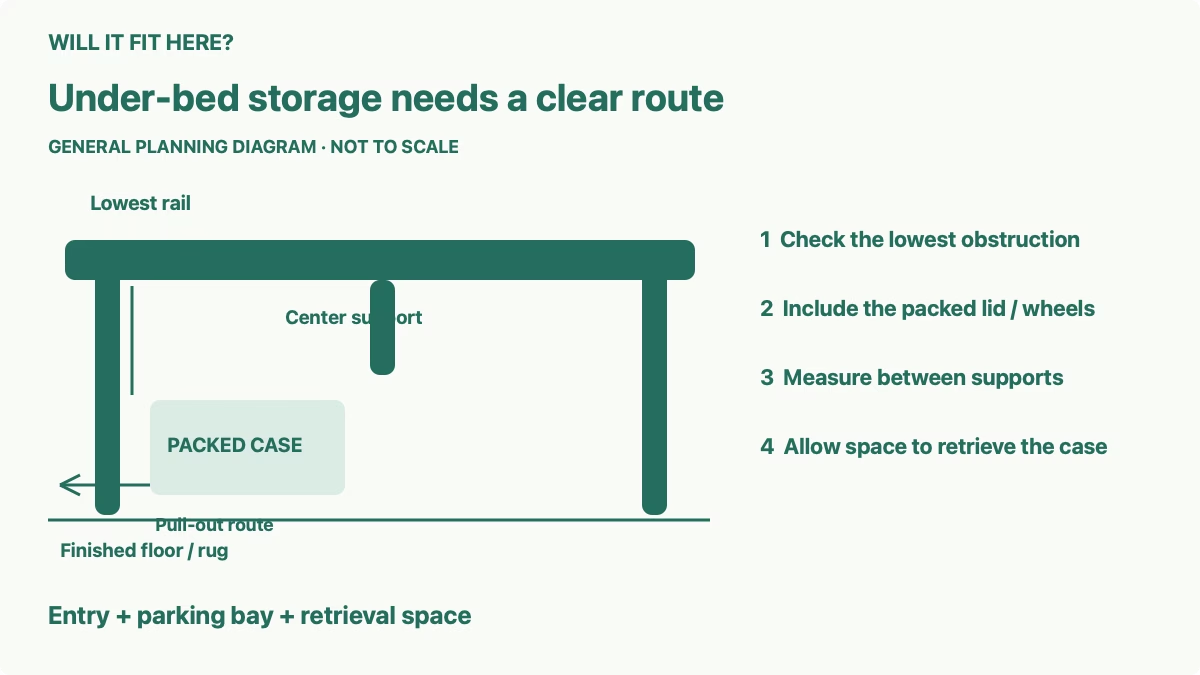
1. Measure under-bed storage clearance at the lowest obstruction
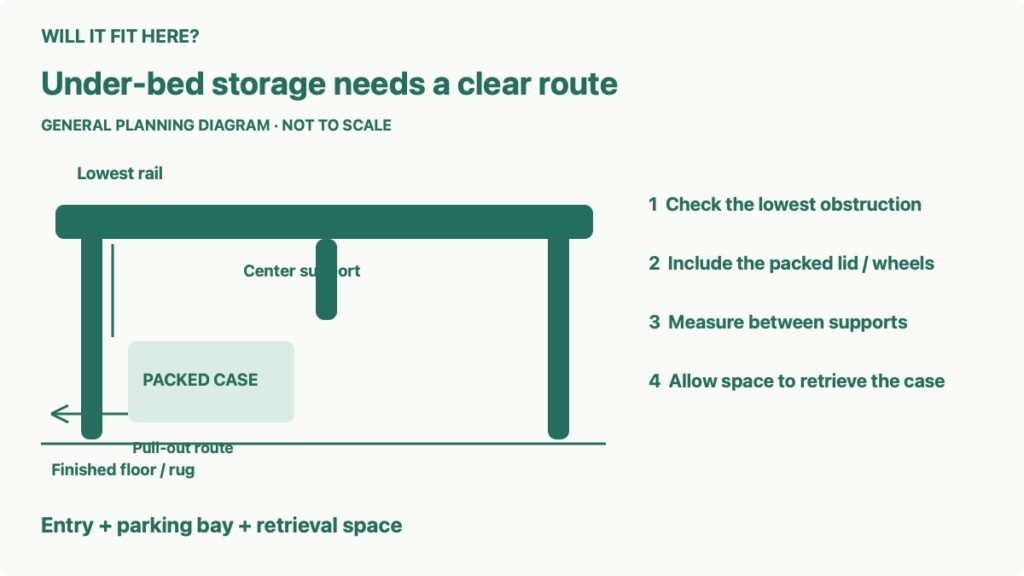
Measure vertically from the floor to the underside of the side rail where the container will enter. Repeat at the head, middle and foot of that opening. Then look farther under the bed for crossbars, brackets and a center beam that hang lower. Record the smallest height that the container must pass beneath, rather than the largest gap you can find.
A decorative frame can have generous-looking legs and a low rail between them. Conversely, the entrance can be low while the interior has more height. A tall container that would fit inside still fails if it cannot pass the entrance. Keep those two measurements separate on your worksheet.
Use the actual floor surface. A deep rug, a raised carpet seam or a sloped floor changes the clearance. Do not measure on bare flooring next to the bed if the container will travel over a rug. If the bed has an adjustable mechanism, use its manual to establish whether storage is permitted and what must remain clear.
2. Compare the packed container with the usable bay
For a current manufacturer example, IKEA lists its US SKUBB white storage case, article 705.910.61, as 25½ inches wide, 20¾ inches deep and 7½ inches high. Those are product measurements. The same page lists different packaging measurements because the case is supplied folded. The package height is not the height of the case filled with bedding.
For any model, use the complete outside dimensions with its lid shut, wheels fitted and handles in their normal position. A rigid box needs clearance for the lid rim. A fabric case can bulge above its nominal height when stuffed. Measure your packed sample if you already own one; if ordering online, treat the stated height as a starting point and choose space that does not depend on compressing the contents against the bed.
Make a simple cardboard height gauge for the proposed packed height. Slide it through the intended path without lifting the bed. If it touches a rail or bracket, the plan needs a shorter container or a different bay. This is a planning test, not a substitute for inspecting the actual loaded case.
3. Map supports before buying several matching cases
A queen or king mattress does not imply one uninterrupted rectangle underneath. Center legs, end legs and cross members divide the floor into smaller bays. Measure each bay between the parts that actually limit movement. Check whether a container can rotate at the entrance and whether its far end hits a support after the near end is hidden.
| Check | Measure at home | Decision it resolves |
|---|---|---|
| Entry height | Floor to lowest rail or bracket | Can the packed case get in? |
| Bay width | Between legs and center supports | Can it park without being squeezed? |
| Usable depth | Entrance to the first obstruction | Will the handle remain reachable? |
| Retrieval space | Clear floor outside the entrance | Can you remove it without moving furniture? |
Draw a rough plan showing each leg and beam. Add container outlines only after marking those obstructions. Buying four cases from the total mattress area can leave one case with no accessible home. Two shorter cases may work better than one long case when the center legs interrupt the slide-in route.
4. Check the under-bed storage pull-out route
Place a removable tape outline beside the bed equal to the container’s outside depth in the direction you will pull it. Put the nightstand, bedroom door and nearby chair in their usual positions. A box can fit beneath the bed yet require you to move the nightstand every time you want a spare sheet.
Decide whether you need to remove the case completely before opening it. A hinged lid may need more headroom than the closed case. A zippered fabric case may also need to come out so that you can reach the corners. Check hand access to the handle and leave a route that does not require dragging the container across loose cords.
For a hypothetical example, a case 7½ inches high beneath a rail measured at exactly 7½ inches has no practical allowance for a bulging lid, rug or measurement error. That equality is a reason to choose a lower case, not evidence of an easy fit. There is no single universal extra-clearance number for every bed and container.
5. Make the final fit decision with a loaded sample
Try one container before buying a complete set when possible. Fill it as you intend, close it normally and check its maximum height. Slide it in and out without forcing it, raising the frame or moving support legs. Confirm that its handle stays accessible and that the contents do not press against the underside of the bed.
Keep bed supports and any required ventilation or moving-mechanism area clear. Do not remove a center leg, trim a beam or add unapproved bed risers to make a storage purchase work. If the frame manual does not allow the planned arrangement, choose another storage location.
Common questions about under-bed storage
Can a soft case squeeze through a smaller gap? It may deform when empty, but the useful test is its packed shape. Repeated rubbing can make access frustrating and damage fabric or contents.
Should wheels be included in the height? Yes. Use the complete assembled outside height, and check that wheels can cross the floor surface along the route.
Will a case made for a wardrobe also work under a bed? Its intended storage use does not guarantee your frame clearance. Compare its published dimensions with your measured bays and retrieval space.
Sources and related fit checks
Manufacturer example: IKEA US SKUBB storage case 705.910.61: product and packaging measurements. Source checked October 7, 2026. Product versions and regional listings can differ; verify the article you plan to buy.
For the surrounding bedroom layout, see our queen bed in a 10×10 room guide and king bed in a 12×12 room checks. Measure the storage access route after choosing the bed’s everyday position.