Quick answer: A portable AC window kit fits only when its panel matches the actual opening, the hose connectors clear the sash or frame, and the unit can stand within the permitted hose route. Measure the window channel and the connected setup before buying an extension or trimming a panel.
This is a planning guide for a renter or homeowner whose portable air conditioner seems to fit the room but may not connect neatly to the window. It covers measurement and accessory compatibility. It does not establish cooling capacity or replace the exact unit’s installation manual.
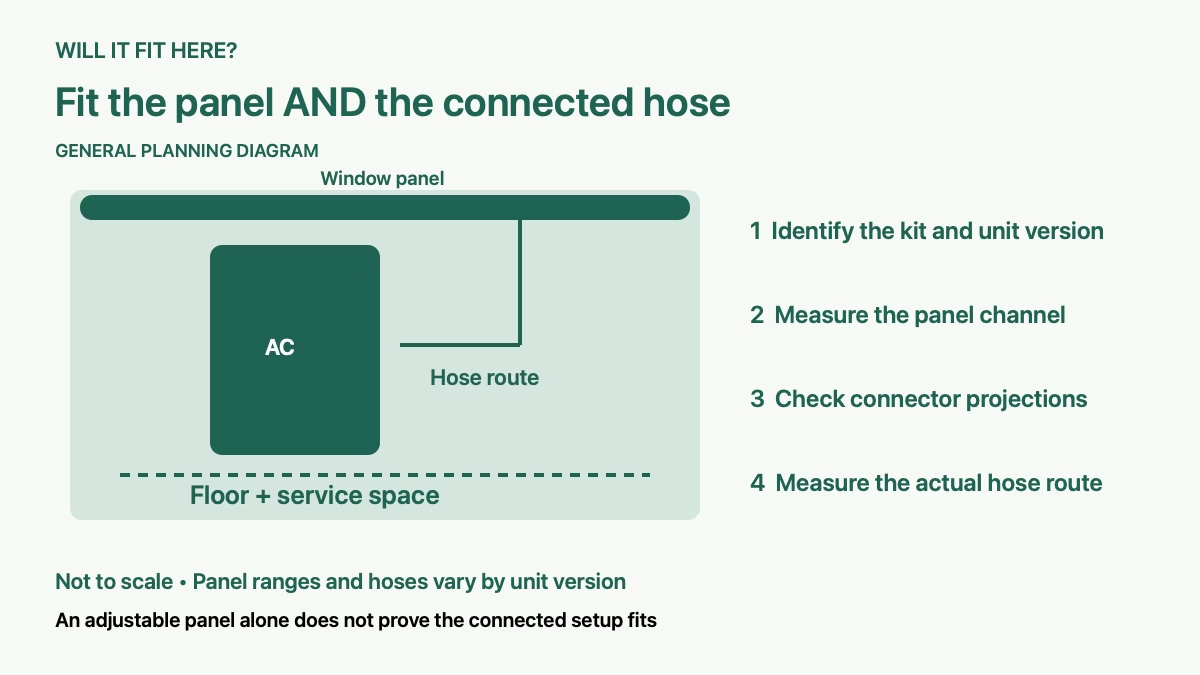
1. Match the portable AC window kit to the unit version
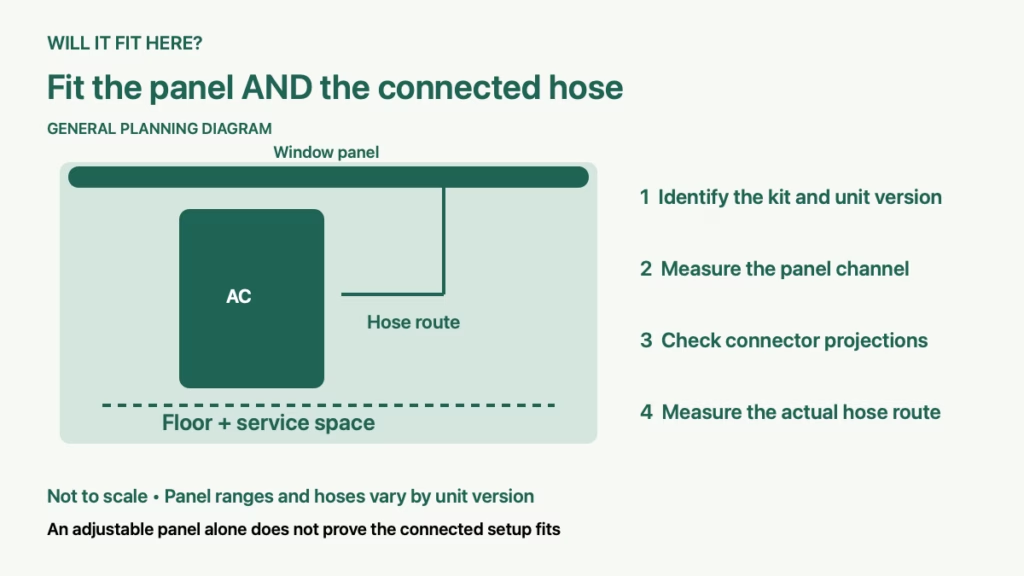
Record the air conditioner’s full model number and the window-kit part number. Compare the panel, hose diameter and both connector ends. A hose that looks similar can use a different diameter or locking connection. Buying a universal adapter from a photo alone leaves several compatibility questions unanswered.
Whynter’s current ARC-14S product page illustrates the problem: its main specifications list a 6.5-inch-wide kit adjustable from 20 to 56 inches, while an accessory section describes ARC-WK-DUALN as 20 to 46 inches long. The page also says hose sizes can vary by unit version. Confirm the actual included kit and matching manual with Whynter before relying on the larger maximum. These are ARC-14S references, not dimensions for all portable AC kits.
2. Measure the window channel where the panel will sit
Identify how the window opens. For a vertically moving sash, the panel generally occupies a horizontal span at the bottom. For a side-sliding window, it generally occupies a vertical span. A hinged casement window needs a different approved arrangement; the fact that its opening is wide enough does not make a sliding panel compatible.
Measure between the surfaces that will retain the panel, rather than between the decorative trim edges. Record the available span, the channel depth and the space for the panel’s thickness. Check for handles, locks, screens and other hardware that could conflict with the hose outlet.
Photograph the opening with a tape measure visible and sketch the panel position. This helps the manufacturer distinguish a length problem from a window-type problem. Include the direction in which the sash closes; an accessory might reach across the opening yet prevent the window from securing as intended.
3. Check the portable AC window kit with connectors attached
A portable AC window kit needs to be checked with its fittings attached. Attach the specified connectors according to the manual and look at the depth they occupy on both sides. A connector can project into a screen, a window crank or a curtain even when the panel itself sits neatly in the channel.
Check each hose separately on a dual-hose system. Label the intake and exhaust positions using the manual so that you can assess their routes without swapping functions. Do not reduce the connector opening, crush a hose or improvise a shared outlet to make the arrangement smaller.
For example, imagine that the panel reaches across the opening, but the inside connector lands directly behind a deep window handle. Moving the unit farther away does not remove that collision. The panel orientation or approved window arrangement needs review before the hose route can be planned.
4. Measure the route from the unit to the window
Place a temporary outline of the air conditioner on the floor, preserving the manual’s ventilation space. Measure from the actual connection point on the unit to the window connector along the proposed route. The distance to the window wall is not the same measurement.
Whynter lists the ARC-14S supplied hoses as extending up to 60 inches. That is the hose length, not a promise that the unit can sit 60 inches from the wall: connector depth and changes of direction consume part of the route. Plan a short, unobstructed route and ask the manufacturer about extensions for your exact version.
Check whether the hose crosses a door, blocks a drawer or takes away the passage beside a bed. Keep the unit in a position where filters and drain points remain accessible. A longer hose should not be the first response to an unsuitable floor location.
5. Resolve the fit before modifying the portable AC window kit
If the panel is too short, identify an approved extension or another approved window solution. If it is too long, confirm the exact manual’s trimming instructions and which section can be shortened without damaging connection points. Do not cut a panel simply because another brand’s guide allows it.
The ARC-14S/ARC-14S2 manual requires a correctly grounded supply and prohibits an extension cord. If the planned location cannot meet the electrical instructions, consult a qualified electrician. Window fit does not make an unsuitable power connection acceptable.
Before operating the unit, complete the manufacturer’s fastening, sealing, hose and drainage checks. For a rented home, confirm permission for any proposed window or building modification. A custom insert should be planned around the approved installation requirements, not used to bypass them.
Questions to settle before ordering accessories
Can I reuse my old kit? Verify the part number, panel range and connector system against the replacement unit. Similar cooling ratings do not establish accessory compatibility.
Can I use it without venting outside? In cooling mode, use the manufacturer’s required outside venting arrangement. A mode-specific exception for dehumidifying is not a cooling installation method.
What if the website and manual differ? Send the unit and kit identifiers to support and get a version-specific answer before ordering or cutting. Keep that answer with your measurements.
Sources and related fit checks
Sources checked October 6, 2026: Whynter ARC-14S specifications and accessories and ARC-14S/ARC-14S2 installation manual. Confirm the manual for your unit version.
For room planning around the unit, see our small-bedroom furniture clearance guide and robot dock approach-area checks.