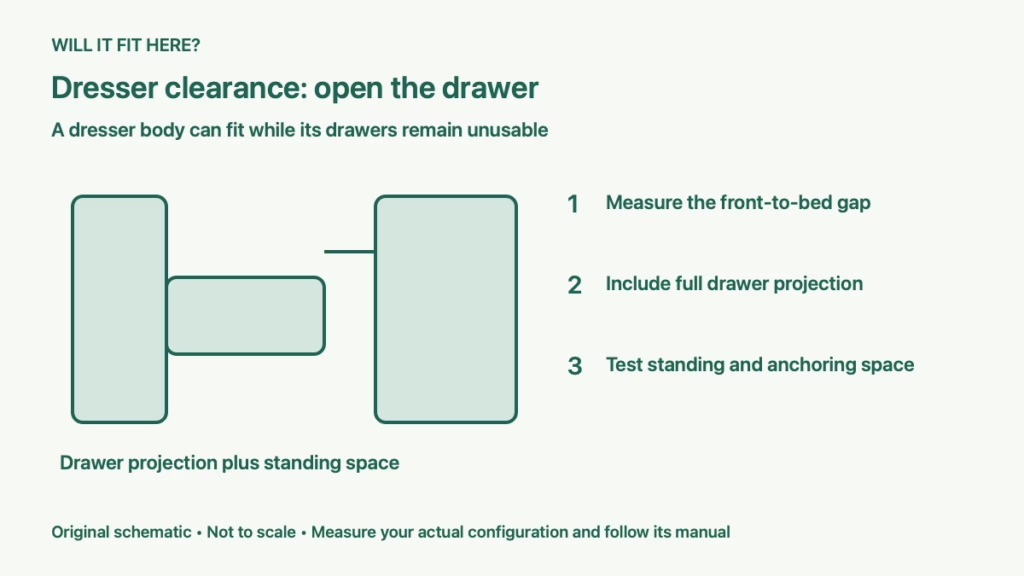
Quick answer: Dresser drawer clearance beside a bed must include full drawer projection and the space you need to stand, bend and reach inside. Measure from the closed dresser front to the nearest bed-frame edge, then subtract the drawer’s actual travel. A cabinet body fitting the gap does not prove its drawers will be usable.
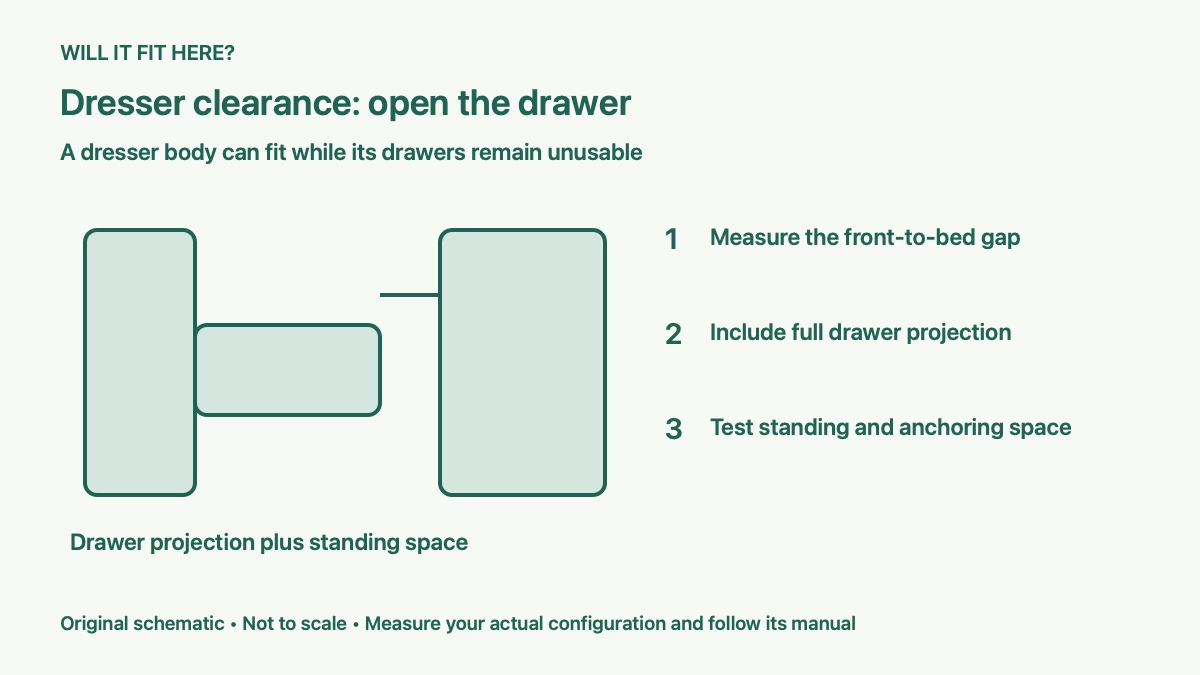
This guide is for a bedroom where a dresser can sit opposite or beside a bed, but the remaining aisle looks tight. It focuses on access to stored clothes, rather than replacing drawer slides or choosing a bed size.
1. Measure the gap from the correct surfaces
Measure from the closed dresser’s outer front, including handles, to the nearest rigid bed part. A projecting rail, upholstered footboard or corner post may be closer than the mattress. Check the entire dresser width, because the bed edge may not be parallel to its front.
Include wall trim behind the dresser, permitted anchoring position and any leveling arrangement in its final location. Dresser drawer clearance can shrink when a unit sits forward of a skirting board. A room measurement taken before the bed frame was assembled may therefore be misleading.
Write the smallest usable gap on a floor sketch. Keep the mattress dimensions separate from the outside bed-frame dimensions so you can identify which obstruction limits access.
2. Find the drawer’s real opening projection
Look for drawer pull-out or open-position measurements for the exact product. Interior drawer depth is not the same as how far the front moves. Handles can add to the opened envelope, and different drawers in one unit may have different travel.
For example, IKEA’s VIHALS six-drawer dresser, article 904.832.49, lists an 18.5-inch body depth, 15⅞-inch inside drawer depth and 10⅛-inch drawer pull-out. That distinction is useful for this specific product; do not transfer its pull-out value to another dresser.
If the seller does not provide open dimensions, ask for a measurement with the drawer at its intended stop. Do not force it past the stop or remove a drawer to claim extra everyday access.
3. Calculate the remaining standing space
Use this planning calculation: remaining space = closed-front-to-bed gap − full opened projection. Measure the projection from the same closed-front reference used for the gap. If your measurement already includes the handle, avoid adding it twice.
As a hypothetical example, a 30-inch gap with a 15-inch opened projection leaves 15 inches before the bed. That is simply the arithmetic, not a recommendation that 15 inches is adequate for every person. Test whether the actual user can stand and reach the drawer without leaning on the bed or squeezing sideways.
Dresser drawer clearance needs to suit the task. Removing folded clothes from a shallow top drawer differs from bending to the bottom drawer or lifting a bulky blanket. Mock up both with a cardboard drawer front and normal clothing basket.
4. Check the full bedroom route
Open drawers should not collide with an entry door, closet door or a second furniture piece. Test the room route with the usual laundry basket and check whether someone can reach the bed while another person uses the dresser. Decide which operations must be possible simultaneously.
For the broader room plan, see our queen bed in a 10-by-10 room checks and bed and desk operating-space guide. Those layouts do not replace your actual frame and dresser measurements.
5. Keep anchoring and final verification in the plan
Follow the dresser’s assembly, leveling and wall-attachment instructions before testing normal drawer operation. IKEA’s safer-home guidance requires appropriate wall attachment for its dressers and chests. Do not move a unit away from its required anchoring arrangement to gain dresser drawer clearance.
After installation, check each drawer to its intended open position and confirm access to the lowest storage. If a layout fails, consider a shallower approved product, another wall or a different furniture arrangement rather than accepting unusable drawers.
Decision: Dresser drawer clearance passes when the body fits, drawers open properly, the user can retrieve items and the bedroom route stays practical. Record the smallest gap and actual drawer projection before ordering; neither room area nor dresser width alone answers the question.