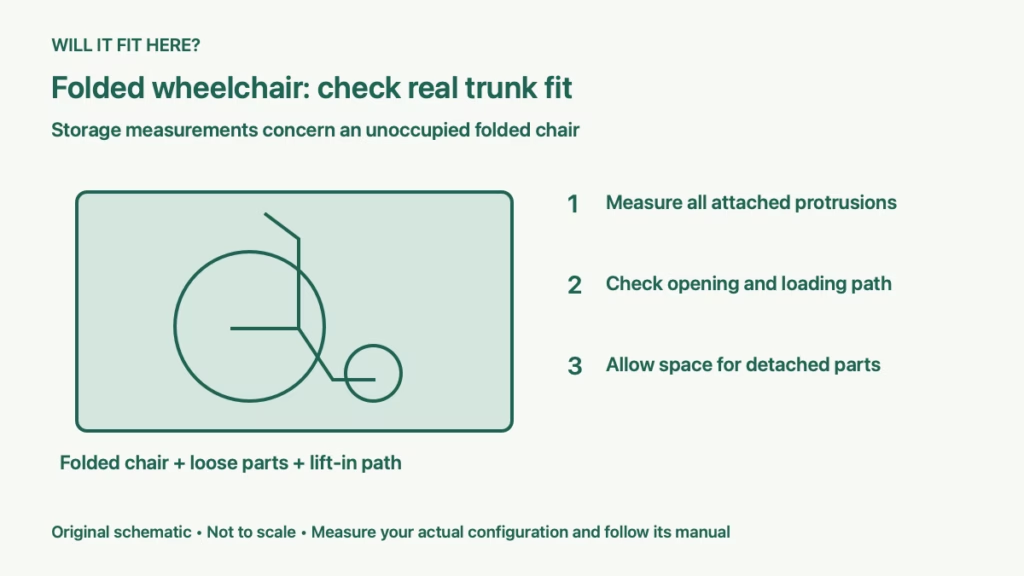
Quick answer: A folding wheelchair fits a car trunk only when its actual folded shape passes through the opening, can be turned into place and leaves room for detached parts. Seat width, trunk volume and shipping-box dimensions do not answer those questions. Test the unoccupied chair in the configuration its manufacturer permits before depending on the car for a journey.
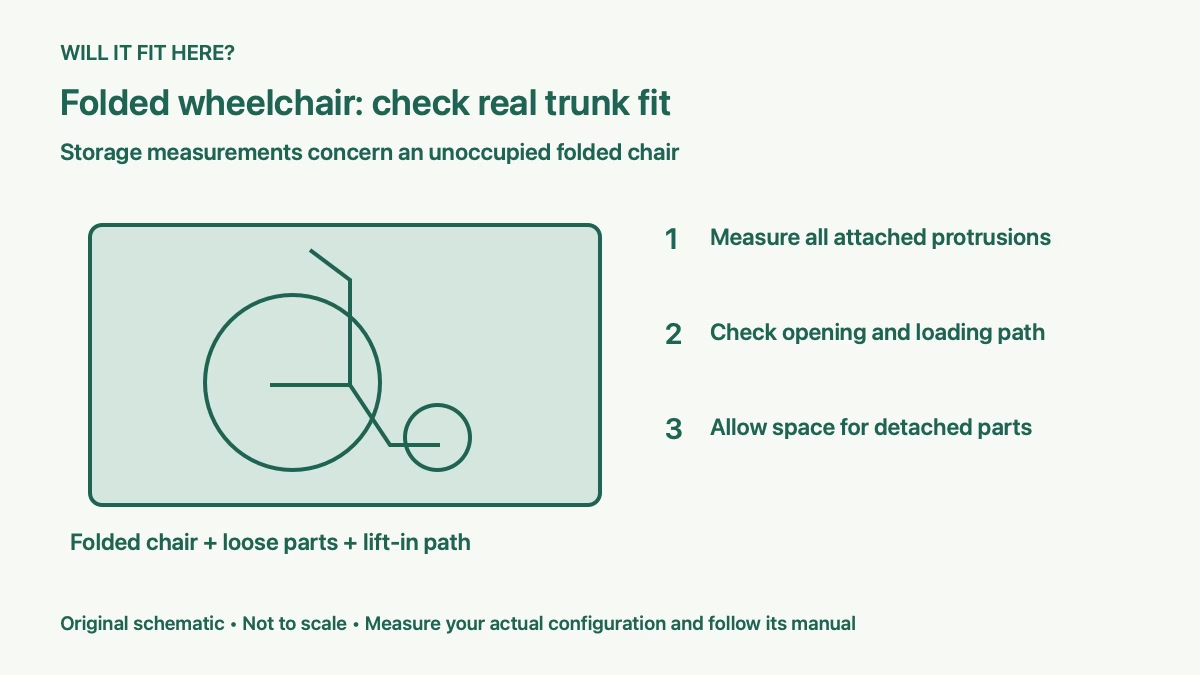
1. Choose the folding wheelchair transport configuration
You are arranging a lift, a rental car or a family trip and need to know whether the chair can travel with its user. Begin with the user’s required seating and transfer arrangements, then check storage. This guide concerns storing an unoccupied chair. It does not assess whether someone can travel seated in the wheelchair, which requires the appropriate vehicle and securement guidance.
Read the manual for the exact chair and accessories. Confirm which components may be folded, swung away or removed for transport and how to refit them. A removable footrest on one model does not establish that another footrest can be detached. Keep the transport configuration reproducible, especially when different people will help load the chair.
2. Measure the actual folding wheelchair envelope
With the chair folded as instructed, measure its maximum length, width and height, including handles, wheel locks, anti-tip devices, footplates and any accessories that remain attached. Note protrusions on both sides. An apparently narrow folded frame can have a wheel or handle that reaches beyond the dimension you first measured.
Sunrise Medical’s official QUICKIE 2 product page describes a configurable folding chair and separately lists shipping dimensions. That distinction matters: a shipping specification is not a measurement of every user’s folded configuration. Use the actual chair or ask its supplier for configuration-specific transport dimensions. Do not transfer one product’s measurements to all folding chairs.
If permitted parts are removed, measure the remaining chair and every loose part separately. A cushion, wheel or footrest still needs a protected place in the car. Keep an inventory so the smaller main frame does not create a missing-part problem at the destination.
3. Check the trunk opening before the storage area
Measure the clear opening width and height where the folded chair will enter, including curved corners and the trunk sill. Check how far the opening sits above the ground and whether the loader can reach into it comfortably. Inside, measure usable length, width between intrusions and height beneath the closed lid or parcel shelf in the planned seat arrangement.
A folding wheelchair may fit the interior but not the route into it. A sedan’s opening can require a lift-and-turn movement that differs from a hatchback’s rear access. Inspect hinges, latch hardware and sloping trim as well as the floor. Leave the car’s seats in the positions actually needed by the driver and passengers rather than measuring an unrealistically empty cabin.
4. Test the folding wheelchair loading movement
Use the actual chair for a controlled trial with appropriate help. Start gently and protect both the car and chair at contact points. Check where hands must grip and where the frame must rotate past the sill. Do not force the chair through a gap or lift it by a component that its manual does not identify as suitable.
Storage fit and manageable lifting are separate results. A chair that squeezes into the trunk after an awkward heavy lift may be unsuitable for daily use by the person who will actually load it. Try unloading as well as loading. If you cannot complete both movements comfortably and safely, discuss a different vehicle or loading arrangement with the chair’s supplier.
5. Check closure, restraint and reassembly
The trunk must close normally without pressing on the frame, cushion or wheels. Secure the unoccupied chair and loose parts in accordance with the vehicle and chair instructions. Ensure the packed arrangement does not obstruct vehicle controls or essential visibility. Verify that luggage added later does not defeat the trial you performed.
At the destination, follow the maker’s reassembly checks before the chair is used. If a quick-release wheel or detachable support was removed, its correct reattachment matters more than making the packing faster. Keep the necessary instructions accessible to anyone helping with transport.
A practical booking decision
Give a driver or rental provider the folding wheelchair’s transport envelope and ask about the clear trunk opening, not just a vehicle class. Arrange a real trial where possible. The loading-route measurement guide explains why a resting fit does not prove entry. The closed-hatch shape guide helps identify upper rear-space losses.
Accept the arrangement when the real chair enters and exits without force, the lid closes, all parts are accounted for, and the people involved can reproduce the process. If any step remains uncertain, resolve it before the journey.