Quick answer
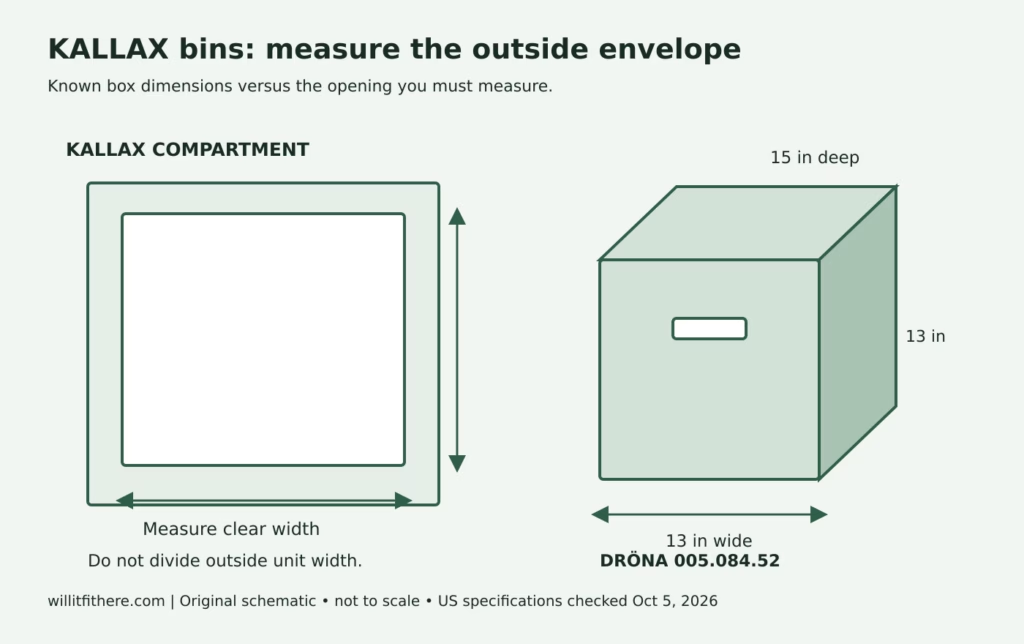
IKEA’s DRÖNA box 005.084.52 is a verified starting point: it measures 13 inches wide ×15 inches deep ×13 inches high, and IKEA specifically says it is sized for KALLAX. For another brand, compare the bin’s full outside measurements with your actual clear cube opening and usable depth. “13-inch cube” on a label is not enough.
Use DRÖNA as a reference, not a universal limit
The dark-gray DRÖNA in this guide has article number 005.084.52. Its 13 ×15 ×13-inch size and explicit KALLAX compatibility are documented on IKEA’s US product page. That makes it a better starting point than a bin chosen only because its title contains “cube storage.”
Compatibility for one box does not prove that every similarly labeled basket will work. A woven rim may flare outward, a rigid handle can project beyond the side, and a lid can increase both height and width. Compare the shape that must pass through the opening, not just the base.
Also distinguish an open KALLAX compartment from a compartment fitted with doors, drawers or another insert. The hardware and insert panels change the usable opening. Measure the configuration you will actually use.
Understand width, depth and the clear opening
| Reference | Published dimensions | Use |
|---|---|---|
| DRÖNA 005.084.52 | 13 W ×15 D ×13 H in | Known box designed for KALLAX |
| KALLAX 206.316.39 | 30⅛ W ×15⅜ D ×30⅛ H in | Outside unit size, not an individual opening |
| Your cube opening | Measure clear W and H | Compare with the widest and tallest part of the bin |
| Your usable depth | Measure in final position | Allow for walls, backing, handles and chosen projection |
Metric reference: DRÖNA’s listed 13 × 15 × 13-inch dimensions convert to approximately 33.0 × 38.1 × 33.0 cm. The listed KALLAX exterior converts to approximately 76.5 × 39.1 × 76.5 cm; it is not the compartment opening. Values are approximate conversions of the cited US inch measurements, not separate regional product specifications.
The current white KALLAX 206.316.39 dimensions above describe the entire unit. Dividing its width in half would include frame and partition material, so it cannot supply the clear width of a cube. This is why an external bookcase dimension should never replace an internal measurement.
Write “outside bin” and “clear opening” beside your notes. They are intentionally different measurements. Neither is the bin’s internal capacity, which is relevant only after you have established that the box fits.
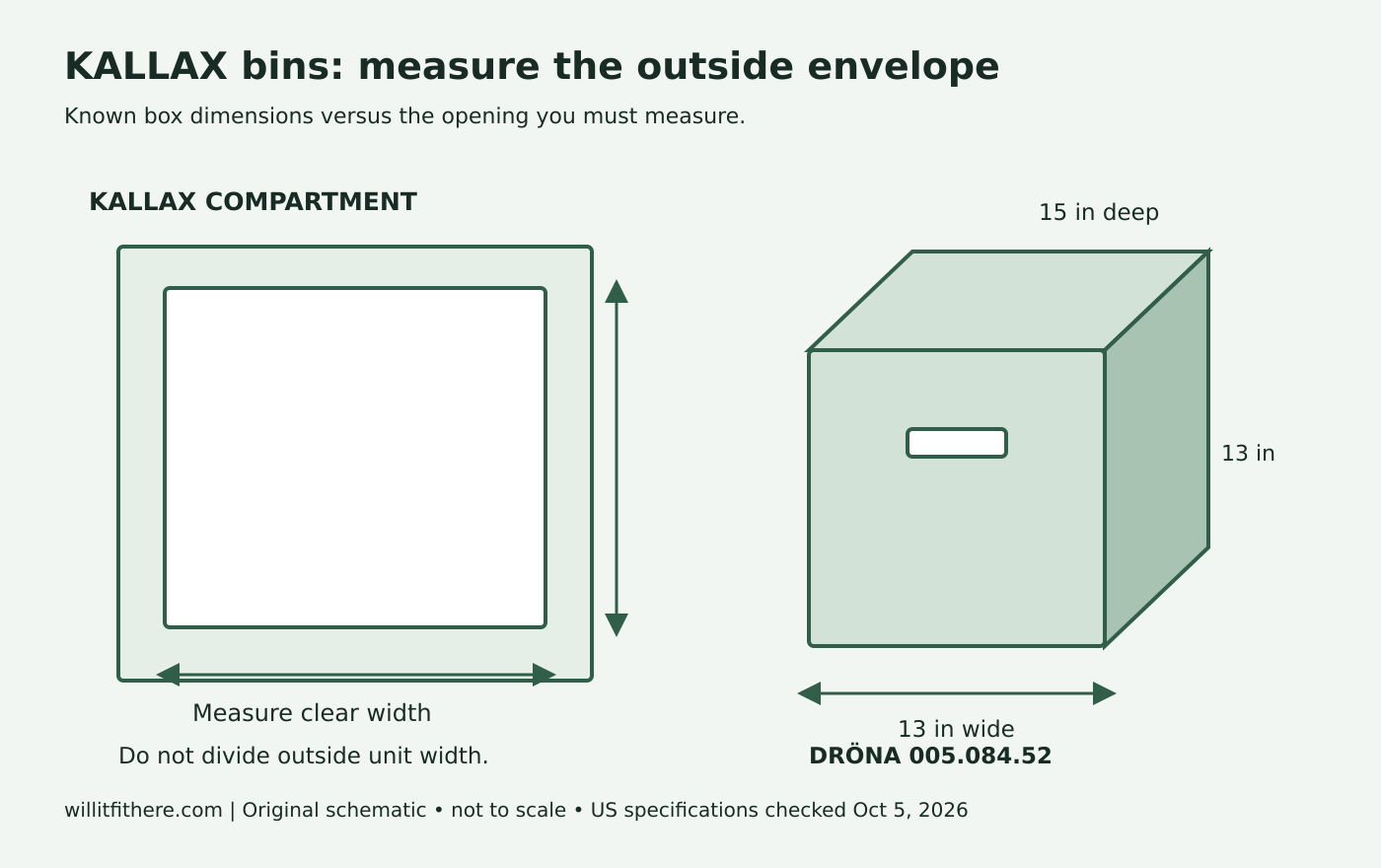
Measure a bin and a cube properly
- Measure the opening left to right at the front and farther inside. Use the narrowest clear width.
- Measure clear height at the front lip and inside the compartment. Include any fitted insert or hinge.
- Measure depth to the actual rear limit with the shelving in its final position. If the unit is against a wall, include that wall in the check.
- Measure the bin at its widest point, usually a rim, handle or lid rather than the base.
- Measure total height with the lid closed and with the contents packed as intended. A fabric top can bulge when overfilled.
- Measure front-to-back size including fixed projections. Then check that you can grip the handle and remove the box without scraping.
A straightedge is useful for irregular baskets: hold it against the widest projection so the tape records the outside envelope. Measure a sample if the retailer gives only a nominal size or inside dimensions.
Worked example: DRÖNA and a measured compartment
Suppose your own bare compartment measures 13¼ inches wide and 13¼ inches high at its narrowest points. Those numbers are hypothetical measurements for this example, not a published specification for every KALLAX. Against a DRÖNA’s 13-inch width and height, the calculated spare space is ¼ inch on each axis.
If centered, that is only ⅛ inch to each side, not ¼ inch on both sides. It is a dimensional screening result, not a guarantee against rubbing when the box is full or the shelf is slightly out of square. Test a single sample before buying a full set of third-party boxes.
Now compare a hypothetical rigid basket with a 12¾-inch base and a 13½-inch top rim. The base looks promising, but the rim is ¼ inch wider than the example opening. The smaller base does not rescue the fit. A “13-inch” product name would not have revealed that problem.
Depth is checked separately. Do not subtract the DRÖNA depth from the shelving unit’s outside depth and call the difference a guaranteed rear clearance. The box position, wall, shelf construction and acceptable front projection determine the usable space.
Check handles, lids and daily access
A bin can pass through the opening and still be inconvenient. Decide whether you need to remove the whole box or reach in while it stays on the shelf. A rigid hinged lid may need overhead room that the compartment does not provide, while a lift-off lid needs somewhere to be placed.
Pull handles should remain reachable in the intended position. If the handle recess is at the top, a near-zero top gap may make it awkward to use. If a handle projects out front, include it when checking a narrow walkway or the space behind a door.
Try the box with the things you intend to store. A soft-sided box that slides easily while empty may become wider when packed with bulky textiles. Do not rely on squeezing a loaded box past the frame, especially when its contents are fragile or sharp. Choose a little more usable clearance instead.
Common KALLAX bin mistakes
- Using total shelving width divided by the number of cubes as the opening size.
- Confusing a box’s internal storage dimensions with its external size.
- Buying a rigid basket by its base size while ignoring a flared rim.
- Assuming adding a lid will leave the dimensions unchanged.
- Checking one open cube and then filling a different cube that contains an insert.
- Assuming a flexible fabric box and rigid plastic box have identical tolerance for a close fit.
The shelving itself also needs to be installed correctly. The current KALLAX page requires secure anchoring and suitable screws and plugs for the home; IKEA advises professional help if you are uncertain. Storage boxes do not replace the required restraint. Follow the exact unit’s assembly and loading instructions.
Before-buy checklist
- Identify your KALLAX unit and whether the target compartment contains an insert.
- Record the narrowest clear width and height.
- Check usable depth with the unit in its final location.
- Find the bin’s maximum outside size, including handles, rim and lid.
- Confirm access for pulling the box out and handling its contents.
- Test one sample before ordering many close-fitting third-party bins.
- Keep the shelving’s anchoring and loading requirements separate from the bin-size check.
For the documented DRÖNA article, IKEA provides direct compatibility evidence. For an alternative basket, a measured sample is the most useful next step when the available listing does not clearly identify the outside envelope.
If you are comparing shelf bins with under-desk drawers, our IKEA ALEX under-desk fit guide explains which desk openings to measure before choosing drawer storage.
Sources and measurement notes
Product information checked October 5, 2026. These are US-market articles; use the number on your own product or order when checking another finish, size or production version.
- IKEA US DRÖNA box, 005.084.52 — 13 ×15 ×13-inch outside dimensions and explicit KALLAX compatibility.
- IKEA US KALLAX shelf unit, 206.316.39 — Current outside dimensions and required anchoring; not an internal-cube measurement.
The room examples and subtraction checks are planning calculations, not hands-on product tests or manufacturer fit guarantees.