Quick answer: Cabinet hinge sizes include more than the cup diameter. For a concealed replacement hinge, match the cabinet construction, door overlay or inset arrangement, cup diameter and depth, fixing pattern, hinge arm and mounting plate. Then check door thickness, opening angle and clearance. A 35 mm cup (about 1.378 inches) is only one measurement; it does not make two hinges interchangeable.
This guide covers concealed cup hinges on cabinet doors. If yours is a butt hinge, knife hinge, pivot hinge or other specialty fitting, use its manufacturer’s replacement information. Before loosening a hinge, support the door and arrange help for a heavy or awkward door. Never let its weight hang from one loosened fitting.
Start with the hinge system, not a shopping filter
Open the cabinet and photograph the hinge, its connection to the cabinet and any stamped numbers. Take a second photo of the whole door in its closed position. A close-up can identify a part; the wider view shows how that part is being used.
- Face-frame cabinet: a frame surrounds the opening at the front of the box. Record whether the hinge attaches to that frame or to a separate mounting arrangement.
- Frameless cabinet: there is no front face frame, and the hinge commonly connects to a mounting plate on the cabinet side panel.
- Special construction: corner doors, angled cabinets, glass doors and unusually thin doors need hardware specified for that application.
Save the hinge and plate codes separately. A number on the hinge cup may identify only part of the assembly. If the old hinge worked properly, its full model and matching plate are a stronger starting point than a product photo that looks similar.
How to measure cabinet hinge overlay
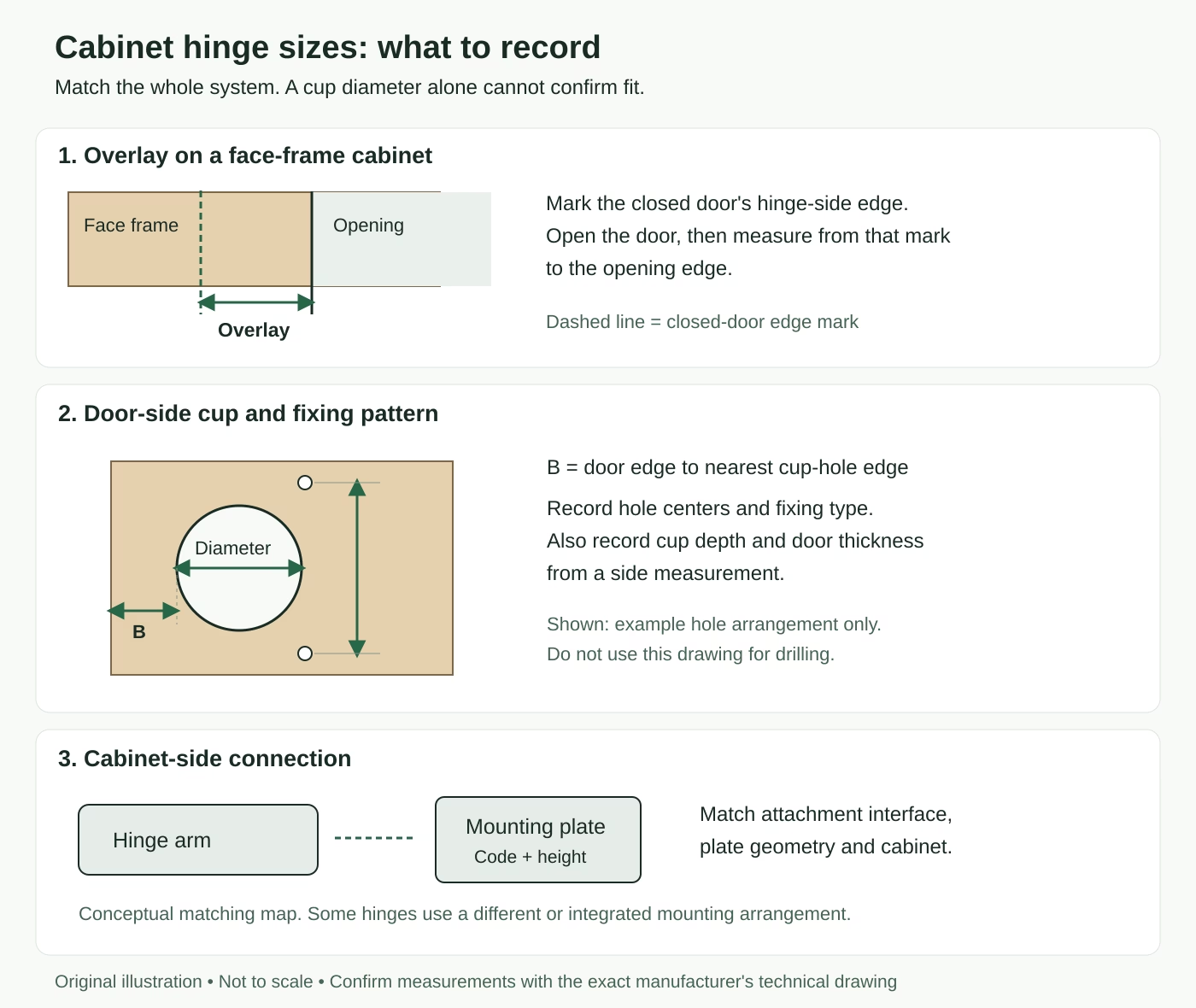
Overlay is the distance the closed door covers the cabinet opening’s edge. Measure it at the hinge side. Do this before removing the door, while you can still see its normal closed position.
- Close the door. On a face-frame cabinet, use a finish-safe removable marker, such as suitable low-tack tape, to record the door’s hinge-side edge on the frame. Test any tape on an inconspicuous area first.
- Open the door. Measure across the frame from the opening’s inner edge to your closed-door edge mark.
- Record the distance in inches and millimeters, and photograph the measurement. If the door is sagging or sitting crooked, flag that for the supplier rather than treating the current position as an ideal specification.
For example, an observed overlay of 1/2 inch is 12.7 mm. That is a measurement example, not the definition of “full overlay.” On a frameless cabinet, record the door’s coverage of the side panel and the panel thickness. Ask the supplier to confirm the correct reference edges if the construction is unclear.
Full overlay, half overlay and inset describe configurations. Full overlay generally covers most of the supporting frame or panel face; half or twin overlay is used where doors share a partition; an inset door sits within the opening. These labels do not assign one universal overlay dimension. For inset doors, record the gaps around the door and its position within the opening instead of inventing a positive overlay measurement.
Cabinet hinge sizes: cup, depth and fixing pattern
For a 35mm cabinet hinge replacement, measure the existing preparation and compare it with the proposed hinge’s technical drawing. Keep the metric product designation when ordering; a rounded inch conversion is useful for understanding size, not for selecting a drill bit.
- Cup-hole diameter: measure the circular recess in the door, not the outside width of the hinge’s metal flange.
- Cup-hole depth: measure from the back surface of the door to the flat recess floor. Check the product’s required boring depth separately from the metal cup’s own height.
- Boring distance: record the distance from the door edge to the nearest edge of the cup hole. Do not confuse this with door-edge-to-cup-center distance.
- Fixing pattern: record hole centers, their position relative to the cup, and whether the fitting uses screws, dowels or another fastening system. There is no universal 45 mm screw spacing for every concealed hinge.
- Door thickness: measure the door where the hinge is installed. Note any shaped edge or profile that affects the available material.
If measuring the recess requires removing a hinge, first support the door and follow the hinge’s removal instructions. Do not pry out unfamiliar press-in or expanding fittings just to get a measurement. A supplier may be able to identify the preparation from the exact hinge model and photos.
Manufacturer examples show why depth matters
Blum’s CLIP top BLUMOTION assembly page says its boring pattern matches CLIP top, while the boring depth changes to 13 mm. Its 110° and 110°+ technical leaflet, pages 4–5, specifies 35 mm cup holes and a minimum 13 mm boring depth for the holes shown. Those are requirements for the listed hinges, not every concealed hinge.
| Product example | Manufacturer’s stated depth | Converted reference |
|---|---|---|
| CLIP top BLUMOTION 110° / 110°+ leaflet | 13 mm minimum boring depth | About 0.512 inch |
| COMPACT CLIP 30C2 and 31C1 | 7/16-inch cup depth | 11.1125 mm |
| COMPACT CLIP 31C3 | 1/2-inch cup depth | 12.7 mm |
The COMPACT CLIP values come from Blum’s series-specific product descriptions. “Cup depth” and “minimum boring depth” are preserved as the manufacturer states them. Use the exact model’s installation drawing to determine the preparation it requires. Inch conversions use 1 inch = 25.4 mm; they do not imply interchangeability.
Match the hinge arm and mounting plate
The mounting plate is the cabinet-side part that many concealed hinges attach to. Check its product code, attachment interface, height, fixing layout and position on the frame or panel. A clip-on connection that looks familiar is not proof that another brand’s hinge will lock onto it correctly.
Plate height also affects the door’s final position. The Blum planning tables show overlay changing with plate height and boring distance for the specified hinge. That is why a generic “full overlay hinge” can still be the wrong replacement.
Ask whether the proposed hinge can reuse the existing plate. If not, ask for the complete compatible hinge-and-plate combination and confirmation that its fixing pattern and geometry suit the existing cabinet. Matching the door cup while leaving the cabinet-side connection unresolved is only half a fit check.
Check opening angle, door thickness and clearance
A replacement must work throughout its swing, not just look aligned when closed. Note nearby walls, adjacent doors, projecting handles and any internal pull-out that has to pass the open door. Record the original hinge’s stated opening angle if you can identify it; do not force the door farther open to estimate a larger angle.
Check the proposed model’s permitted door thickness and minimum gap or reveal requirements. Also ask whether it moves the door far enough out of the opening for existing pull-outs. A wider opening angle alone does not establish that clearance.
If you are replacing the pull-outs too, take a separate set of measurements using our drawer-slide replacement guide. Door clearance and slide dimensions both matter, but they are different checks.
Take this measurement worksheet to the supplier
Copy this list into your notes and attach clear photos. Leave an uncertain field marked “unknown”; a guessed dimension can send the search toward the wrong part.
- Cabinet: face frame / frameless / other: ______; manufacturer or furniture model: ______.
- Existing hardware: hinge brand and full code: ______; mounting plate code: ______; photos attached: ______.
- Door arrangement: overlay / shared-partition overlay / inset / specialty: ______.
- Hinge-side overlay: ______ inches / ______ mm; or inset gaps and setback: ______.
- Door: thickness ______; height ______; width ______; material ______; existing hinge count ______. Include known weight if available.
- Cup preparation: diameter ______ mm; recess depth ______ mm; edge-to-cup-hole-edge distance ______ mm.
- Door fixings: screw / dowel / other ______; center-to-center spacing ______; positions relative to cup ______.
- Cabinet fixing: plate height or code ______; hole layout and attachment location ______.
- Motion: existing opening angle ______; soft-close wanted ______; walls, handles or pull-outs needing clearance ______.
- Condition: sagging door, loose screws, cracked material or damaged holes ______.
Ask the supplier: “Which exact hinge and mounting plate match these measurements? Can I reuse the existing holes and plate? Please confirm the required boring depth, door-thickness range, overlay and opening clearance from the product drawing.”
If you are refreshing handles at the same time, record their hole spacing separately with our cabinet-pull measuring guide. Pull dimensions do not identify the hinge.
Common replacement problems and what they mean
- The cup fits, but the door sits too far left or right: recheck overlay, boring distance and the hinge-and-plate combination before relying on adjustment.
- The hinge will not seat against the door: the recess depth or fixing system may be wrong. Do not force it or deepen the hole without the correct technical requirements and suitable help.
- The arm will not connect to the plate: confirm the approved mounting interface and exact plate code.
- The door closes but hits something when opened: check the opening geometry, surrounding clearance and any specified restriction accessories.
- The hinge moves because its screws will not hold: damaged holes or cabinet material need an appropriate repair assessment. Buying another hinge with the same cup diameter does not restore the mounting strength.
This is a measurement and selection guide, not a drilling or repair template. Stop if the door cannot be supported safely or the cabinet material is damaged. Have a cabinet installer or the hardware manufacturer assess the next step.
Cabinet hinge questions
Are all 35 mm cabinet hinges interchangeable?
No. A matching cup diameter still leaves depth, fixing pattern, overlay geometry, plate compatibility and clearance to check. Use the full hinge model and mounting system whenever possible.
Can I replace ordinary hinges with soft-close hinges?
Often there is a suitable upgrade, but confirm it for the existing preparation and door. A new soft-close mechanism may require different depth or hardware. Give the supplier both the current hinge code and your measurements.
Does full overlay mean 1/2 inch?
No. Full overlay describes a door arrangement. Measure the actual coverage at the hinge side and use the selected hinge’s planning information.
Can I measure only the old hinge?
Its markings are useful, but also measure the door and cabinet. The old hinge may be mismatched or the door may have shifted. Photos, construction details and the worksheet make replacement cabinet hinge compatibility much easier to confirm.
Source note: Product examples were checked against the linked Blum documentation on October 4, 2026. The technical leaflet is an older manufacturer reference; current model instructions control the final selection. This guide is based on documentation and measurement reasoning, not hands-on product testing.