Quick answer
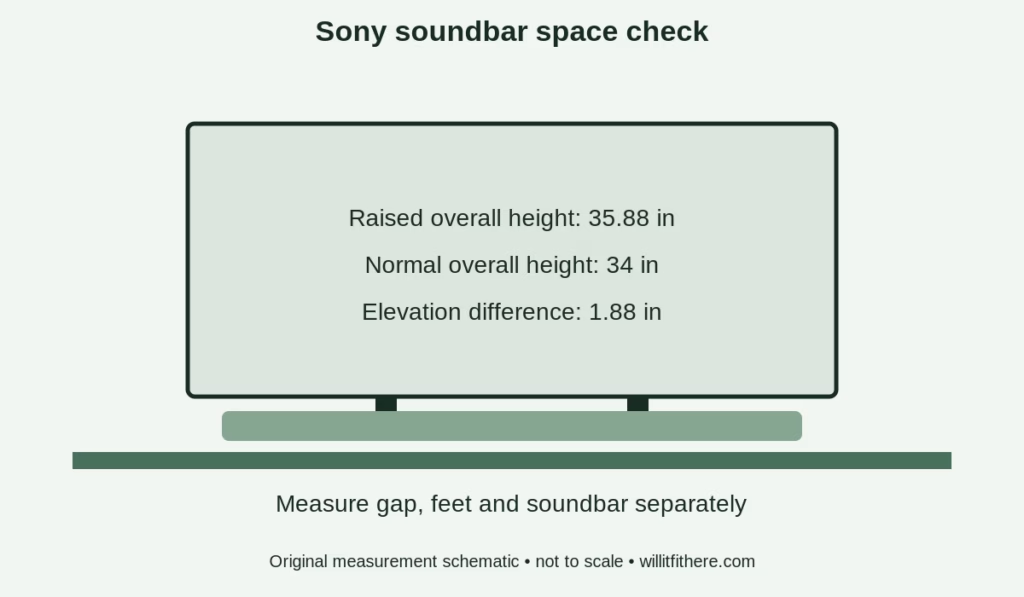
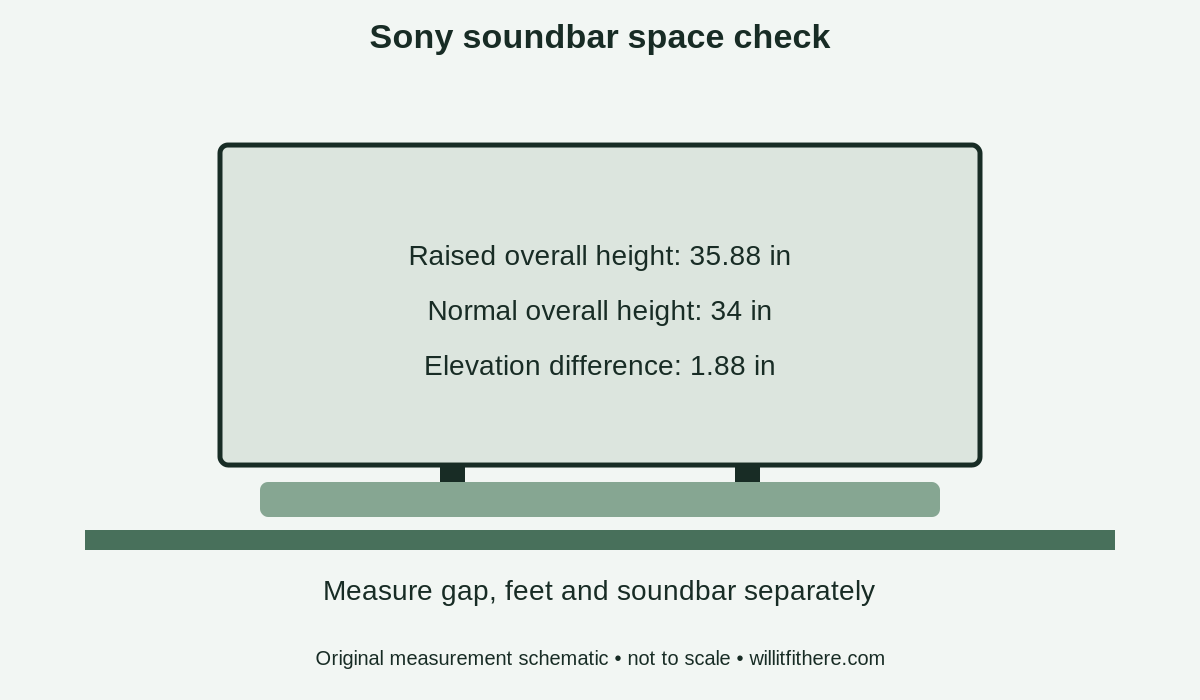
The 65-inch Sony K-65XR50 has an inside stand position and a raised inside-for-soundbar position. Sony lists overall heights of 34 and 35.88 inches respectively. The 1.88-inch difference is extra TV elevation, not a guarantee that a particular soundbar fits underneath.
1. Confirm the television and stand position
This guide concerns the US 2025 BRAVIA 5 K-65XR50. Do not substitute BRAVIA 7, BRAVIA 8, a larger BRAVIA 5 or a different region’s stand layout. A familiar family name does not establish the same foot spacing or clearance. Photograph the TV’s model label and identify the position used by the supplied stand.
Sony’s US specifications identify two positions: inside and inside for soundbar. Use the model setup guide for the supported assembly configuration. This article compares space; it does not replace the setup procedure or authorize improvised risers.
2. Read the published dimensions correctly
| Published item | K-65XR50 figure | What it establishes |
|---|---|---|
| TV with stand: inside | 57 × 34 × 13.63 in | Overall assembled envelope |
| TV with stand: soundbar | 57 × 35.88 × 13.63 in | Raised overall envelope |
| Inside stand width | 18.75 in | Published stand width, not clear opening |
| TV without stand | 57 × 32.88 × 2.38 in | Bare television envelope |
Sony also lists separate stand-part dimensions. Those are not automatically the unobstructed gap below the screen. Neither the published stand width nor an individual foot’s width should be treated as the free distance between feet without checking what the dimension endpoints represent.
3. Measure the usable gap at the soundbar location
Start at the cabinet surface and measure to the lowest obstruction over the soundbar’s proposed position. Depending on the layout, that may be the lower television housing, a sensor area or a stand component. Measure at the left, middle and right of the proposed soundbar, and at both its front and rear edges.
Then measure the soundbar at its tallest point, including its feet and any raised control area. Use the intended orientation. Record its width and depth as well; a soundbar that is low enough may collide with a foot or extend beyond the usable shelf. If it sits in front of the television rather than directly below it, check the sightline from the actual seating position.
Keep a small geometry sketch showing the screen, feet and soundbar as separate shapes. That is more useful than a single note saying “three inches of space,” because the narrowest point may occur only over one part of the soundbar.
4. Use subtraction as a screening calculation
The published raised and normal assembled heights differ by 35.88 − 34 = 1.88 inches. This tells you the approximate change in overall elevation between the listed positions. It does not mean the normal position already has 1.88 inches of free soundbar space.
Subtracting bare-TV height from raised assembled height gives 35.88 − 32.88 = 3.00 inches. That is a nominal geometric estimate based on rounded overall dimensions, not a certified minimum unobstructed clearance. Sony’s independently rounded metric figures can produce a slightly different result; do not treat either subtraction as a precision measurement.
For a practical example, imagine you measure an actual minimum clear gap of 3.1 inches and your soundbar measures 2.7 inches at its tallest point. The vertical remainder is 0.4 inch. That passes the simple height screen, but you still need the soundbar manufacturer’s operating clearances, unobstructed speakers, and space around stand parts and cables.
5. Map the soundbar and stand from above
Make paper outlines of the soundbar and the occupied stand areas using measured dimensions. Place them on a sketch of the usable cabinet top. A soundbar wider than the distance between the feet might work in front of them, but cannot be assumed to slide between them. Conversely, a narrow soundbar may reach too far back and collide with a stand.
In a hypothetical layout, a 16-inch usable shelf depth minus a 4.5-inch soundbar depth leaves 11.5 inches behind the bar. That is not automatically enough for the TV’s stand because the shapes may overlap, or they may need to remain separate. Compare the actual outlines and intended front edges rather than adding or subtracting rectangles indiscriminately.
Include connector projection and the natural cable route. A right-angle connector or different cable is not a universal solution: verify compatibility and space with the equipment you actually own. Avoid a layout that depends on crushing cables against the cabinet.
6. Keep the screen, sensors and speakers usable
Check whether the proposed bar blocks any visible image from your normal seat. The physical bottom of the TV and the bottom of the active image are different reference lines. A bar placed in front can appear acceptable while standing nearby but obstruct the view from a low sofa.
Identify the television’s remote-control sensor using its documentation. Keep its required line of sight clear and test the controls after normal setup. Do not assume that every command uses the same wireless method or that a soundbar’s repeater solves all obstruction problems.
Also consult the soundbar’s placement instructions. Upward- or side-directed speakers may need clear space that a shelf or television housing removes. Physical fit is separate from acoustic performance and from HDMI or other electronic compatibility.
7. Check the complete arrangement before buying
- K-65XR50 model and supported stand position confirmed.
- Actual minimum gap measured across the soundbar footprint.
- Soundbar height includes feet and raised details.
- Foot collisions and front-to-back shelf space checked.
- Screen sightline and remote sensor remain unobstructed.
- Soundbar speaker clearances and cables have room.
- Furniture supports the combined equipment load.
If the television is not yet available to measure, ask the seller for the clearance at the specific soundbar location. Send the bar’s width, height and depth with that question. A reply quoting only the TV’s total assembled height does not resolve the under-screen gap.
When the layout is marginal, select a lower-profile soundbar or a different supported furniture arrangement rather than modifying the stand. Do not balance feet on loose blocks to manufacture a clearance that the supplied configuration does not provide.
8. Sources, limits and next step
The dimensions and two-position identification come from Sony’s K-65XR50 US specification page, checked October 5, 2026. The Sony manuals page links the model setup guide. The 1.88-inch increase and 3.00-inch estimate are calculations, not separately published clearance guarantees.
The safest buying answer is specific: this soundbar’s measured envelope clears this television in its documented stand position, with the necessary operating space. Without that comparison, the presence of a “soundbar position” is encouraging but incomplete evidence. Keep height, footprint and everyday operation as separate checks.