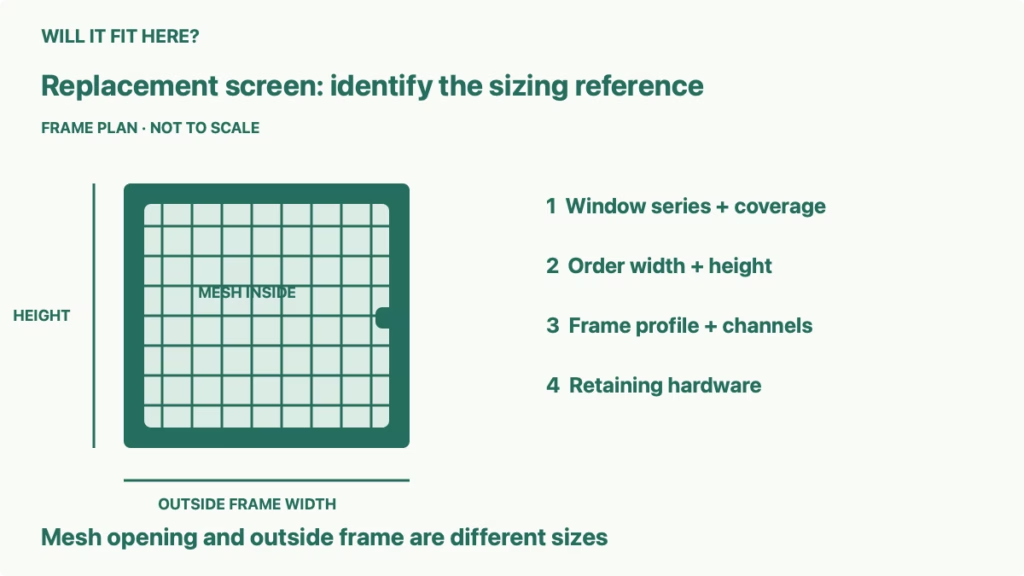
Quick answer: Replacement insect screen fit depends on the correct window series, complete frame dimensions, frame profile and retaining hardware. Measure using the manufacturer’s reference points. The mesh opening, visible glass and outside screen-frame size are different measurements; do not substitute one for another when ordering.
You have a damaged removable screen or a missing screen and want a replacement that seats securely in the window. Start with the product identity and the required order dimensions. A rectangle with matching width and height can still fail if its frame thickness, channel engagement or latch arrangement belongs to another window series.
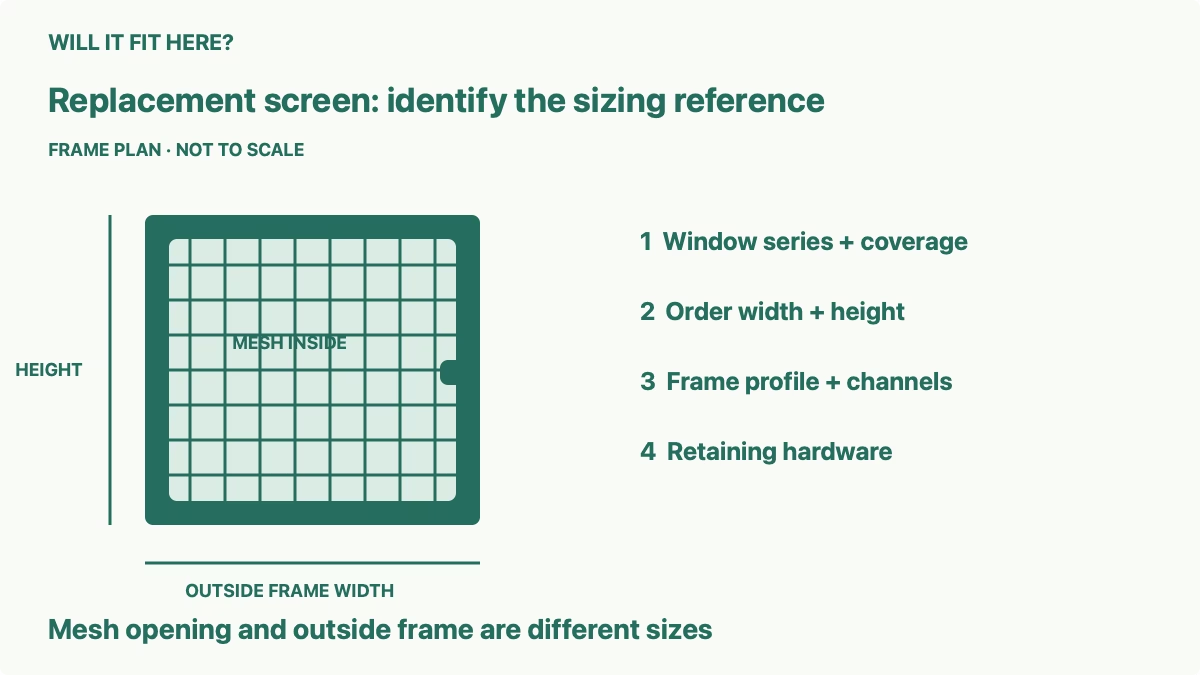
1. Identify the window before replacement insect screen fit
Record the window brand, product series and size code where available. Note whether it is hung, casement, awning or sliding and whether the required screen covers the full opening or only part of it. Similar exterior dimensions do not establish interchangeable parts.
Record information on the existing screen frame if it can be read safely. A model code, retaining-clip position or corner profile can help identify the original product. Treat it as a clue to verify with the manufacturer rather than guessing from color or mesh appearance.
If the original screen is missing, use the window manufacturer’s sizing method for that series. The correct method may use a unit code, specified opening references or another defined measurement. Ask for the method before producing a custom outside-frame size from a visible-glass reading.
Keep the selected replacement description with the worksheet. “White insect screen” is too broad; the correct series, coverage, frame and hardware must remain attached to the dimensions throughout the order.
2. Distinguish frame, mesh and channel dimensions
For an existing removable frame, outside width and height run between the farthest frame edges. The mesh opening is the clear area inside those members. Mark which one is being measured so that the frame rails are not accidentally omitted.
Measure the existing frame at several locations and check whether it is distorted. A bent corner can make a damaged screen a poor ordering reference. Do not average a damaged shape into a replacement size without the manufacturer’s guidance.
For a missing frame, identify the exact channel or sill points shown in the official measuring guide. A channel-to-channel distance is not automatically the finished screen width. Some products require a prescribed deduction, while another dimension may be ordered directly.
A hypothetical outside frame measuring 30 inches wide with 1-inch members on each side has a 28-inch inside opening. Ordering a 28-inch outside frame because the mesh opening was measured would change the intended fit substantially. The example demonstrates reference-point error, not a product specification.
3. Use only the selected series’ measuring rule
The Andersen custom-screen guide cited here applies to 400 Series Woodwright and Tilt-Wash double-hung windows. It measures width at the sill, 6 inches above it and the midpoint, then uses the smallest reading minus 1/8 inch. Height uses the smaller of center and edge readings at the shown sill and head-channel points.
That width deduction belongs to this guide. Do not subtract 1/8 inch from every screen dimension or apply it to another window system. Copy the correct reference and adjustment into your worksheet before taking the final reading.
The same guide says to include the tape-measure housing dimension and keep the tape level. Record the entire measurement method, especially if you are using a tool differently from the illustrated setup. A small reference error can consume the intended clearance.
The document is revised April 7, 2005 and remained available on the official site when checked. Confirm applicability to your exact current or older window with Andersen before ordering. A date of access does not make an older guide universal.
4. Compare frame profile and retention hardware
Check frame depth or thickness using the replacement’s confirmed specification. A matching rectangle can sit proud of the intended channel or fail to engage it if its profile is different. Compare the whole cross-section where the manufacturer provides it.
Record the positions and types of latches, pins, clips, springs or pull tabs on the intended product. These are part of the compatibility check rather than optional decorations. Verify them against the window’s specified retention system.
Check the permitted insertion and removal path. A replacement may need to enter a channel at a particular angle before seating. Do not assume that a frame small enough to pass through the opening will then retain correctly.
Do not force an incompatible frame or improvise retaining hardware. A physical gap or unstable seating should lead to a parts and dimension review with the manufacturer. An insect screen is not a fall-protection barrier.
5. Check the opening’s condition and order record
The cited Andersen guide separately checks diagonals and frame straightness before its custom sizing procedure. It says a diagonal difference beyond 1/4 inch or straightness variation beyond 1/16 inch prevents its custom screens from fitting. Those thresholds apply to that guide’s window assessment.
If the frame appears distorted or the channels are damaged, have the manufacturer or an experienced contractor assess the window. This measurement guide does not provide structural adjustment or permission to alter the opening.
Take measurements only from a safe position. For elevated, inaccessible or uncertain access, arrange qualified assistance. Do not lean through a window opening to retrieve a missing dimension or rely on a screen for support.
Order with the actual finished dimensions or unit information requested by the supplier. The cited Andersen guide asks for recorded dimensions rather than describing a standard screen to be cut down. Keep the series, width reference, height reference, frame profile and hardware together on the order record.
| Item | What to verify |
|---|---|
| Window identity | Brand, series, size and screen coverage |
| Width and height | Correct reference points and series-specific adjustments |
| Frame profile | Compatible thickness and channel engagement |
| Retention | Required hardware type and location |
| Opening condition | Distortion resolved before a custom order |
Common questions
Can I order from visible glass dimensions? Only if the manufacturer explicitly uses that reference for your series.
Should I subtract the same clearance from every screen? Use the exact product’s prescribed sizing method.
Does matching width and height guarantee fit? Frame profile, retention hardware and opening condition also matter.
For another mounting comparison, see bidet attachment fit. Browse the Installation & Setup guides for separate compatibility checks.
Official source and limits
Checked October 7, 2026: Andersen custom insect screen measuring guide 0005415. Its stated scope is the identified 400 Series double-hung windows. Examples are hypothetical; no firsthand replacement installation or universal cut size is claimed.