Quick answer
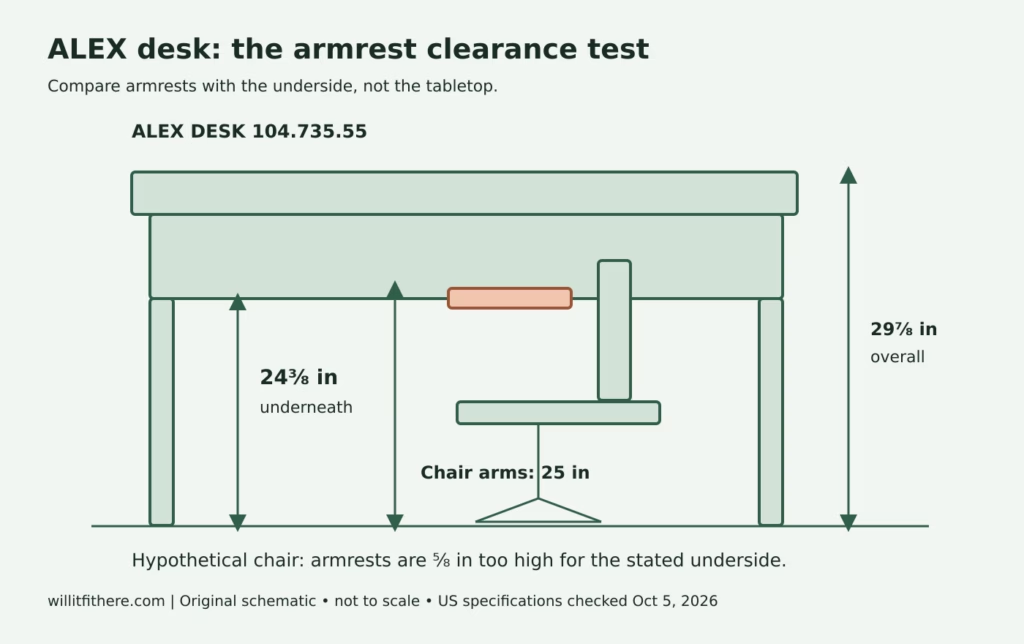
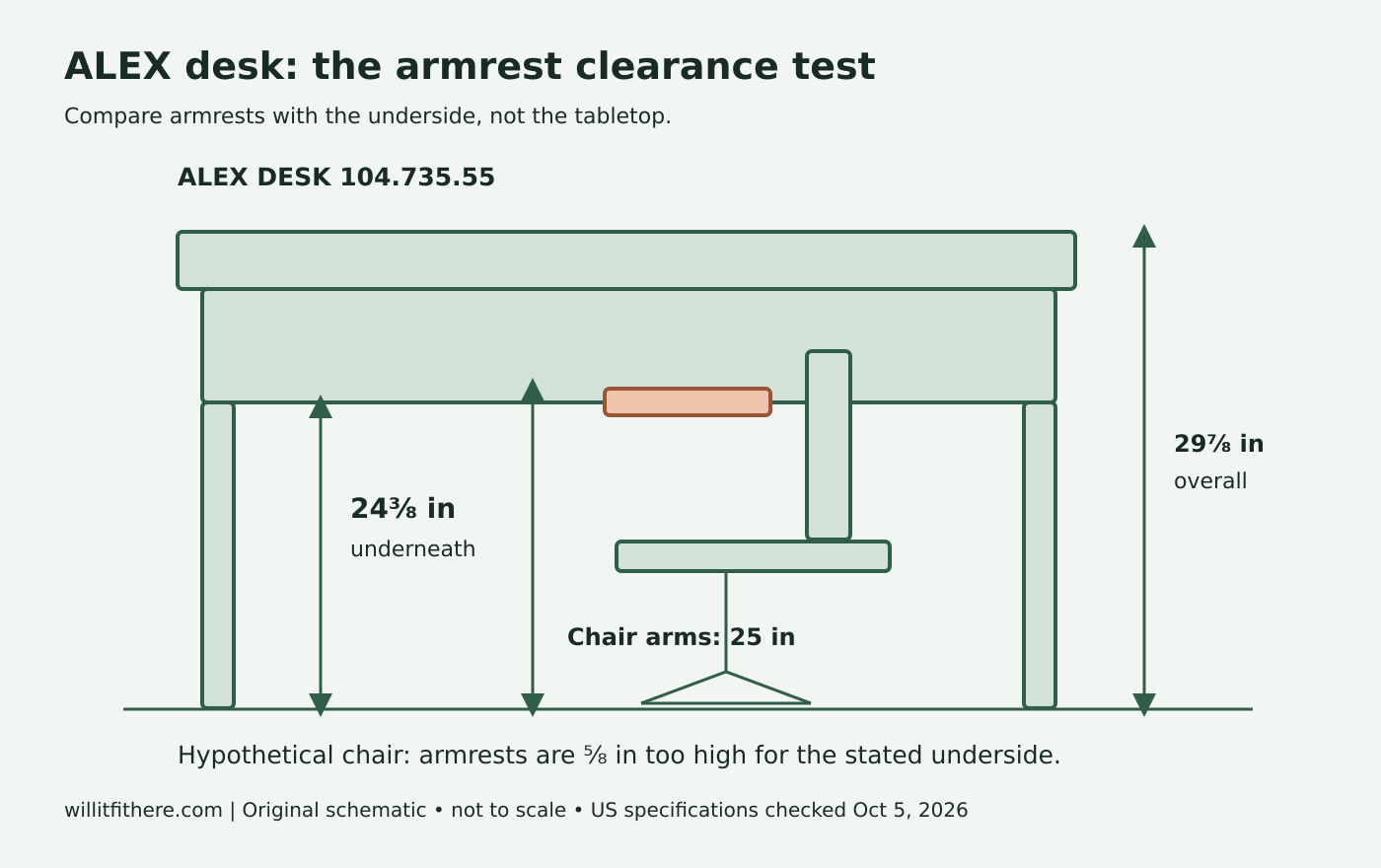
For the compact white ALEX desk 104.735.55, IKEA lists 24⅜ inches of height under the furniture, even though the desk is 29⅞ inches high overall. Your chair’s armrests must clear the actual underside on the way in. You also need enough width between obstructions and enough depth for the chair base; seat height alone cannot answer the fit question.
Confirm the exact ALEX desk
This article covers the white 39⅜ ×18⅞-inch ALEX desk, article 104.735.55. It has built-in drawers below the worktop. Other ALEX desks and tabletop combinations can have different clearances, so match the article number before applying this guide.
There are two useful versions of “fit”: being comfortable to sit at the desk and pushing the empty chair farther underneath for storage. A chair might pass the first test while leaving its arms or back outside the desk footprint. Decide which result you need before comparing numbers.
Do not choose a chair solely because its lowest adjustment lets it tuck away. Record the seat setting that suits the user, then check storage separately. A successful parking test does not demonstrate a comfortable working position.
Overall desk height is not armrest clearance
| Desk dimension | IKEA 104.735.55 | What it answers |
|---|---|---|
| Overall height | 29⅞ in | Height to the top of the desk |
| Height under furniture | 24⅜ in | Published underside-height reference |
| Overall width | 39⅜ in | Desk exterior; not clear leg spacing |
| Overall depth | 18⅞ in | Desk exterior; not guaranteed chair insertion depth |
Metric reference: the desk’s listed overall dimensions convert to approximately 100.0 cm wide × 47.9 cm deep × 75.9 cm high. Its 24⅜-inch underside height converts to approximately 61.9 cm; use that underside dimension when screening armrest height. Values are approximate conversions of the cited US inch measurements, not separate regional product specifications.
Source: IKEA US ALEX desk measurements. The 5½-inch difference between the overall height and underside-height reference explains why using tabletop height can give a misleading armrest result. It should not be interpreted as a measurement of every individual frame or drawer part.
The published outside width also does not tell you the free gap between the legs. Check that opening on the actual assembled desk or ask IKEA for the relevant clear measurement. A chair with widely spaced arms may fail horizontally even if its arms are low enough.
Measure the chair at your real seat setting
- Put the chair on the floor surface where it will be used and set the seat to your normal working height.
- Measure floor-to-top height at the tallest part of each armrest. Include pads, adjustment buttons and upward-curved ends.
- Measure the maximum outside width across the arms. Repeat farther back if their shape changes.
- Measure the chair base at its widest span and note how far the casters project beyond the seat.
- Measure the actual desk opening at the front and along the path the arms will travel. Include the lowest drawer housing or crossbar.
- Roll the chair in slowly without forcing it. Stop at first contact and identify which part limits the movement.
For a chair you have not bought, request floor-to-armrest measurements across the seat-height range. A specification for “arm height above seat” needs the corresponding seat height before it can be compared with a floor-to-desk measurement.
Worked example: high arms and adjustable arms
Suppose a chair’s armrest tops are 25 inches above the floor at the user’s normal seat setting. Compared with the compact ALEX desk’s 24⅜-inch underside reference, the arms are 25 − 24⅜ = ⅝ inch too high. The 29⅞-inch tabletop height is irrelevant to that collision.
Now suppose a different chair has adjustable arms that can reach 23¾ inches above the floor without changing the working seat setting. The calculated vertical spare space is 24⅜ − 23¾ = ⅝ inch. That clears the published height comparison, but width and the actual insertion path still need testing.
For a separate width illustration, assume you measure 31 inches between the limiting desk obstructions and the chair measures 28 inches across its arms. The total difference is 3 inches, or 1½ inches per side if centered. The 31-inch opening and both chairs are hypothetical; they are not additional IKEA or chair-manufacturer specifications.
Keep the results separate on your shopping note: vertical clearance, horizontal clearance and parking depth. A pass on one line cannot offset a failure on another.
Check the chair base and the working position
After the arms clear, the star base may meet a desk leg or rear obstruction. Swiveling can change which caster reaches a leg first. Check a realistic range of chair positions instead of testing only one carefully aligned orientation.
The backrest can also stop the chair from disappearing beneath the desk, even with the arms lowered. If your aim is a clear walkway behind the desk, measure the remaining projection of the parked chair. Do not equate the desk’s shallow depth with the amount of chair it can contain.
For working use, check your knees and thighs beneath the drawer section and make sure you can sit close enough to the work surface. If lowering the entire seat solves arm collision but makes the position unsuitable for the user, it has not solved the working-fit problem. Consider a compatible chair design or a different desk rather than accepting an uncomfortable setup.
Common chair-clearance mistakes
- Comparing arm height with the desk’s top surface rather than the underside.
- Using the chair’s seat height as though it were the height of the arms.
- Mixing armrest-above-seat measurements with floor-to-armrest measurements.
- Assuming the desk’s total width equals the clear width between its legs.
- Testing a chair on a hard shop floor and overlooking the rug in the home office.
- Forcing arm pads under a drawer housing or assuming they will compress enough.
- Removing chair arms or desk braces without explicit manufacturer support.
Measure an adjustable chair both empty and in normal use when that changes the fit. For parking, the empty chair is the relevant case. Record which state was measured so a close comparison does not depend on an unstated assumption.
Before-buy checklist
- Match desk article 104.735.55 or obtain your own model’s measurements.
- Use 24⅜ inches as the published underside reference for this desk.
- Measure floor-to-armrest height at the intended seat setting.
- Check the widest arm spacing against the actual clear desk opening.
- Check the base, casters and backrest along the parking path.
- Measure any chair projection into the walkway.
- Test comfort at the desk separately from empty-chair storage.
- Use only manufacturer-supported adjustments and configurations.
The most useful buying question is specific: “What is this chair’s floor-to-armrest height at my working seat setting, and will its full width pass this measured opening?” That is much more reliable than asking whether a generic office chair fits an ALEX desk.
Sources and measurement notes
Product information checked October 5, 2026. These are US-market articles; use the number on your own product or order when checking another finish, size or production version.
- IKEA US compact ALEX desk, 104.735.55 — 39⅜-inch width, 18⅞-inch depth, 29⅞-inch overall height and 24⅜-inch height under furniture.
The room examples and subtraction checks are planning calculations, not hands-on product tests or manufacturer fit guarantees.