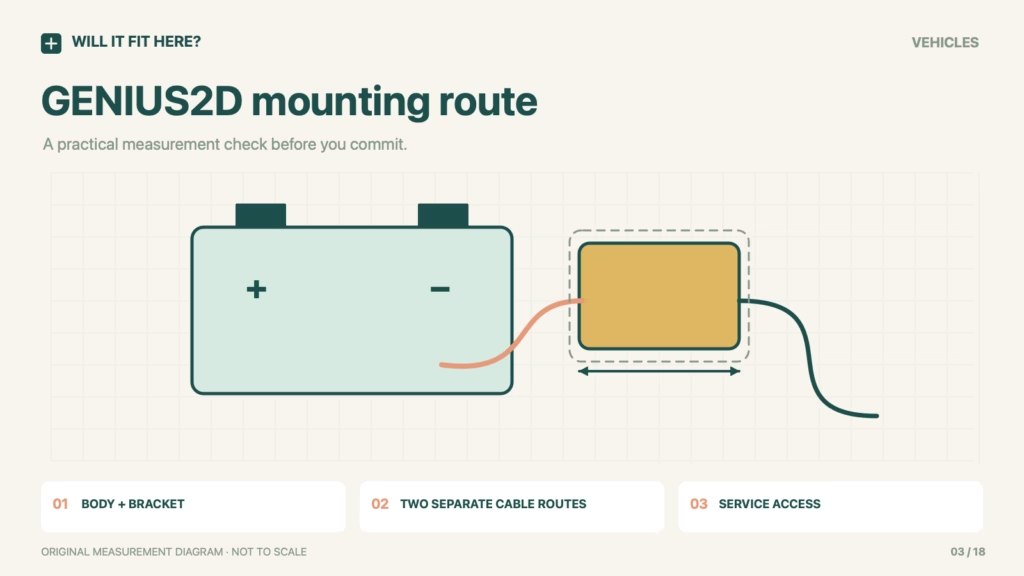
Fit verdict — Conditional. NOCO GENIUS2D fit requires a supported mounting location and workable cable routes near a compatible battery. NOCO’s current specifications list a 3 × 3.5 × 1.6-inch body (H × W × D), with 24-inch AC and DC leads. The body can fit a recess while the bracket, connectors or routed leads do not. Confirm the battery application and mounting instructions before treating a compact footprint as installation approval.
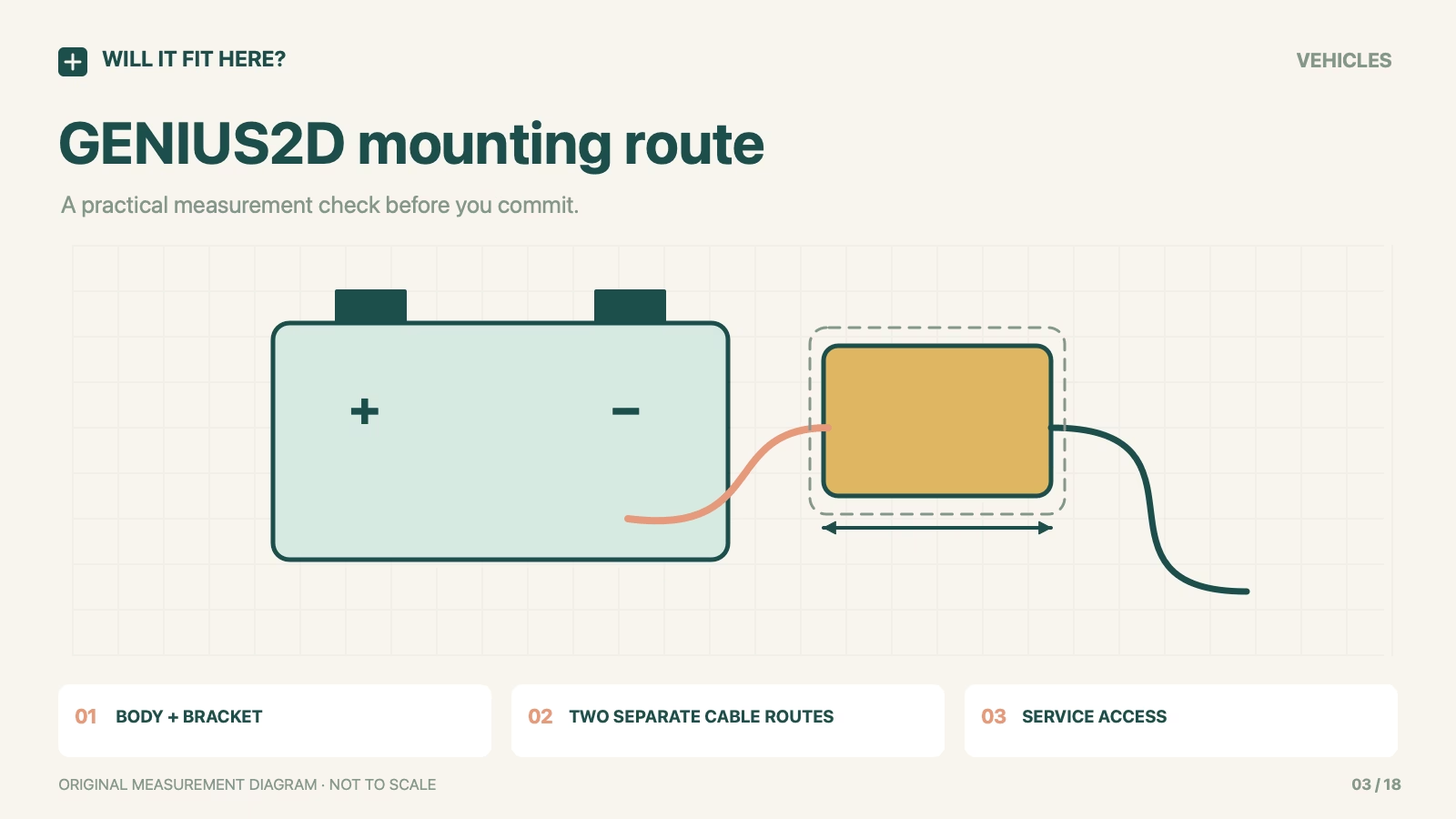
NOCO GENIUS2D fit: scope
NOCO GENIUS2D direct-mount charger. This checks physical placement and route planning; it does not prescribe a vehicle-specific electrical installation.
Dimensions and conditions
| Check | Reference or condition | What it means |
|---|---|---|
| Body reference | 3 × 3.5 × 1.6 in, H × W × D | Current NOCO technical specifications. |
| AC lead | 24 in published length | Measure the routed approach, not a straight-line gap. |
| DC lead | 24 in published length | Include the approach to the approved battery connection. |
| Battery application | 12 V lead-acid types identified by NOCO | Do not infer lithium compatibility from the body size. |
| Bracket and service space | Measure the actual installed assembly | The bare body does not include every usable clearance. |
1. Template the complete NOCO GENIUS2D mounting assembly
Trace the actual bracket and body together, showing the direction in which the unit is installed and removed. Mark the screw approach and room for the leads as they leave the housing. Do not place a body-only rectangle over an engine-bay photograph and call the fit complete. The useful question is whether the charger can be mounted and serviced as instructed without relying on a flexible hose, cover or moving part for support.
2. Follow the routes with a flexible measuring tape
Measure each proposed cable path independently. A path around a battery cover or existing loom is longer than the shortest line between endpoints. Record the intended entry and exit directions, then check the full route against the matching manual’s requirements for moving parts, heat and sharp edges. Do not stretch a lead across an unsuitable route simply because the published length appears close. Keep access to normal vehicle service points in the plan.
3. Check the hood and the parked charging arrangement
Inspect the space above the mounting location as well as the flat mounting face. Closing panels and insulation can intrude into a space that looks open with the hood raised. Plan the stationary AC approach separately from the DC route and follow NOCO’s instructions for connection and disconnection. Photograph or sketch the proposed arrangement for an installer if the mounting substrate or routing is uncertain. Never infer an approved driving arrangement from a successful parked fit check.
Before you decide: 5 checks
- Identify GENIUS2D and the battery chemistry and voltage before measuring.
- Template the body, bracket, fasteners and lead exits together.
- Measure the real AC and DC routes independently.
- Check panel closure, heat, moving components and routine service access.
- Use NOCO’s current mounting and charging instructions before installation.
FAQ
Can the cable lengths simply be added into one 48-inch reach?
No. The AC and DC leads serve different connections. Each route must work independently.
Is IP65 permission to mount it anywhere?
No. An enclosure rating is not an approval of a mounting surface, cable route or battery application. Follow the matching location and mounting instructions.
Can I reuse measurements for the GB40 jump starter?
No. A direct-mount charger and a portable jump starter have different bodies, connections and use conditions.
Official sources and scope
Checked on 26 October 2026. The cited product, variant and region control. Follow the matching current instructions. The measurement workflow is editorial guidance; no firsthand installation or universal fit is claimed.