Quick answer
A dog crate fits a refreshed Model Y only if its full exterior envelope passes the hatch and clears the seats, trim and closed liftgate in your exact configuration. Tesla’s cargo-volume figures cannot prove that. Test a full-size empty template or the actual empty crate before buying.
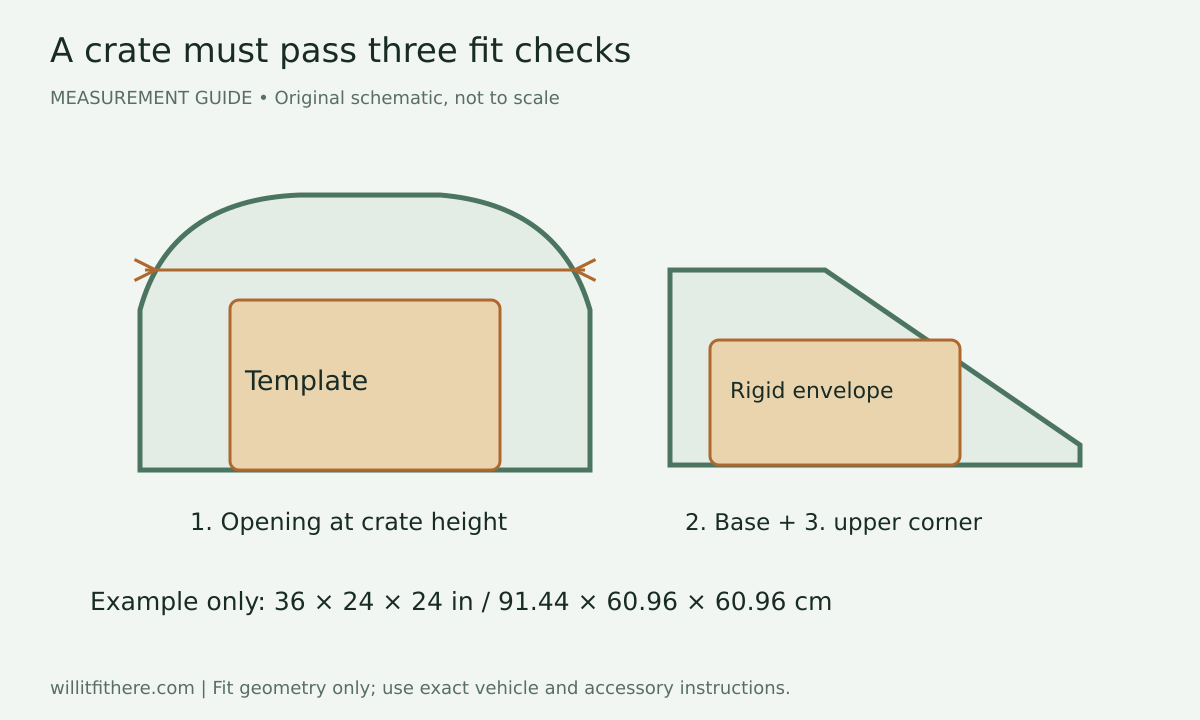
Identify the exact Model Y before measuring
Start with the vehicle’s build and seating configuration. “2025+ Model Y” is not a single cargo measurement. Tesla’s current US owner’s manual dimension page separates several configurations, including different seating arrangements. A measurement from a pre-refresh car or a different row layout may answer the wrong question.
Choose the seats you actually need for the trip and leave them in their intended positions. A crate that fits with a rear row folded has not passed a seats-up test. Keep the load floor, cargo liner and any installed accessories in their normal positions for the comparison.
Record the vehicle configuration alongside every measurement. A phone note labeled only “Model Y trunk, 36 inches” loses the reference height, seat position and direction that make the number useful. Take a photo of the tape’s endpoints, without treating the image as a substitute for the number.
Measure outside the crate, including protrusions
The size label on a crate is not a reliable exterior dimension. Interior sleeping space, floor length and a nominal size class answer different questions. Measure the largest outside width, depth and height with handles, door hardware and any attached accessories in the intended travel positions.
For a concrete manufacturer example, GUNNER’s G1 size table lists the Intermediate exterior as 34×23×28.5 inches, with a 30-inch height including carry handles. That is approximately 86.36×58.42×72.39 cm, or 76.2 cm high with handles. These numbers identify an envelope to test; they do not confirm this crate fits a Model Y.
The same maker lists smaller internal floor dimensions. Comparing those interior numbers with your vehicle would understate the object you must load. Verify the exact product generation and selected size before ordering, and ask the maker to resolve any conflicting product drawings or variant labels.
Measure the opening at more than one height
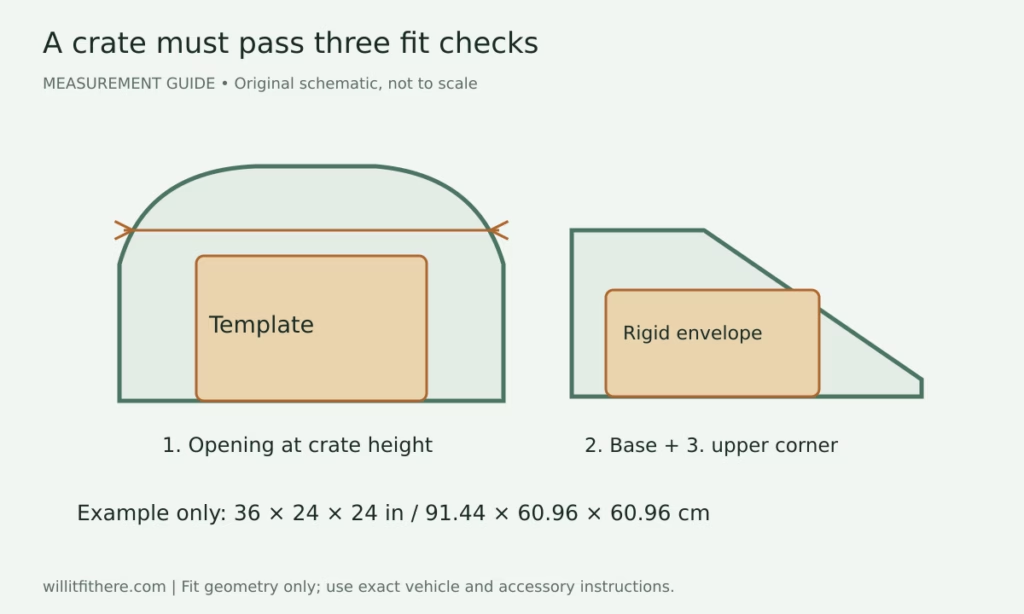
Open the hatch in a suitable clear space and measure between the hard trim boundaries rather than across the weather seal’s outer edge. Record the available width low down, halfway up and near the top of the crate’s proposed position. A tapered opening cannot be represented by its widest span alone.
Measure usable height from the loading surface to the lowest obstruction along the path. The sill and cargo floor may not be at the same level. An object that is short enough once inside can still be too tall while crossing the raised entry edge.
Do not remove trim or rely on compressing it. You are checking an ordinary loading path. Allow room for hands and controlled handling rather than designing a zero-clearance scrape through the opening. There is no universal clearance number that turns every tight fit into a practical one.
Check the closed-hatch space at crate height
The back of an SUV is not a rectangular cupboard. Floor length can be greater than the available length higher up, where a sloping hatch approaches the seats. Mark the planned crate’s rear top corners on a lightweight mock-up and check their position relative to the closed-hatch envelope.
Measure from the seatback at the crate’s height, not just from the seat’s lower edge. Also check floor width where the entire base would sit. Wheel housings, side pockets and a raised liner lip can reduce usable space even when the central cargo area looks generous.
Do not use powered hatch closure to crush a template or force a real crate into place. Stop if clearance is uncertain, and follow the vehicle manual for hatch operation. A latch closing is only one part of the fit check; the crate also needs its intended position and usable door access.
Try a three-dimensional template
An illustrative 36×24×24-inch crate envelope is 91.44×60.96×60.96 cm. Make a light cardboard box or a rigid-edged cardboard outline representing all six faces. Label which edge is length so that rotating the template does not silently change your plan.
Suppose the measured path has a 25-inch minimum opening height. A 24-inch-high envelope has 1 inch of nominal vertical difference there. Now suppose the closed-hatch length at the template’s top is only 35 inches. The 36-inch-long crate fails that orientation even though it crossed the opening. These are hypothetical numbers, not Tesla cargo dimensions.
Keep the empty template square. A crushed cardboard corner can hide the exact conflict you need to detect. If the trial relies on tilting, test the whole rotation path and the final position. A diagonal calculation in one view cannot establish clearance through a three-dimensional opening.
Make sure the crate remains usable
Fit includes the ability to open the crate door as intended. Leave the template in position and trace the door swing outside its front face. Check whether luggage or a nearby seat would block that swing or make removal unnecessarily awkward.
Repeat the loading and unloading movement with the actual empty crate if the seller allows a trial. The lightweight model establishes geometry; it does not represent the real lifting effort or balance. Evaluate the motion you would use regularly, including your reach across the sill.
Keep pet suitability separate from car packaging. A crate that fits the vehicle may be inappropriate for your animal or intended use. Consult the crate maker’s sizing and transport guidance and appropriate professional advice; this article does not evaluate animal restraint or crash protection.
Use this before-you-buy checklist
- Exact vehicle configuration and required seating positions recorded.
- Crate exterior dimensions verified for the specific model and size.
- Handles and door hardware included in the envelope.
- Opening width checked at several heights.
- Sill-crossing height and the complete loading path tested.
- Closed-hatch clearance checked at the crate’s upper corners.
- Base sits in the intended location without relying on trim compression.
- Crate door can operate and the empty crate can be removed.
If a seller says “fits Model Y,” ask which build, seats, load floor and crate orientation were used. A useful answer includes those conditions. A photograph with the hatch raised does not answer whether the hatch closes around the crate.
What the evidence can and cannot tell you
Tesla’s manual provides model-specific dimension and cargo-volume information, but the cited table does not supply a complete rigid-crate loading envelope. The missing opening and closed-hatch measurements are why this guide asks for a vehicle-side test rather than promising a universal yes.
For the separate building-entry question, see our Model Y garage-door fit guide. Sources checked October 5, 2026. Illustrative measurements are not hands-on vehicle tests.