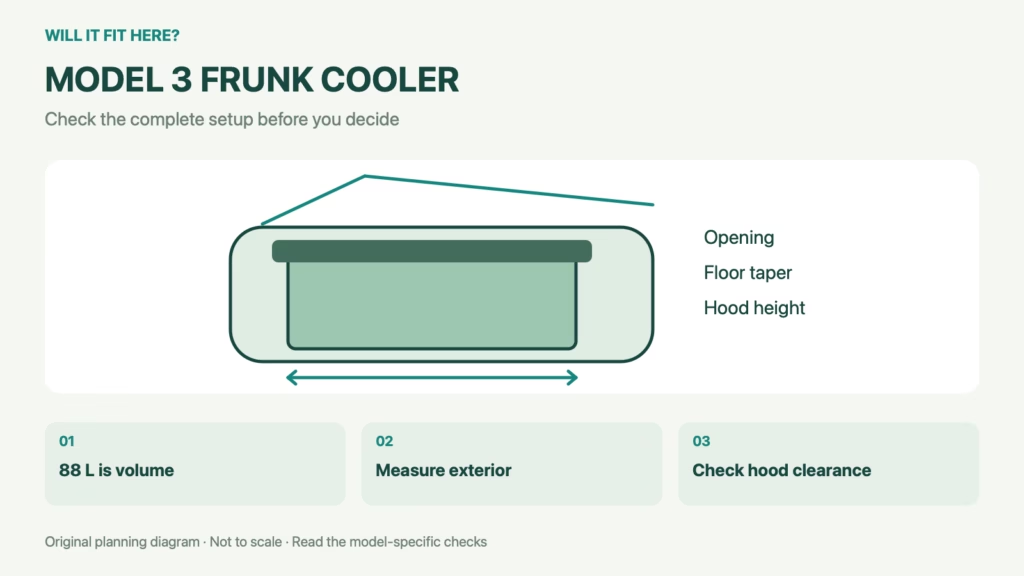
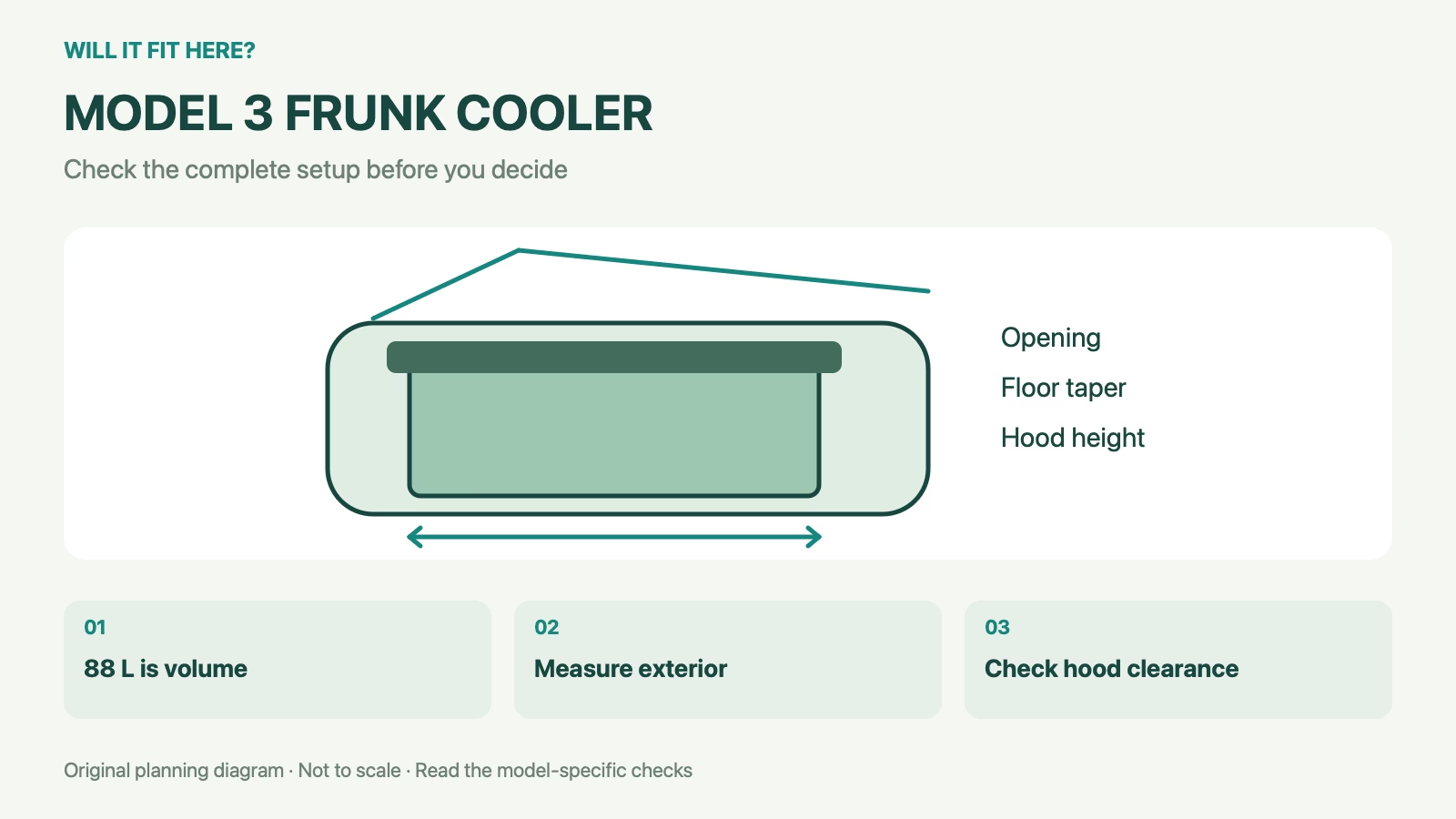
Fit verdict: A Model 3 frunk cooler fits only when its outside shape clears the opening, sits on the usable floor and leaves the hood free to close. Tesla lists 88 L of front-trunk cargo volume in the current Model 3 manual. That is a volume figure, not a rectangular cooler size or a promise that an 88 L container will fit.
Dimensions and conditions
| Check | Reference | What it means |
|---|---|---|
| Published cargo volume | 88 L / 3.1 cu ft | Current Model 3 manual; not inside dimensions |
| Cooler dimensions | Measure outside the packed cooler | Include handles, hinges and latches |
| Frunk geometry | Measure your specific vehicle | Opening, bottom and upper rim can differ |
1. Measure your Model 3 frunk cooler
Record the model year and the actual front-trunk liner installed in the car. An aftermarket mat, organizer or divider can reduce usable space. On the cooler, measure with its handles in the position they will occupy during travel. Marketing capacity describes the space for food and drinks inside the cooler; insulation, feet and hardware sit outside that volume. Two coolers with the same capacity can have very different external proportions. Ask a seller for an exterior dimensional drawing if the listing only gives litres.
2. Check the whole loading path
Use a lightweight cardboard box matching the cooler’s maximum outer dimensions. Lower it through the opening without pushing against the trim. A box that clears the opening may still sit too high on a tapered floor, so check where its bottom actually rests. Do not use the hood to compress a test object. Inspect clearance visually with the hood open, and follow the vehicle’s closure instructions only after the cargo is clearly below the required envelope. A flexible bag and a hard cooler do not behave the same way at a tight corner.
3. Plan unloading as carefully as loading
Leave a practical handhold to lift a full cooler back out. Check whether you will open its lid inside the frunk or remove it before use. A cooler that must be removed needs a manageable loaded weight, including ice and water. Keep cargo within the vehicle’s stated loading limits and secure it as instructed. If the fit depends on removing the liner or other vehicle parts, treat that as an unresolved installation question rather than a normal packing solution.
4. Keep a Model 3 frunk cooler fit record
Keep separate entries for the cooler's widest point, its bottom contact area and its total height. Record the frunk opening and usable floor at those same positions. Mark the result unresolved if a curved corner or taper cannot be measured confidently. A refundable purchase or an empty demonstration unit can be useful when a precise template does not reproduce the shape.
Model 3 frunk cooler: a worked fit example
Illustrative calculation: a cooler measures 50 × 32 × 30 cm externally, so its bounding-box volume is 48 L. That is below 88 L, but it can still fail if the usable floor is narrower than 32 cm at the point where its feet land. A volume comparison therefore cannot replace a full-size template. These example dimensions are not measurements of a Tesla frunk.
Before you decide: 5 checks
- Identify your vehicle year and installed liner.
- Measure cooler exterior with all fixed hardware.
- Test the opening and the usable floor separately.
- Verify hood and lid access without compressing cargo.
- Check loaded weight and a secure lifting grip.
FAQ
Does 88 L mean any 60 L cooler will fit?
No. Storage volume does not establish opening width, floor shape or available height.
Can I use another owner’s measurements?
Use them to shortlist products, then check your own vehicle and liner.
Should I test with ice already inside?
Establish the empty fit first, then assess loaded handling and the vehicle’s loading limits.
Related fit guides
- Will a YETI Tundra 45 Fit Your Sedan Trunk Opening?
- Hitch Bike Rack Fit: 5 Useful Garage Checks
- Vehicles fit guides
Sources
Sources checked 3 November 2026. Product-specific facts are attributed above. Worked examples and measuring methods are planning guidance; example dimensions are not product specifications. Recheck the exact model or current travel policy before acting.