Quick answer: Check two independent questions: whether the poles are permitted in the chosen baggage, and whether their protected collapsed shape fits the bag. Folding a pole short enough does not change its tip classification or the airline’s baggage limits.
Check the current screening rule first
TSA’s current US hiking-pole guidance distinguishes blunt-tipped from sharp-tipped poles. It allows blunt-tipped poles in carry-on or checked baggage, while sharp-tipped poles are not allowed as carry-on items. TSA officers retain the final screening decision. Do not use an old blanket “all hiking poles are prohibited in carry-on” summary.
This is US screening guidance, not a worldwide rule or airline size allowance. Confirm the departure and connection rules and the airline’s acceptance for your actual equipment. Do not assume that adding a removable rubber cover changes how a sharp-tipped pole will be classified.
Measure the protected collapsed assembly
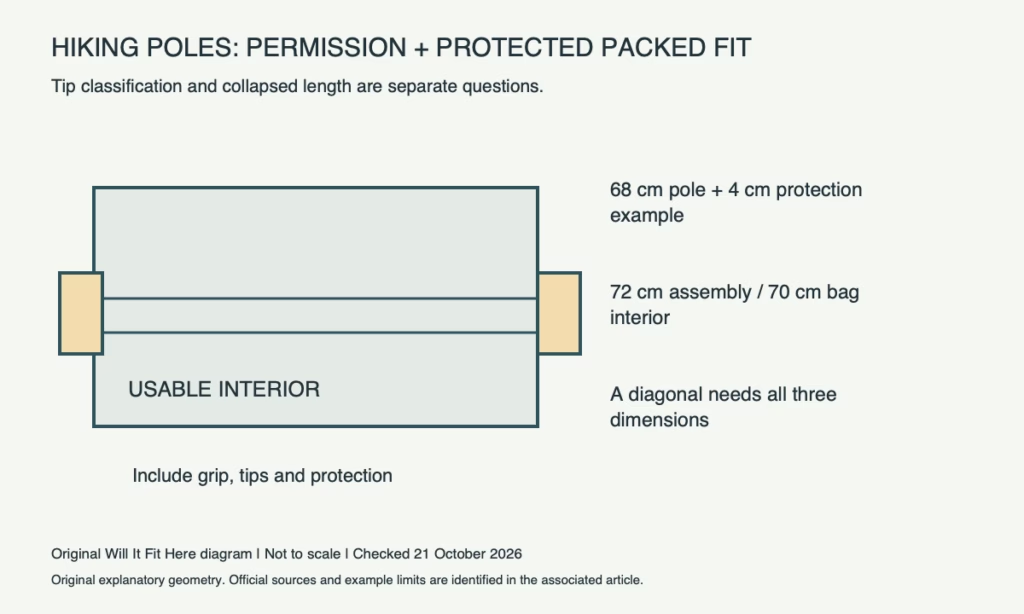
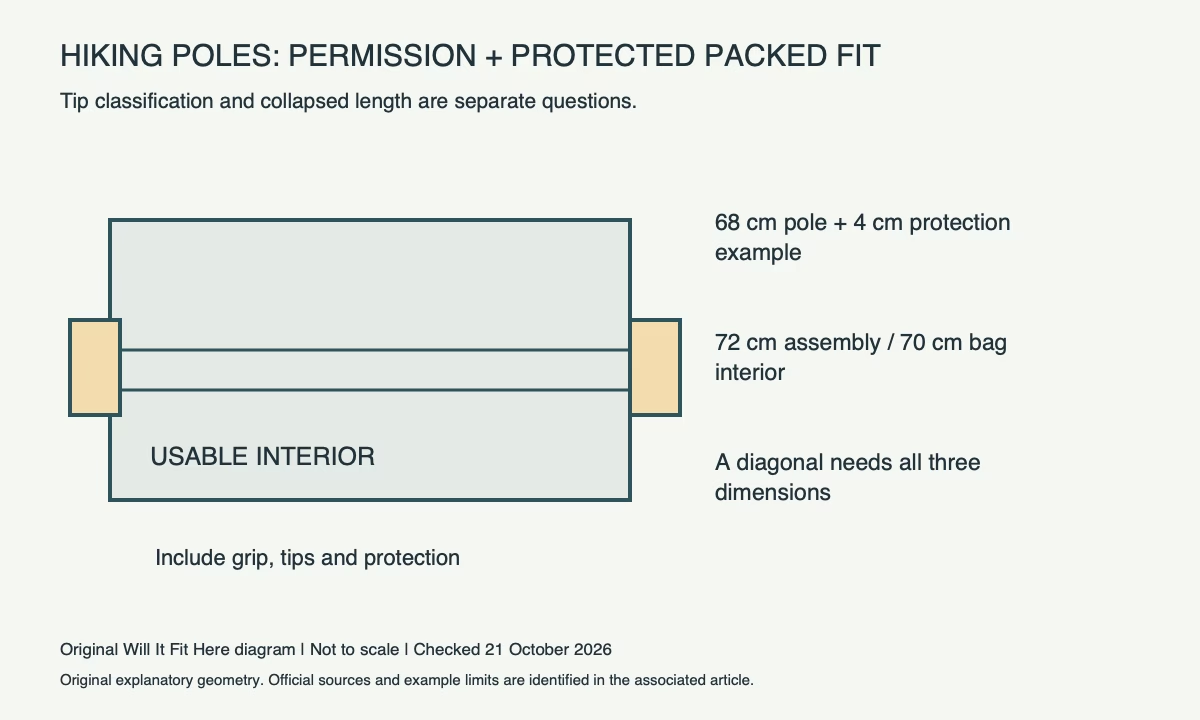
Collapse or separate the poles only as their maker permits. Measure the longest packed section, including handle, tip protection and any protruding cord or fitting. Record the width and thickness of the bundled pair too; a narrow bare shaft is not the packed envelope.
| Hypothetical straight packing check | Length |
|---|---|
| Collapsed pole before protection | 68 cm |
| Chosen tip/end protection added overall | 4 cm |
| Protected assembly | 72 cm |
| Usable straight bag length | 70 cm: 2 cm too short for that orientation |
The protection allowance is an example, not a pole-maker requirement. A diagonal arrangement needs a separate three-dimensional check of the protected bundle, the opening and the actual interior. The suitcase’s outside diagonal includes walls and hardware and is not usable storage length.
Check closure and the outer bag
Place the protected assembly so it does not load the zipper, press a sharp point into the fabric or prevent normal closure. Follow the pole and baggage makers’ instructions; do not shorten, cut or force a pole to make it fit. Sharp items in checked baggage require suitable protection for handlers and inspection.
After packing, measure and weigh the whole suitcase against the applicable airline rules. If a separate pole bag is needed, confirm how it counts and whether it is accepted, rather than assuming sporting equipment travels as a free extra item.
Before you decide
- Actual tip type and current screening/airline conditions checked.
- Protected collapsed length, width and thickness measured.
- Bag opening and usable interior checked in the intended orientation.
- Closed outer bag dimensions, weight and item count confirmed.
Common questions
Does a rubber tip cap guarantee carry-on acceptance? Do not assume it changes the pole’s classification. Ask the screening authority about the actual item.
Can I use the outside suitcase length for the pole? No. Measure the usable interior and include protection, grip and bundle thickness.
Official sources and scope
Checked October 21, 2026: TSA current hiking-pole guidance, TSA sharp-object packing guidance. Confirm the exact product, route or current policy before acting. No firsthand fit test is claimed.
Related guide: Amtrak Checked-Bag Fit: Linear Inches, Weight and Route Checks. This addresses a separate fit check; its measurements do not transfer to the products above.