Quick Answer
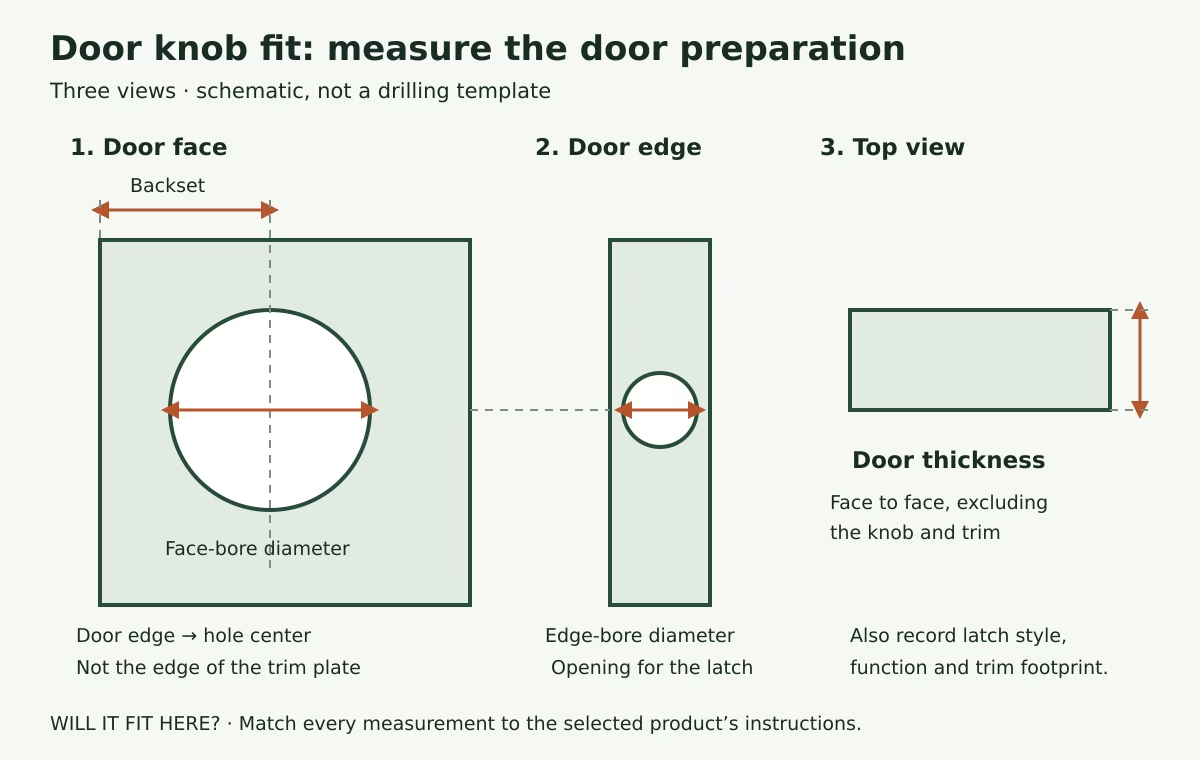
Door knob sizes are a set of fit measurements, not the diameter of the grip. For a common bored residential door, check the backset, face-bore diameter, edge bore and door thickness against the exact replacement’s template. Common references include a 2-1/8-inch face bore (about 54 mm) and a 2-3/8- or 2-3/4-inch backset (about 60 or 70 mm). Matching only one measurement is not enough.
This guide covers selecting replacement knobs and levers for existing bored doors. Mortise locks, rim locks, multipoint systems and surface-mounted dummy handles need their own product-specific checks.
Door knob sizes at a glance
Use these door knob sizes as a first comparison, then read the chosen model’s requirements. The dimensions below come from Schlage’s residential door-preparation checklist; they are not a promise that every brand or older door follows the same pattern.
| Measurement | Reference size | What to compare |
|---|---|---|
| Face bore / crossbore | 2-1/8 in ≈ 54 mm | Diameter of the hole through the broad face |
| Backset | 2-3/8 in ≈ 60 mm or 2-3/4 in ≈ 70 mm | Latch-side door edge to face-bore center |
| Edge bore / latch bore | 1 in = 25.4 mm | Diameter of the hole in the narrow door edge |
| Door thickness | 1-3/8 to 1-3/4 in ≈ 35–44 mm | Door material from one face to the other |
Keep the inch fractions when shopping for US hardware. The metric figures are rounded conversions, not separate product specifications.
How to measure your door
Gather a ruler or tape measure, a note-taking app and your current hardware’s model information if available. Keep the door open while inspecting it. If removing hardware is necessary, use its instructions and keep the door from closing until it is safely reassembled. This guide does not cover drilling or altering doors.
1. Measure the backset to the center
On the latch side, measure horizontally from the door edge to the center of the large hole. With the knob still installed, its spindle center can help you make a preliminary check; confirm the actual bore center if the hardware obscures it. Do not stop at the nearest edge of the round trim.
Schlage defines backset using the door edge and crossbore center. Its two common options differ by 3/8 inch, or about 9.5 mm, so rounding an uncertain measurement to “roughly 2½ inches” is not useful.
2. Check the face bore, then the edge bore
Once safely exposed, measure each opening across its center. Record the large face opening and small latch opening separately. A trim plate may hide the edges of the face bore, so measuring across the visible trim cannot tell you the underlying hole size.
3. Measure the door thickness
Measure the door itself at the open edge, face to face. Exclude protruding hardware. If a product lists a thickness range or requires a separate kit, check that your specific model and measured thickness are covered before buying.
Checks beyond backset
An adjustable latch solves only the backsets named in its specifications. Continue with these visual and product checks:
- Latch preparation: photograph the existing edge. Note a rectangular faceplate with rounded or square corners, or a drive-in collar without that plate. Check what the new kit includes and permits.
- Trim footprint: compare the new rose or escutcheon with the old outline, exposed marks and any nearby trim. A fitting mechanism may still leave an old paint line visible.
- Function: choose the required passage, privacy or keyed-entry function. A fixed dummy handle serves a different purpose.
- Movement and clearance: for a lever, check its model’s handing instructions and the space around nearby walls or trim. A lever can extend farther sideways than a knob.
- Door condition and designation: damaged, unusual, fire-rated or security doors need appropriate approved hardware and qualified advice. Do not change their preparation based on a generic size chart.
Replacement shopping card
Copy this card into your phone. Enter an actual measurement or “unknown”; an unknown fit item belongs in the check column rather than the pass column.
| Fit item | Your door | Candidate product | Result |
|---|---|---|---|
| Backset | ________ | ________ | Pass / check |
| Face-bore diameter | ________ | ________ | Pass / check |
| Edge-bore diameter | ________ | ________ | Pass / check |
| Door thickness | ________ | ________ | Pass / check |
| Latch faceplate / collar | ________ | ________ | Pass / check |
| Trim footprint and clearance | ________ | ________ | Pass / check |
| Function / model / handing | ________ | ________ | Pass / check |
Example: a door with a 2-3/4-inch backset needs hardware that explicitly supports that setting. A box marked 2-3/8 inch only remains a mismatch even if its trim covers the hole. Conversely, an adjustable-backset label leaves thickness and bore compatibility to be checked separately.
What a mismatch means
| What you find | Buying decision |
|---|---|
| Backset outside the named settings | Look for the specified latch or hardware system; do not assume adjustment extends beyond the listed options. |
| Bore hidden or measurement uncertain | Get the current model or safely verify the exposed opening before ordering. |
| Door thicker than the listed range | Confirm an approved model-specific thick-door solution with the maker. |
| Correct dimensions but latch sticks in current use | Treat alignment or door condition as a separate issue; replacing the knob may leave it unresolved. |
| Old lock has a large rectangular pocket in the door edge | Check whether it is a mortise system; stop using this bored-door chart as the selection method. |
Before-you-buy checklist
- Record all four door measurements, keeping the backset fraction exact.
- Save photos of the door face, edge and existing hardware markings.
- Read the selected model’s template, included-parts list and fit range.
- Match latch preparation, function and any handing requirements.
- Confirm there is no unresolved door damage, designation or clearance issue.
For a separate cabinet-hardware project, use our cabinet-pull measurement guide. Pulls use mounting-hole spacing, so the door-knob backset measurement does not transfer to that job.
Door knob sizing questions
Are all door knobs the same size?
No. The grip shape and decorative trim can vary, and the mechanism must match the door preparation and thickness. Shop from recorded fit measurements and the product template.
Is 2-3/8 or 2-3/4 the size of the hole?
Those are common backsets: the distance from the latch edge to the hole center. They are not hole diameters.
Can I buy a lever instead of a knob?
Possibly. Check the replacement lever’s preparation, thickness range, function, handing and movement clearance. Sharing a finish or brand name does not establish compatibility.
What if the door matches every measurement but the old trim is larger?
Separate mechanical fit from appearance. Compare the new trim footprint with the old outline and surrounding surface before ordering; do not assume the new trim hides previous marks.