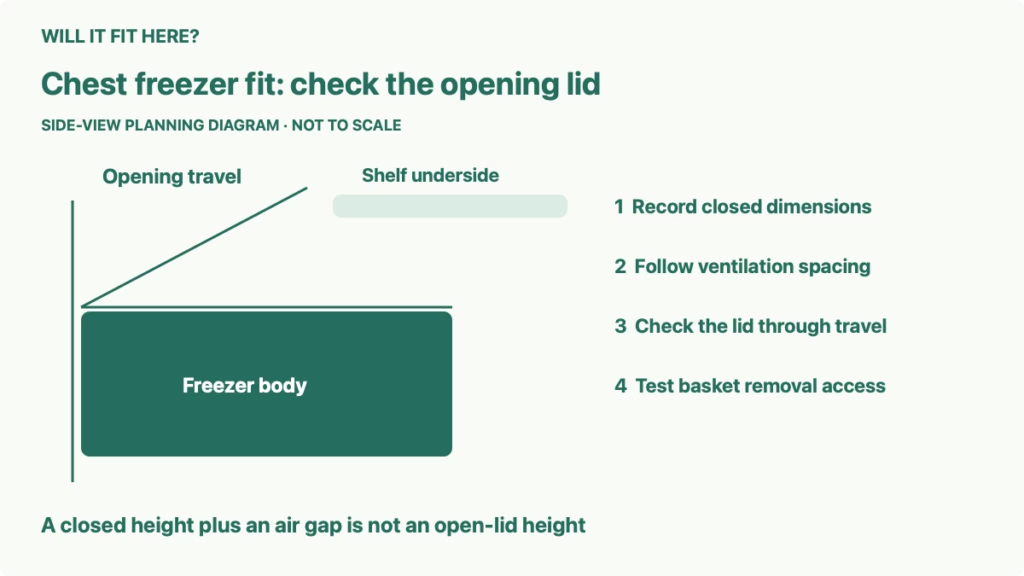
Quick answer: Chest freezer fit below a shelf requires the closed appliance footprint, the manufacturer’s ventilation clearances and enough room for the lid to open through its required travel. A small air gap above the closed lid does not prove that you can use the freezer there. Check the exact model’s opening geometry and basket access before buying.
This guide is for placing a freestanding chest freezer in a utility room, pantry or suitable garage with overhead shelving. The reader’s decision is whether that location allows normal loading and cleaning, rather than merely holding the closed cabinet. Confirm that the location itself meets the appliance’s installation instructions.
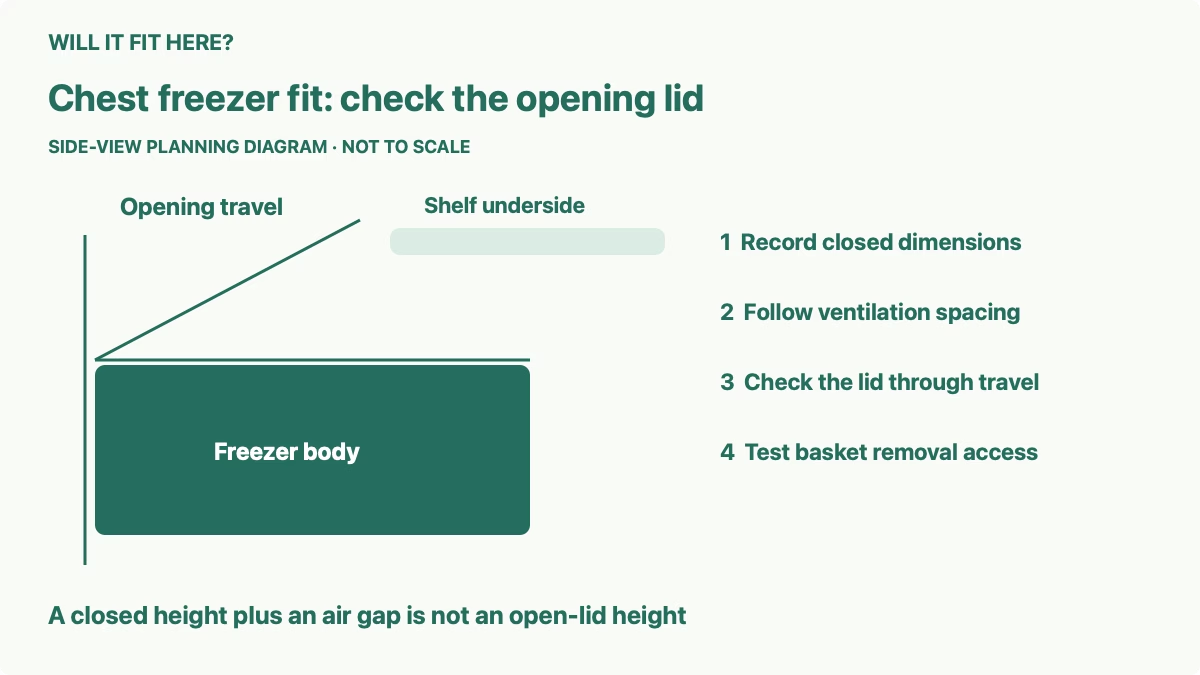
1. Measure the complete closed appliance
Record the exact model number and maximum assembled width, height and depth from the manufacturer’s dimensional drawing. Check whether the depth includes hinges, handle projections and other rear parts. Do not substitute the carton dimensions or the freezer’s capacity for these measurements.
Measure the available floor space to its nearest obstructions, including baseboards, pipework and shelf uprights. A cabinet that appears to fit between two walls may stop short because its rear hinge reaches a projecting trim piece. Mark the complete outline at the intended position rather than measuring the room in a different, unobstructed spot.
Keep the intended installed height in the plan. Follow the manufacturer’s floor and leveling guidance. If an approved support arrangement raises the freezer, the shelf-to-lid clearance changes by the same amount. Do not plan from the product height alone while ignoring the final support beneath it.
2. Separate chest freezer fit from ventilation spacing
Read the exact appliance’s clearance requirements. Those spaces help the unit operate and should not be reduced to make the room plan pass. A freestanding freezer is not automatically suitable for an enclosed cabinet, even if its outer dimensions leave a visible gap.
For a labeled example, the GE FCM5/FCM7 manual linked from the FCM7STWW product page requires 3 inches, or 76 mm, above, behind and beside the freezer for air circulation. The same section separately requires sufficient top space for the lid to open. Its ventilation figure is therefore not an open-lid height. Use that manual only for an applicable model and confirm the current instructions for the freezer you choose.
Draw the required ventilation area around the appliance footprint. Keep it clear of stored boxes and shelf uprights. Check any permitted location conditions, including ambient temperature, moisture and direct exposure, in the model’s instructions. Room dimensions alone do not establish that a garage or pantry is suitable.
| Check | What it establishes |
|---|---|
| Closed outer dimensions | Whether the cabinet can occupy the proposed position |
| Required air circulation space | Whether that position follows the model’s clearance instructions |
| Lid travel and final opening | Whether the freezer can be opened normally below the shelf |
| Basket and loading access | Whether its contents and removable parts remain usable |
3. Check the shelf against the whole lid movement
Measure to the lowest underside of the shelf, bracket or stored object above the freezer. Include the shelf’s front edge and any support that projects below it. Measure the shelf’s horizontal position too: an obstacle directly over the hinge can affect a different part of the movement from one over the front edge.
Ask the maker or dealer for the maximum height and rear projection with the lid open as intended. If the specification only gives closed dimensions, request the missing opening measurement. Do not estimate the open height by adding the lid’s visible depth to the cabinet height without confirming the hinge geometry.
Inspect a display model or an accurate operating drawing when possible. Check the lid through its travel, not just in the final position. A handle, corner or hinge can hit the shelf before the lid reaches a usable angle. Include any rear movement the maker’s diagram specifies.
Do not force the lid past its intended travel, alter its hinges or prop it in a way the instructions do not permit. If the proposed shelf prevents normal opening, choose another position or a different appliance. A measurement failure should be resolved before purchase rather than hidden by a temporary workaround.
4. Test loading and removable-basket access
Plan where you will stand while reaching into the freezer. Include the fully open lid and the floor route in front of it. Check whether a nearby door, laundry basket or shelving support forces you to lean around an obstacle while lifting a food package.
Confirm the space needed to remove any baskets or dividers according to the instructions. The lid may open enough to reach the top layer while still obstructing a removable basket. Ask for the removal sequence and dimensions if they are not clear from the product documentation.
Use a simple mock-up of the appliance outline and shelf edge to compare positions. Keep this separate from a hands-on appliance test: an outline can help you spot an awkward stance but cannot certify the lid’s support or hinge behavior. Verify those details on the exact model.
Consider the objects you will normally store. Check whether a large container can be lowered into the opening without striking the shelf or lid. Keep overhead items secure and outside the required operating space. Do not count on moving a shelf’s contents every time the freezer is used unless that routine is practical and follows the appliance guidance.
5. Keep maintenance, power access and delivery workable
Read the model’s cleaning and defrosting instructions before choosing a permanent position. Allow access to the required drain, controls and service points. A narrow bay can become inconvenient if the freezer must be moved for every permitted maintenance task.
Check the appliance’s power requirements and cord route with its instructions. Use a suitable supply and obtain qualified electrical help when needed. Do not use a pinched cable, an unsuitable adapter or an extension lead to compensate for a location that lacks the required connection.
Measure the delivery route independently of the installed footprint. Check the carton, doors and turns, and follow the maker’s handling guidance. A freezer that will fit under the shelf may still need a different path or extra assembly access to reach that position.
Finish with the model number, closed dimensions, required air gaps, open-lid envelope, lowest shelf projection and basket-removal access on one plan. If any required condition fails, change the location or choose a different model before ordering. Chest freezer fit should support ordinary use as well as placement.
Common questions before placing a freezer below shelving
Is the listed top ventilation gap enough to open the lid? Do not assume so. Confirm the separate lid-opening geometry and requirements.
Can I compare only the closed height? Include the installed support height, shelf brackets and the lid’s complete travel.
What if no open-lid height is published? Ask the maker or dealer for the exact measurement or inspect an applicable display model before purchase.
Sources and related fit checks
Manufacturer reference: GE FCM7STWW product page and linked FCM5/FCM7 installation manual. The linked manual’s clearance section is on printed page 8. Source checked October 7, 2026; the listing marks this example model as no longer manufactured. Confirm the current manual for your chosen model.
For another appliance with moving parts in a compact room, see our dishwasher door and island clearance guide. For an occupied room setup, use the digital piano and bench-space checks.