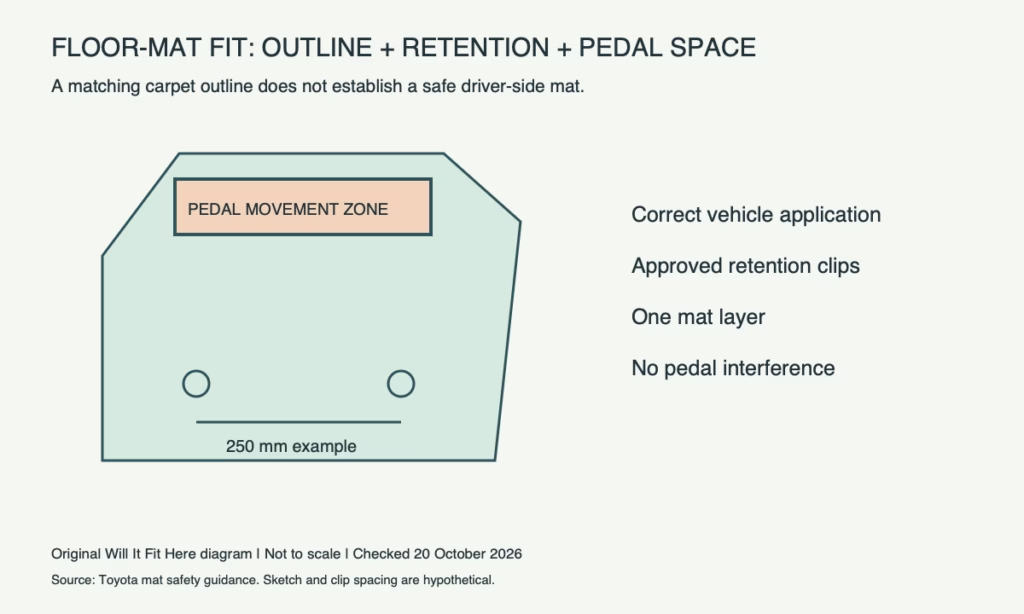
Quick answer: A replacement floor mat fits the driver’s footwell only when it is the correct approved application, its retention system secures it, and it cannot interfere with the pedals. Matching the carpet’s rough length and width is insufficient. Do not drive with a mat that shifts, curls or contacts a pedal.
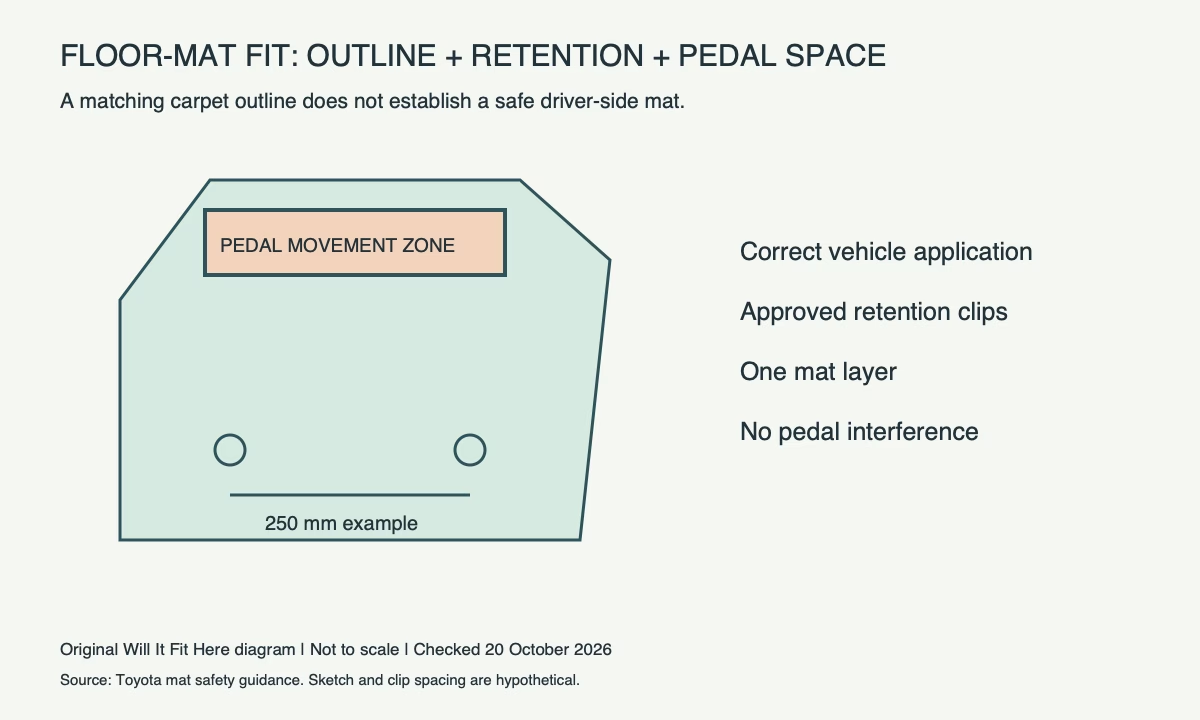
Identify the vehicle and retention system
Use the full model year, body style, driving side and floor configuration in the supplier’s fit selector. A visually similar passenger mat or a mat for the previous generation is not an acceptable driver’s-side substitute.
Toyota’s linked accessory guidance warns that mats must be secured with their fasteners and must not be installed over an existing mat. Treat that as a manufacturer example; use your own vehicle manual for the approved mat and attachment procedure.
Measure useful reference points
With the vehicle safely parked, follow its manual to remove the old mat. Measure retention-point centre spacing, the fixed floor contour and the mat’s outside outline. Keep clip shape and locking action in the record as well as the spacing.
For a hypothetical pair, floor retention points 250 mm apart do not match mat openings 265 mm apart. That 15 mm difference is about 0.59 in. Stretching the mat or cutting new holes does not establish a secure retention system. Even an exact 250 mm match would not confirm the rest of the application.
Keep pedal travel a separate acceptance check
The raised edge near the pedals matters more than unused space by the sill. Follow the vehicle’s inspection instructions, including the required pedal and mat checks before driving. If you cannot confirm an interference-free, secure installation, remove the unsuitable mat and have the dealer or mat manufacturer resolve the application.
- Correct year, model, driving side and driver’s-footwell part number.
- One mat layer, fitted in its intended orientation.
- All specified retainers engaged and the mat unable to slide forward.
- No curled lip, loose accessory or other object in the pedal area.
- Checks repeated after cleaning or removing and reinstalling the mat.
Common questions
Can I trim a universal mat until it fits? Only use an application and procedure expressly approved for your vehicle and mat. Do not cut around a retention or pedal interference problem.
Can carpet and an all-weather liner be stacked? Follow the exact manual; the cited Toyota guidance explicitly warns against stacking.
Does a matching outline prove compatibility? No. Retention and pedal clearance still need confirmation. For another cabin-space question, see rear-facing seat space checks.
Official source and limits
Checked October 20, 2026: Toyota Land Cruiser accessory guidance, mat safety notes. The cited brochure is a specific application example, not approval for other vehicles. Measurements above are hypothetical; no firsthand fit is claimed.