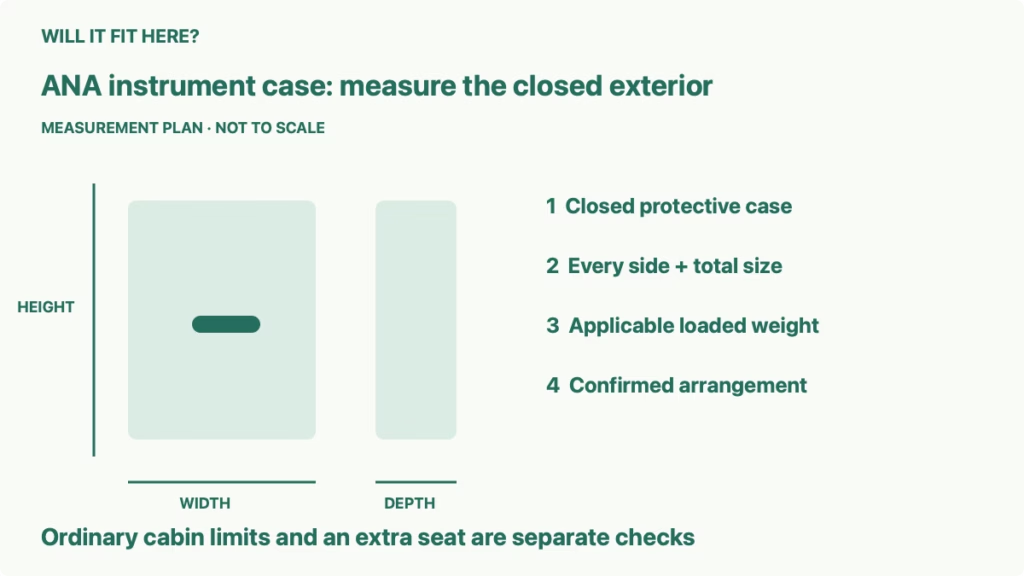
Quick answer: ANA instrument case fit starts with the closed case, not the instrument alone. Compare its complete outside dimensions and loaded weight with the allowance for the operating flight. A case exceeding ordinary cabin limits needs an advance arrangement with ANA; purchasing an additional seat and confirming the instrument’s acceptance are separate steps.
You want a violin, compact guitar or other instrument to travel with you, but its case has a handle, shaped corners and padding that change the outside envelope. Make the decision before departure rather than assuming a narrow case will fit because the instrument itself is light. This guide separates the measurement from the transport arrangement.
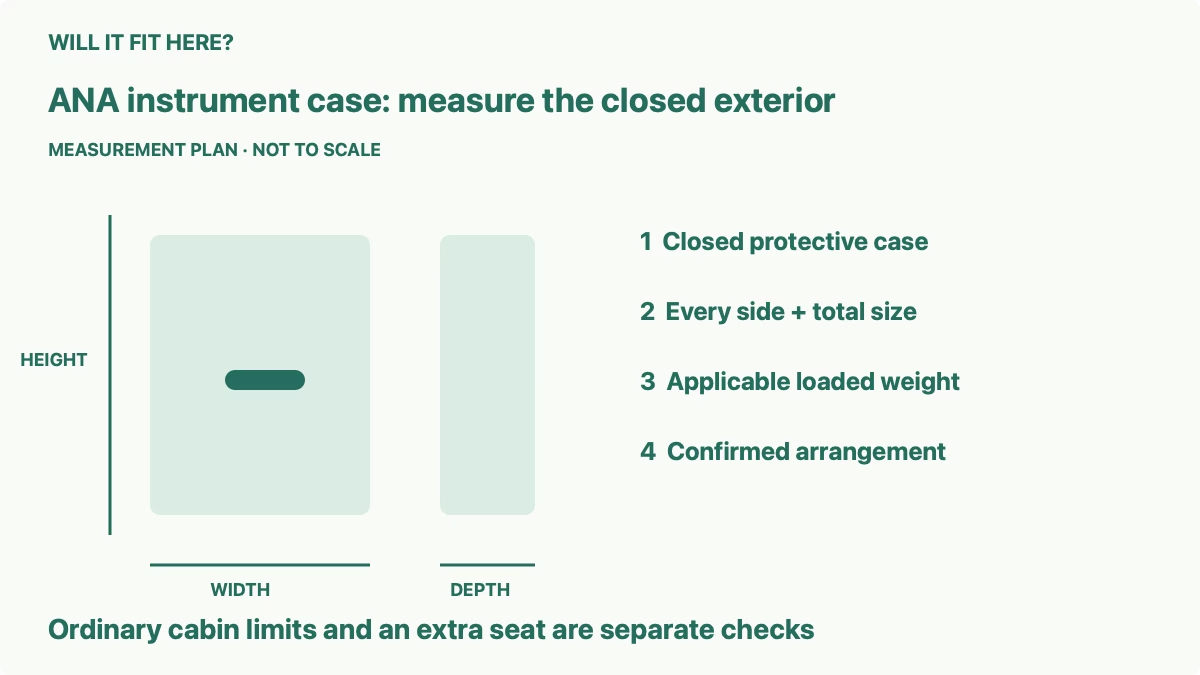
1. Measure ANA instrument case fit with the case closed
Place the instrument in its intended protective case with its normal padding and accessories. Close every latch or zipper. Measure length between the farthest ends, maximum width across the widest portion, and depth including feet, hinges and the handle’s normal stowed position. A shaped case still needs a rectangular outside envelope for comparison.
Use the manufacturer’s exterior specification as a starting point and compare it with the actual loaded case. A soft bag can bulge around a shoulder rest, music folder or accessory pocket. Record the maximum reading rather than choosing the smallest point along its tapered outline.
Do not remove necessary protective padding to force a favorable measurement. Case protection and transport permission solve different problems. If the only way to meet a limit leaves the instrument poorly supported, choose an appropriate case or transport arrangement instead.
Take a photograph of the closed case beside the recorded measurements for your own worksheet. It helps identify which case you discussed when asking the airline. A photograph is supporting information, not a substitute for ANA’s decision about acceptance.
2. Compare the correct ordinary cabin allowance
The current ANA carry-on page lists a 115 cm three-side sum and individual limits of 55 × 40 × 25 cm, including handles and wheels. Its baggage overview lists smaller-aircraft limits: fewer than 100 seats use a 100 cm sum and 45 × 35 × 20 cm sides. Confirm the aircraft and applicable rule.
The overview and carry-on page describe one carry-on bag plus one personal item, with a combined 10 kg maximum. The personal-item size is 40 × 30 × 20 cm for flights boarding from July 1, 2026. A small personal item does not provide a second full cabin allowance.
Check both the side limits and the sum. A hypothetical 58 × 28 × 18 cm case totals 104 cm, yet its 58 cm length exceeds a 55 cm side limit. A passing total cannot erase that failure. Treat the example as arithmetic, not approval for a particular instrument.
Identify which allowance covers the instrument case and what happens to your other bag. Weigh the loaded case and the other included belongings. A light instrument does not establish the combined reading once the case, padding and accessories are added.
3. Resolve the additional-seat arrangement in advance
The ANA carry-on page says an additional seat must be purchased when the item exceeds the carry-on size limit. It specifically describes contrabass carriage in Economy. Ask ANA about your exact instrument, case dimensions, loaded weight, cabin and aircraft before making the arrangement.
Do not use a passenger-seat width found online as the instrument’s acceptance limit. The case shape, restraint arrangement, seating location and flight conditions need confirmation. A rectangular case that looks narrower than a seat can still be unsuitable for the approved arrangement.
Provide measurements consistently in one unit and describe projections clearly. Ask whether accessories travel in the same case and which transport option applies to the complete itinerary. Keep the airline’s confirmation with the booking rather than relying on a conversation about a different instrument.
If a flight changes, reconfirm the arrangement. An equipment swap or partner-operated connection can alter the assumptions used in the original request. Resolve a change while there is time to select a suitable alternative.
4. Separate storage space from the size comparison
ANA notes that meeting the ordinary dimensions does not guarantee available cabin storage. Do not treat a dimensional pass as a reservation of a particular locker. The case also needs to reach its approved location without losing its protection or obstructing passenger movement.
Assess your ability to carry and position the loaded case. A comfortable handle at home may be awkward when the case is held vertically in a boarding queue. Make a handling plan that respects the approved arrangement rather than improvising placement in an aisle or at your feet.
Keep the instrument secured inside the case for the intended journey. Ask the airline about any uncertain placement detail. This fit worksheet does not provide a restraint installation method or permission to alter cabin furnishings.
Mark any unanswered storage or handling question as unresolved. The practical outcome should be “confirmed arrangement,” “alternative needed” or “awaiting airline answer,” not an optimistic guess based only on external dimensions.
5. Check every operating flight and the fallback option
List the operator for every segment. ANA’s current page says that the operating airline’s rules apply on codeshare flights. Carry the same exterior measurements into each check so that a connection is not evaluated against the first airline’s allowance by accident.
If cabin carriage is not confirmed, discuss the appropriate checked or other transport option with ANA. Its checked-baggage page covers instruments within applicable baggage requirements and explains that oversize acceptance depends on cargo loading. Protection, weight, dimensions and confirmed acceptance all need review.
Do not assume an extra-seat request automatically solves a different flight’s checked-baggage question. Keep each decision attached to the relevant segment and case. Compare any alternative’s requirements before selecting it.
| Worksheet item | Record |
|---|---|
| Complete case | Closed length, maximum width and depth |
| Ordinary allowance | Side limits, three-side sum and combined weight |
| Oversize arrangement | ANA confirmation and additional-seat requirements |
| Connection | Operating airline and confirmed arrangement |
| Fallback | Acceptance and protection requirements resolved |
Common questions
Can I measure only the violin or guitar? No. The closed protective case is the item presented for transport.
Does a small three-side total settle cabin fit? No. Check every applicable side, the total, weight and permitted arrangement.
Does buying another seat guarantee acceptance? Obtain ANA’s confirmation for the exact instrument and itinerary.
For a different airline’s combination check, see Qantas cabin bag fit. Browse the Travel guides for separate packing decisions.
Official sources and limits
Checked October 7, 2026: ANA baggage overview, ANA carry-on rules and ANA checked baggage and instruments. Confirm current rules before travel. Examples are hypothetical; no firsthand flight test or specific aircraft clearance is claimed.