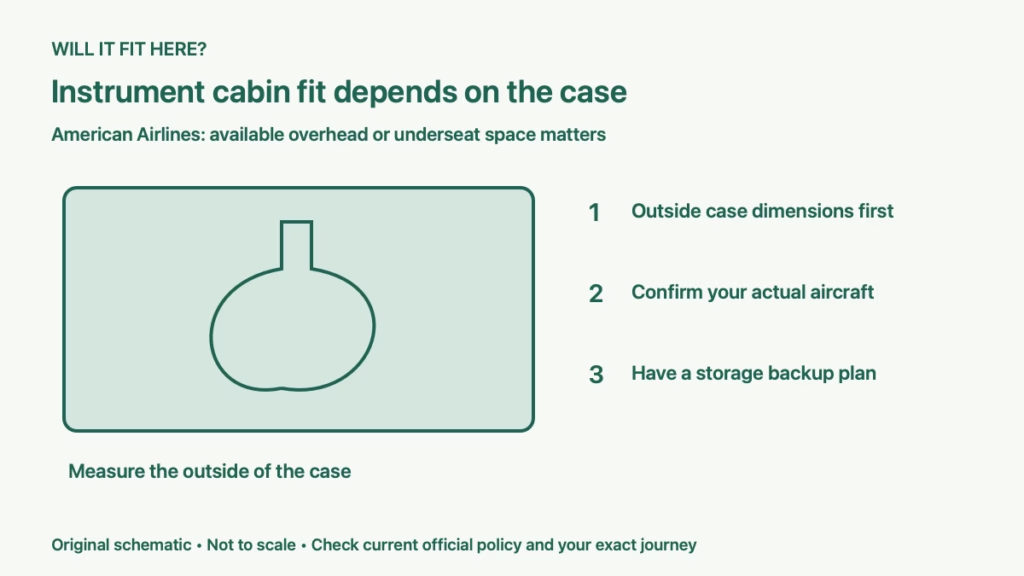
Quick answer: A guitar case can travel in American Airlines’ cabin only if the instrument meets the airline’s small-instrument storage conditions and there is suitable available space in an overhead bin or under the seat. Measure the outside of the closed case, confirm the actual aircraft, and arrange a backup before departure. A guitar’s length by itself does not establish cabin fit.
This guide is for a musician who wants to avoid discovering at the gate that a favorite instrument cannot go into the intended space. The useful question is how your complete case will be stored on each aircraft, not whether somebody once carried a similar guitar on another flight.
1. Measure the guitar case rather than the instrument
Close the case with the guitar and accessories inside. Measure its longest outside dimension, its widest point and its thickest point. Include the feet, handle, hinges and any filled exterior pocket. A soft gig bag can become thicker after you add a cable, tuner or clothing.
Take photos of the case next to a measuring tape and write down the three dimensions in one unit. Keep the model name and packed weight in the same note. This gives an airline representative something specific to assess instead of an imprecise description such as “normal acoustic guitar.”
2. Check American’s current musical-instrument conditions
American’s official policy says small instruments may be carried as a carry-on item on a first-come basis when they fit an overhead bin or the space under the seat ahead. The policy also warns that overhead storage differs by aircraft and even within a fleet. These conditions do not create one universal guitar-case dimension that works everywhere.
Look at every operating carrier on the itinerary. A connection can involve a different aircraft, different available storage and another airline’s policy. Treat each segment as its own fit decision, especially if the case is close to the space an airline has described.
3. Ask about the actual aircraft and storage orientation
Identify the aircraft type shown on your reservation and ask American for the relevant storage information when your case’s fit is uncertain. Explain whether the case can be positioned in the necessary orientation while remaining closed and protected. Ask what your options would be if that storage is not available.
A bin’s door opening and its internal usable space are different measurements. A long case must pass through the opening and then sit inside with the door closed. Do not substitute a single diagonal measurement for confirmation of all three dimensions and the loading path.
4. Prepare a realistic backup for the guitar case
American describes an additional-seat option when an instrument does not fit ordinary cabin storage, subject to seat location, aircraft-specific size and other restrictions. Arrange that option with the airline before travel; simply buying an unrelated second ticket does not confirm an acceptable instrument setup.
If checking the instrument is a possibility, review the airline’s current packing requirements and the instrument manufacturer’s transport guidance. American advises a hard-sided case for checked instruments. A soft case that is convenient to carry is not automatically a suitable checked-luggage plan.
5. Recheck the case and itinerary before leaving
Verify that the flight details have not changed and that any special arrangement is recorded as intended. Pack the same configuration you measured. Adding a thick exterior pouch at the last minute can invalidate a close-fit assessment even though the guitar itself has not changed.
Keep the case accessible, protect it during the journey through the airport, and follow the crew’s storage instructions. Boarding earlier can be useful for available space, but it is not a promise that a particular case will be accepted or a particular bin will remain empty.
Do ordinary suitcase limits answer this question?
Not completely. Musical-instrument conditions and available aircraft storage need their own check. Our Delta suitcase guide illustrates why an item’s retail size label may omit projections. If your trip includes a train, our Eurostar suitcase guide explains route-specific baggage allowances; check Eurostar’s separate instrument policy for a guitar.
Official source and fit caveat
Instrument storage conditions and backup options were checked against American Airlines’ official special-items policy for this October 6, 2026 guide. The measurement procedure is a planning aid. Only the airline can confirm the arrangements applicable to your instrument, aircraft and itinerary.