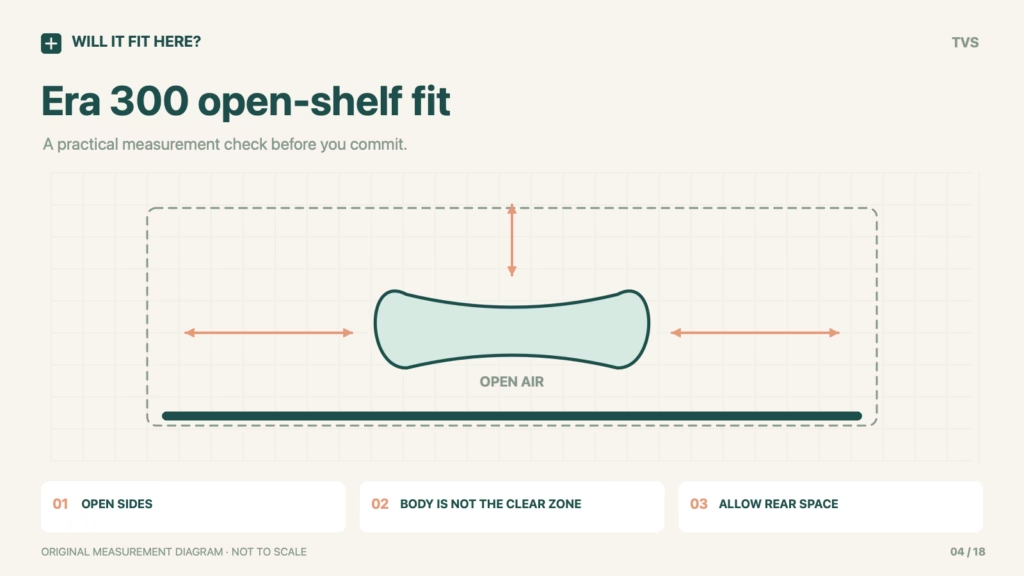
Fit verdict — Conditional. A Sonos Era 300 fit check must reserve acoustic space as well as the body. Sonos specifies at least 1 inch behind, 8 inches on each side and approximately 2 feet overhead for optimal sound. It discourages enclosed bookshelf placement. A cubby that accepts the enclosure is not a confirmed operating position. Plan an open location, cable exit and control access before choosing the shelf.
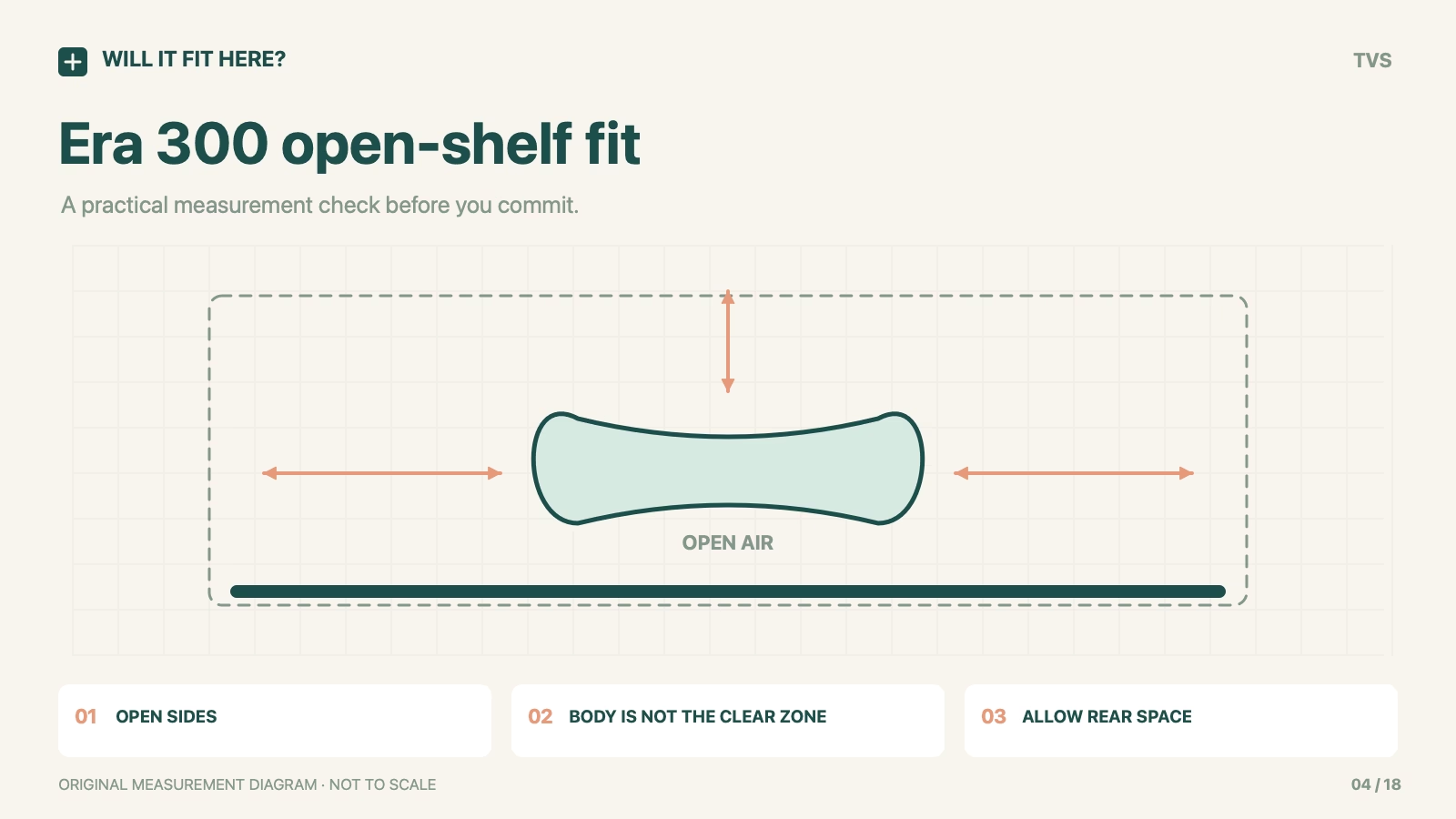
Sonos Era 300 fit: scope
Sonos Era 300 in normal upright shelf placement. Wall-mount and inverted-mount instructions are separate configurations.
Dimensions and conditions
| Check | Reference or condition | What it means |
|---|---|---|
| Body reference | 10.24 in W × 7.28 in D × 6.3 in H | Sonos product listing; do not substitute Era 100 dimensions. |
| Side clearance | At least 8 in on each side | Sonos user-guide shelf/wall placement guidance. |
| Rear clearance | At least 1 in | Separate from a tight cable bend. |
| Calculated side envelope | 26.24 in total width | 10.24 + 8 + 8; an editorial calculation, not a new Sonos specification. |
| Overhead | Approximately 2 ft / 0.61 m for optimal sound | Official guidance; enclosed bookshelf placement is not recommended. |
1. Draw the Sonos Era 300 clear zone around the enclosure
Make one outline for the speaker body and another for the stated side and rear gaps. Put both on the shelf plan. This prevents a frequent measuring error: counting empty cabinet space beyond a solid side panel as if it were open air beside the speaker. Bookends, ornaments and the side of a neighbouring component also interrupt that space. Judge the actual clear area around the intended position, not just the cabinet’s overall outside width.
2. Keep the sound path distinct from the shelf opening
Check the front, sides and area above the unit for obstructions in its normal orientation. An opening can look generous from the room while its rear corner closes in around the enclosure. Do not turn the speaker on its side to solve a height problem or use a shelf-only calculation to select wall-mount hardware. If the intended location requires a different orientation, return to the matching official mounting instructions rather than extending this upright-placement check.
3. Measure with neighbouring equipment in position
Include the TV stand legs, power plugs, cables and anything that regularly lives on the shelf. A plan that works only after temporarily removing a console or stacking books elsewhere may not represent the finished room. Leave access for controls and normal cleaning. Test the actual position before committing to furniture changes, then keep the chosen shelf arrangement consistent. The calculation below assesses space; it does not predict a measured sound response in your room.
Before you decide: 5 checks
- Confirm the model is Era 300 and use its current placement guide.
- Outline the body and the separate left, right and rear clear zones.
- Check solid cabinet sides, shelf lips and nearby objects.
- Route power without treating a compressed plug as clearance.
- Use separate official instructions for any wall or inverted mounting arrangement.
FAQ
Does a 26.24-inch-wide cabinet automatically work?
No. That is only the sum of the listed body width and two stated side gaps. The clear interior, rear space, open sound paths and actual placement still matter.
Can I use the Sonos Sub Mini cabinet-gap advice instead?
No. A subwoofer and Era 300 have different placement requirements. Use the guide for the actual product.
Is a tight enclosed cubby confirmed if the speaker slides in?
No. Physical insertion does not establish the stated operating clearances.
Official sources and scope
Checked on 26 October 2026. The cited product, variant and region control. Follow the matching current instructions. The measurement workflow is editorial guidance; no firsthand installation or universal fit is claimed.