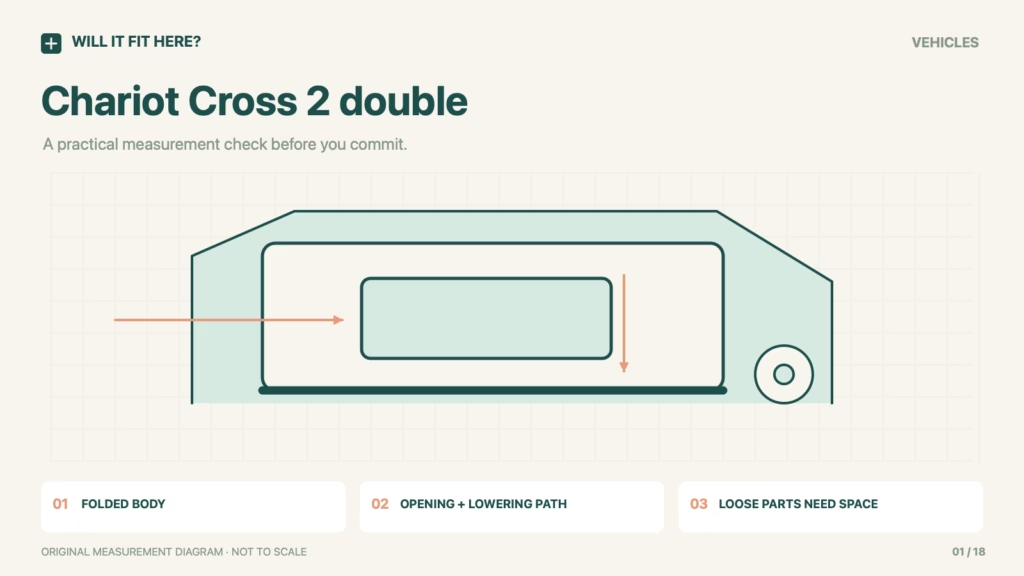
Fit verdict — Conditional. A Thule Chariot Cross 2 fit check must follow the folded trailer through the vehicle opening and into its resting position. For the US double model 10201035, Thule lists a folded envelope of 33.98 × 30.43 × 14.76 inches (L × W × H). A large cargo-volume figure cannot confirm the loading route. Check the folding configuration, loose wheels and accessories separately before treating those numbers as your complete travel load.
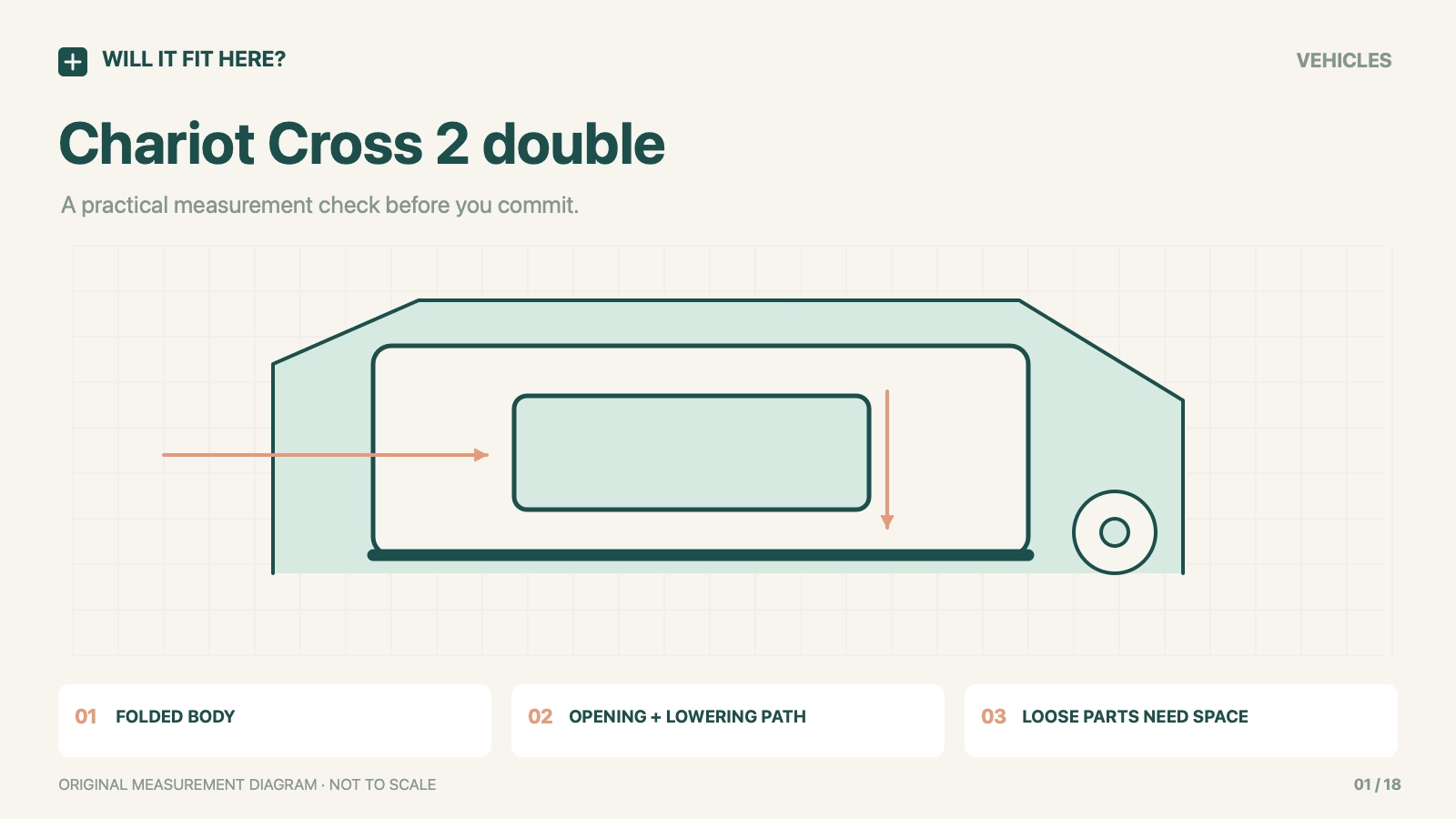
Thule Chariot Cross 2 fit: scope
US Chariot Cross 2 double, model 10201035. This is a vehicle-storage guide, not a bicycle-hitch or child-occupancy approval.
Dimensions and conditions
| Check | Reference or condition | What it means |
|---|---|---|
| Folded reference | 33.98 × 30.43 × 14.76 in, L × W × H | Thule product specifications; verify the actual folded configuration. |
| Trailer identity | Double, model 10201035 | Single and older Cross models need their own measurements. |
| Listed empty weight | 35.6 lb | This is the trailer, not a loaded travel kit. |
| Vehicle opening | Measure clear width, height and loading lip | Trim and latch intrusions are part of the opening. |
| Separate pieces | Measure removed wheels, arm and accessories | A folded-body rectangle does not reserve a place for them. |
1. Record your Thule Chariot Cross 2 packing configuration
Write the model number on your measurement sheet before making a template. Follow the matching folding instructions and arrange the trailer exactly as it will travel. Record what is attached and what is removed. Put the detached pieces beside the folded body instead of assuming they will disappear into unused corners. A packing plan is incomplete if the body fits but the final wheel must sit on a fragile window or obstruct the latch.
2. Trace the loading path before comparing cargo space
Measure the opening at several heights, then the space immediately behind its lower lip. Check whether the folded body can enter level or must turn while partly inside. The entry orientation and final orientation may be different. A flat floor template helps assess the parking position; a lightweight box-shaped mock-up also tests the turn and lowering movement. Keep hands and carrying access in that test rather than using the car trim as a support.
3. Check the seat and hatch in their real positions
Set the passenger seats for the trip before measuring cargo depth. Look at the closing hatch from the side: its inner trim can sweep into a load that appears below the opening when the hatch is raised. Measure the narrowest clear space, not the greatest diagonal. Mark the trailer orientation on the mock-up and note where restraint points remain accessible. Recheck the arrangement when luggage, a parcel shelf or a cargo liner changes.
Before you decide: 5 checks
- Confirm double-model identification and the matching folding instructions.
- Measure the folded body with your chosen attachments still installed.
- Check opening width, lip clearance and room to turn inside the vehicle.
- Reserve separate supported positions for removed parts and normal luggage.
- Confirm hatch closure and an appropriate restraint arrangement without compressing the trailer.
FAQ
Does a 34-inch cargo depth prove it fits?
No. Depth alone does not establish opening width, usable height or the turn behind the loading lip. Treat a close paper comparison as a reason for a careful mock-up, not a guaranteed fit.
Can I use the single-model folded width?
No. Keep the product label, configuration and dimensions together. A single-model width should not be applied to the double trailer.
Does the door-pass-through figure describe a folded trunk envelope?
No. A doorway specification answers a different movement question. Use the folded L × W × H reference and your actual packing configuration for the car.
Official sources and scope
Checked on 26 October 2026. The cited product, variant and region control. Follow the matching current instructions. The measurement workflow is editorial guidance; no firsthand installation or universal fit is claimed.