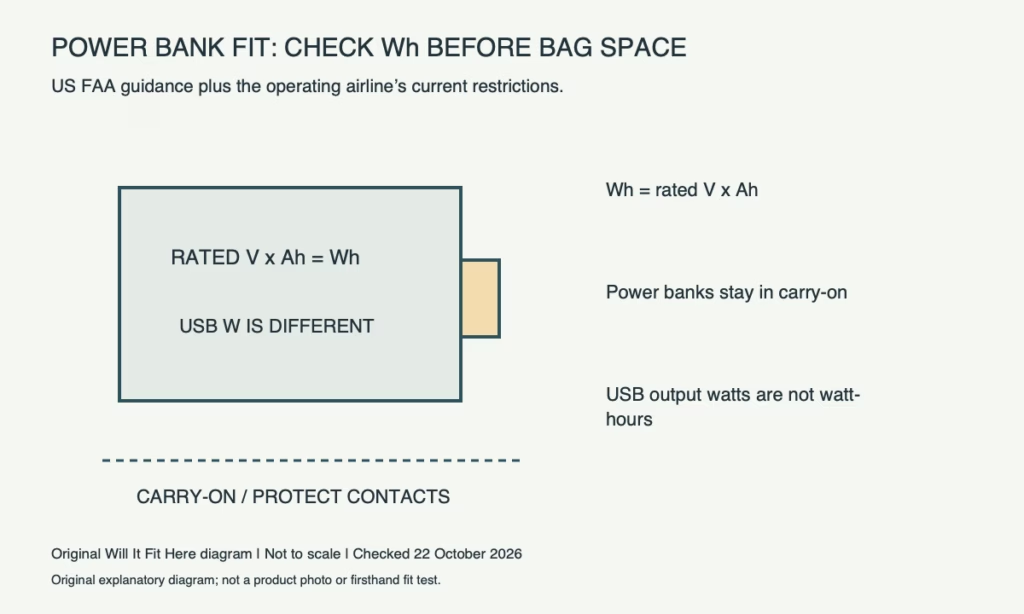
Result — Conditional. Physical size does not decide airline battery acceptance. Under the cited US FAA guidance, check the lithium-ion battery’s watt-hour rating, condition and airline rules. Power banks are spare batteries and must remain in carry-on baggage, including when another bag is gate-checked.
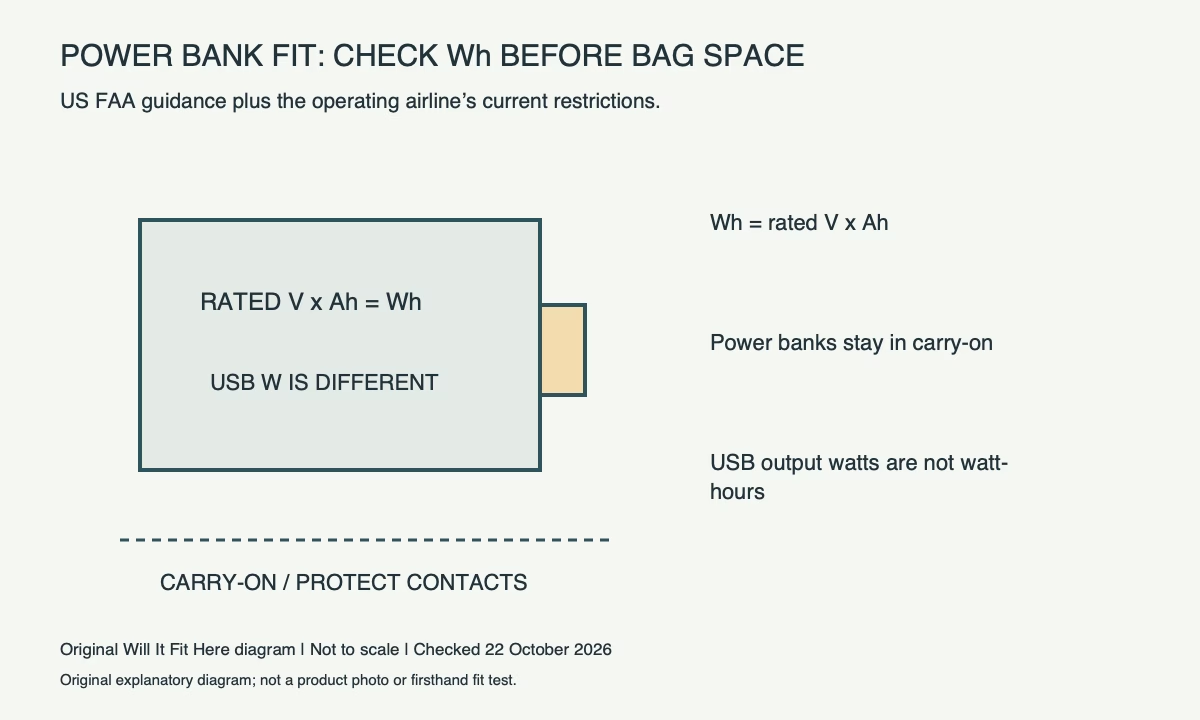
Capacity matters more than pocket dimensions
The current FAA passenger guidance gives 0–100 Wh as the ordinary rechargeable-battery category, 101–160 Wh as requiring carrier approval, and batteries over 160 Wh as prohibited on passenger aircraft under this guidance. Larger approved spare batteries in the 101–160 Wh category are limited to two per person. Airlines and international rules can be stricter.
| Battery category in FAA guidance | Planning result |
|---|---|
| 0–100 Wh | Check condition, personal-use requirements and the airline’s rules |
| 101–160 Wh | Carrier approval required; at most two such spare batteries |
| Over 160 Wh | Not accepted under the ordinary passenger-battery guidance |
| Any power bank | Carry-on only; protect against damage and short circuit |
Read the actual battery label
Look for Wh on the power bank itself and in its matching manufacturer documentation. Do not use the dimensions of the case, a marketing capacity alone or the wattage of its USB output as the rating. A 100 W output specification describes power delivery, not 100 Wh stored energy.
Where a calculation is needed, FAA gives Wh = V × Ah, with mAh divided by 1,000 to obtain Ah. Use the battery’s appropriate rated voltage and capacity from its documentation, rather than automatically substituting a USB port’s output voltage.
For a hypothetical label stating 20,000 mAh at 3.7 V, the calculation is 20 × 3.7 = 74 Wh. At a hypothetical 30,000 mAh and 3.7 V, it is 30 × 3.7 = 111 Wh. These examples demonstrate the calculation; they do not verify any particular product. Obtain confirmation if the label is missing or the rating is unclear.
Keep it with you if the main bag is checked
Pack the power bank where you can remove it before a cabin bag is sent into the hold. Do not leave it in a gate-checked suitcase. Protect its exposed contacts against short circuit and prevent crushing or accidental activation in accordance with the battery maker and airline instructions.
FAA guidance excludes damaged or recalled batteries likely to generate dangerous heat or sparks. A compact case that fits a pocket does not override that condition. Check the product’s condition and current recall information before travel.
Confirm the operating carrier’s current restrictions
Check every operating airline on a connecting itinerary for quantity, Wh, storage and in-flight-use restrictions. An approval from one carrier is not automatically approval from another. Resolve approval needs before reaching the airport.
This guide describes the cited US passenger guidance, not a worldwide permission. Record the exact model, marked Wh rating and airline confirmation together. Then choose a carry-on location that protects the device and keeps it accessible; bag fit comes after acceptance.
Before you decide
- Read the exact model’s Wh rating and condition.
- Use battery-rated V and Ah if a calculation is necessary.
- Confirm each operating airline’s current limits and required approval.
- Keep the power bank protected in the cabin when any bag is checked.
FAQ
Does a 100 W USB output mean 100 Wh battery capacity?
No. Watts describe power, while watt-hours describe stored energy.
Can a power bank remain in a gate-checked cabin case?
No. Remove spare lithium batteries and power banks to your permitted carry-on before the bag is checked.
Official sources and scope
Specifications and guidance checked on 22 October 2026. The named model and region control; follow the matching current instructions for your product. Worked examples are identified as hypothetical.
- FAA current airline-passenger battery guidance and Wh calculation
- FAA PackSafe lithium battery guidance