Quick answer: A dryer’s cabinet depth does not include every permitted exhaust connection. Measure the complete installed route, including outlet position, approved fittings and access, while preserving the exact dryer’s clearance and duct requirements.
Separate cabinet clearance from duct space
GE’s current exhaust-duct guidance specifies a 4 in round duct for the installations it describes and rejects plastic ductwork. Its general clearance page notes that a rear exhaust configuration can require more space than the cabinet’s stated rear clearance. Use the exact dryer model’s installation manual to settle your installation.
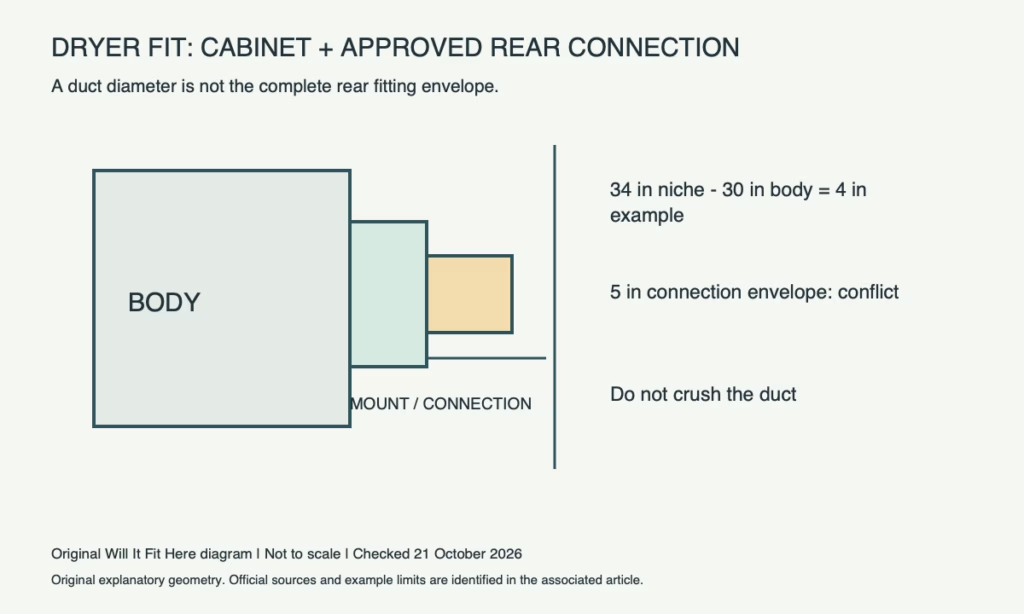
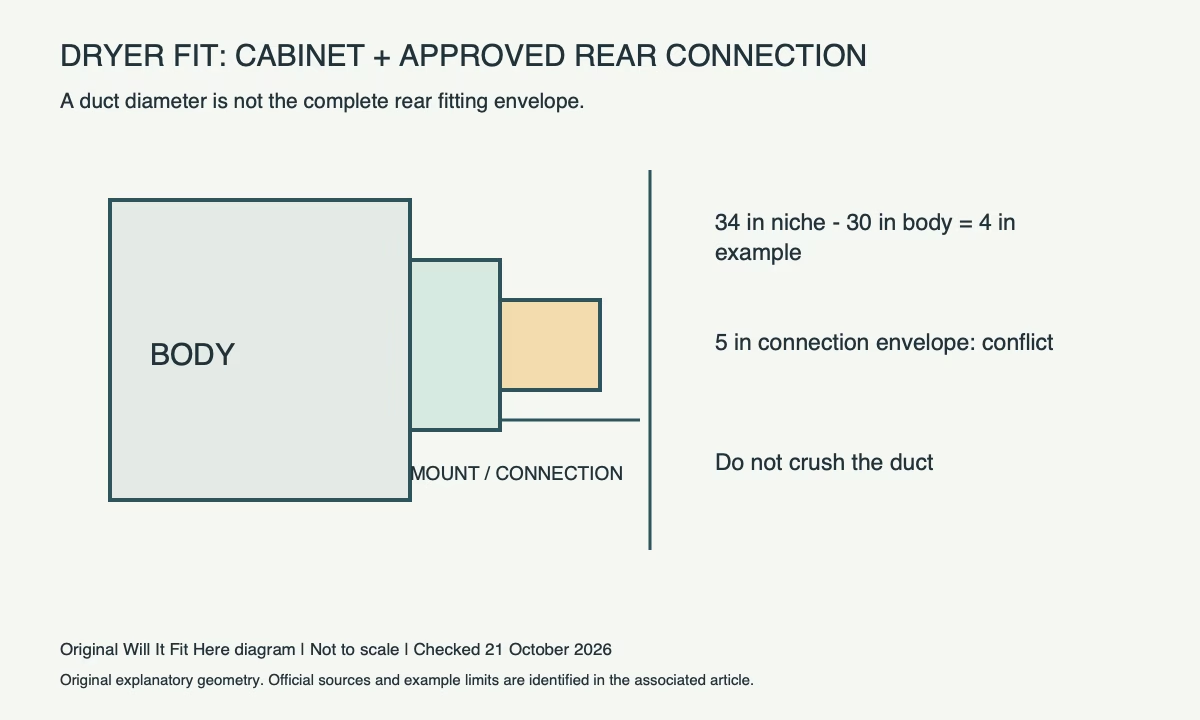
A 4 in duct diameter is 101.6 mm by exact conversion. It is not a universal 4 in wall gap: an elbow, outlet position, engagement and route can require a different envelope. Do not derive the rear clearance by placing one circle behind a cabinet outline.
Measure from consistent reference points
Record the dryer’s full depth, the rear outlet’s location and projection, and the wall connection position. Obtain the dimensional drawing for the approved elbow, transition or other fitting. Include the connection method and room needed to assemble it without crushing the route.
| Hypothetical same-axis comparison | Dimension |
|---|---|
| Usable niche depth | 34 in |
| Dryer envelope before rear connection | 30 in |
| Remaining depth | 4 in |
| Selected connection envelope | 5 in: 1 in conflict before other allowances |
These niche and connection dimensions are hypothetical. A different outlet arrangement or manufacturer-approved kit needs its own drawing and instructions. Do not flatten a round duct, kink a transition or remove required parts to gain the missing inch.
Check the complete exhaust path
The fitting that fits immediately behind the dryer is only the start. Compare the entire route, bends and termination with the dryer manual’s permitted materials and length rules. GE warns against kinked or collapsed venting. A physically short route can still be unsuitable if it is restricted.
Also preserve the appliance’s electrical or gas connection requirements, ventilation and service access. Do not move or disconnect those services based on this dimensional guide. Have the installer resolve a tight fit and confirm the final installation rather than forcing the dryer back against its connections.
Before you decide
- Exact dryer installation manual and outlet orientation identified.
- Rear fitting drawing and connection envelope obtained.
- Complete duct route, materials and restrictions checked.
- Services, ventilation and maintenance access retained.
Common questions
Does a zero rear cabinet clearance mean the vent needs no space? No. The exhaust arrangement can impose its own additional space requirements.
Can a crushed duct be accepted because the dryer runs? No. Resolve the route using an approved arrangement and the model’s instructions.
Official sources and scope
Checked October 21, 2026: GE exhaust-duct installation guidance, GE general clearance distinctions, GE venting-issue checks. Confirm the exact product, route or current policy before acting. No firsthand fit test is claimed.
Related guide: Will a Stacked Washer and Dryer Fit Your Closet?. This addresses a separate fit check; its measurements do not transfer to the products above.